• 4 min read
CivilBot cuts structural modeling from days to hours
University of Miami’s CivilBot turns structural design descriptions into analysis models, reducing work from days to hours and up to 30 times faster.
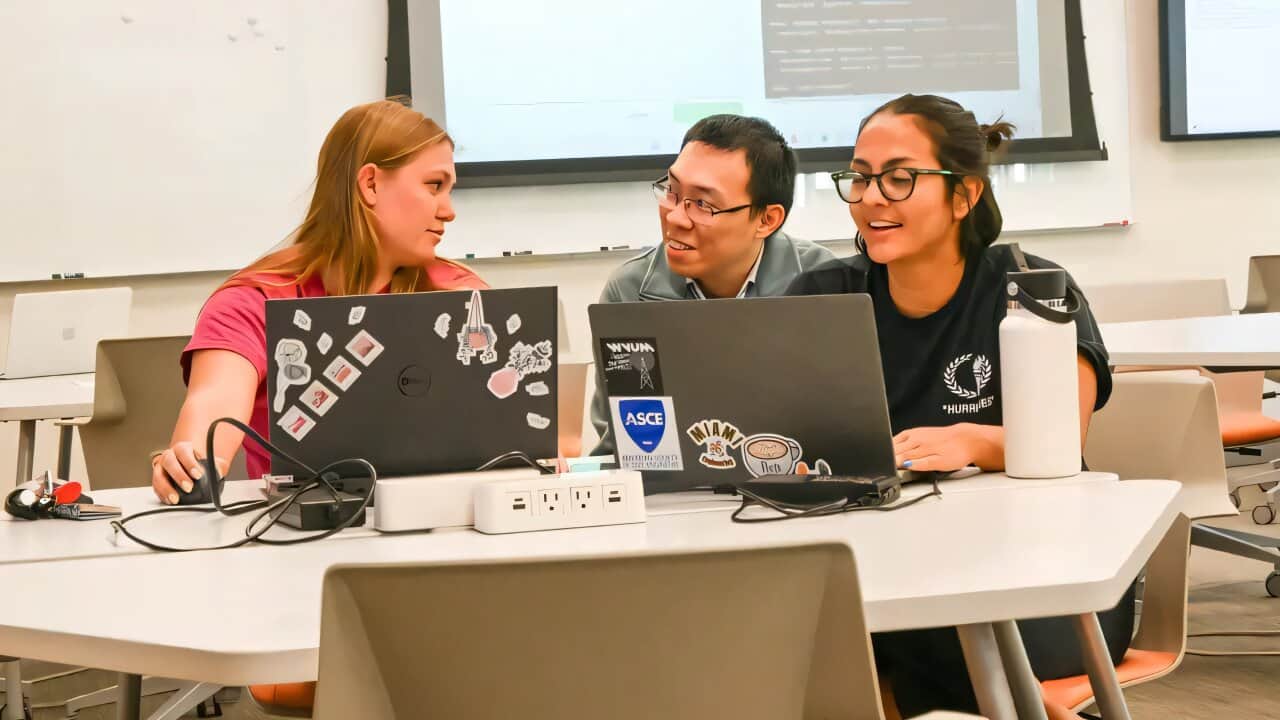
Image: TechXplore
Assistant professor Minghui Cheng, center, talks with students about the AI-powered CivilBot tool. Credit: Betsy Martinez/University of Miami.
Structural engineers can spend one to five days building computer models for new structures. CivilBot, a tool developed by University of Miami researchers and their collaborators, is designed to cut that work to hours—and in some cases make model creation 20–30 times faster.
The software generates code for structural analysis models from a written description of a design. Engineers provide details such as beam lengths, supports and loads, and CivilBot produces code that can be integrated with established engineering software, including SAP2000.

Recommended reading
Nubia’s iMoochi robot pet has OLED eyes and 4G
That removes many of the repetitive mouse clicks involved in manually building a model of a structure’s foundations, beams, columns, joists, trusses and girders. Engineers can then spend more time refining a design instead of setting up its digital representation.
“It used to take a very long time to create a structural model because the engineers had to build it manually, so people get excited about CivilBot because it’s really fast.”
CivilBot’s structural modeling workflow
Cheng said CivilBot generated code describing all the structural conditions of Miami’s Freedom Tower in five minutes. The system is now in its third version. It previously generated only 2D models, while its developers are working toward 3D building models.
The project was created by Cheng and graduate student Ziheng Geng, working with Ran Cao, an associate professor of civil engineering at Hunan University in Changsha, China, and Lu Cheng, an assistant professor of computer science at the University of Illinois Chicago. Jiachen Liu, Cheng’s former University of Miami graduate student, helped revise the tool and set up its website.
University of Miami engineering students trained with CivilBot this spring while developing capstone projects. In a senior design course led by assistant professor Matthew Trussoni, structural engineering students created two mixed-use shopping center designs for Publix.
“Structural engineers create computer models to aid in the design and engineering of all sorts of structures like buildings or bridges. Typically, it can take anywhere from one to five days to create the models on the computer and more time to edit them when changes are made. CivilBot can transform a process that takes days and reduce it to an hour or so, depending on the project, of course.”
Students test CivilBot on building designs
Ryan Wallat and his classmates used the tool while modeling a mixed-use shopping and residential complex made from steel and concrete. He said CivilBot streamlined calculations that previously took days by hand.
“It’s been very helpful to learn how to use CivilBot because in earlier classes, it took us days to do these calculations by hand, but CivilBot helped streamline the process, so it went about 20–30 times faster to create the computer models.”
Senior students Ashlyn Winslow and Priscilla Cevallos also learned the tool through the project. Both began jobs this summer at Thornton Tomasetti, an international engineering firm with offices in Miami.
“I do envision AI tools to be integrated in the industry, and therefore a tool like CivilBot could be incorporated into professional settings. For example, it can help us understand if we have to change the column heights in our design.”
Trussoni plans to use CivilBot again next spring. He said he was not aware of any commercially available tool like it and believes experience with the system could give students an advantage as engineering firms assess new software.
“Working with a tool like CivilBot will give students a leg up going into this industry because many practicing engineers are looking to use these new tools.”
Cheng hopes practicing engineers will adopt CivilBot and help improve it through feedback.
“Ideally, I hope this will be used by practicing engineers to help create buildings faster.”
Andrew Zinin holds a master’s degree in physics and has research experience. He is a longtime science news enthusiast and contributes to Science X’s editorial work.

AI Editor
Ava covers the rapidly evolving world of artificial intelligence, from foundational models and research labs to the real-world economics of intelligence. With a background in computational linguistics, she cuts through the hype to find out what actually works. She firmly believes that benchmarks are just marketing until reproduced in the wild.
via TechXplore