• 3 min read
Australia launches Office of AI and tighter copyright rules
Australia has created a national Office of AI and pledged stronger copyright protections, while proposing binding rules for data centres.
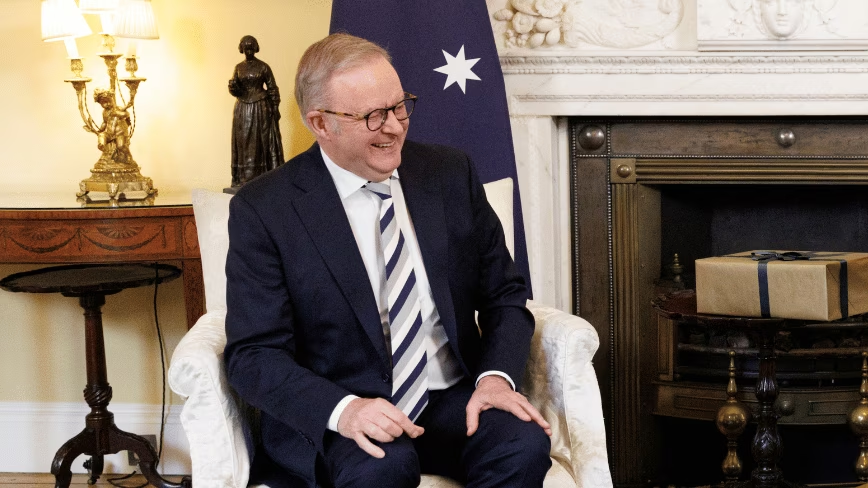
Image: TNW
Australia creates a central AI office
Australia has set up a national Office of AI, with immediate effect, as Prime Minister Anthony Albanese moves to centralise the country’s approach to the technology.
Albanese announced the plan on Wednesday at the University of Sydney, according to the Guardian. The new office will sit within the Department of the Prime Minister and Cabinet and coordinate policy across government.
The government said Australia is the first country to bring AI’s economic, social, security, and environmental issues under one framework. The office will work with industry and innovation minister Tim Ayres and assistant science minister Andrew Charlton, and will also design Australian AI standards.
Copyright protections for creatives
A big part of the speech focused on copyright. Albanese promised “the strongest possible protection” for Australian creatives and argued that using their work to train AI without permission or payment should be treated as theft.
“Let me make this crystal clear: not everything produced in Australia is up for grabs,” he said. “Australian writers, musicians, artists and journalists must retain ownership and control of their work.”
“No company should use Australian books, music, art or news to build or train AI without the artist’s control,” he added. “Anything less is theft.”
The government has also ruled out a text and data mining exemption, which would have allowed firms to train models on Australian content without paying. Cabinet is still discussing copyright reform, and the government does not plan to legislate until early next year.

Recommended reading
Mira Murati’s lab unveils Inkling, a 975B open model
New national standards for data centres
Albanese also outlined binding national standards for data centres, covering:
- where operators can build them
- their power and water use
- how they connect to the grid
He said data centres should not compete with housing for land or push up electricity prices for consumers. Under the proposed framework, the next generation of large centres would face a legal obligation to underwrite new power supply.
Operators would be required to pay their full share of grid connection costs so that expenses are not passed on to homes or businesses. They would also need to put at least as much energy into the grid as they take out.
The facilities would also have to generate renewable energy, reduce water use, and improve energy efficiency. According to the government, the framework would fast-track investment decisions while creating nationally consistent rules on how and where operators build.
Mixed response from industry and politics
The speech drew support from parts of the industry. Annabelle Herd, chief executive of the Australian Recording Industry Association, said her members wanted to sign licensing deals with AI companies.
Jeff Bleich, general counsel at Anthropic, said the company respected the process set out by the prime minister and took seriously its responsibility to meet the government’s terms. Anthropic had previously cited Australia’s policy uncertainty as an impediment to investment in the country.
Microsoft Australia president Jane Livesey said users would adopt AI if they trusted it was “safe and well-governed.” Bran Black, chief executive of the Business Council of Australia, also welcomed the speech, while cautioning against rules that go “too far” and leave Australia out of step with other countries.
There was criticism, too. Former industry minister Ed Husic said on ABC radio that the government had reacted faster to a food-tampering scare than to high-risk AI.
“We can’t have two terms of parliament pass without having some concrete mandated guardrails,” he said.
Albanese framed the moment as comparable to the arrival of social media, arguing that governments should have imposed tougher rules on tech companies earlier. The government aims to legislate the changes early next year.

AI Editor
Ava covers the rapidly evolving world of artificial intelligence, from foundational models and research labs to the real-world economics of intelligence. With a background in computational linguistics, she cuts through the hype to find out what actually works. She firmly believes that benchmarks are just marketing until reproduced in the wild.
via TNW