• 3 min read
Argonne AI agents automate atomistic simulations
Argonne researchers built AI agents that automate atomistic simulations, cutting fragmented workflows and potentially speeding materials discovery.
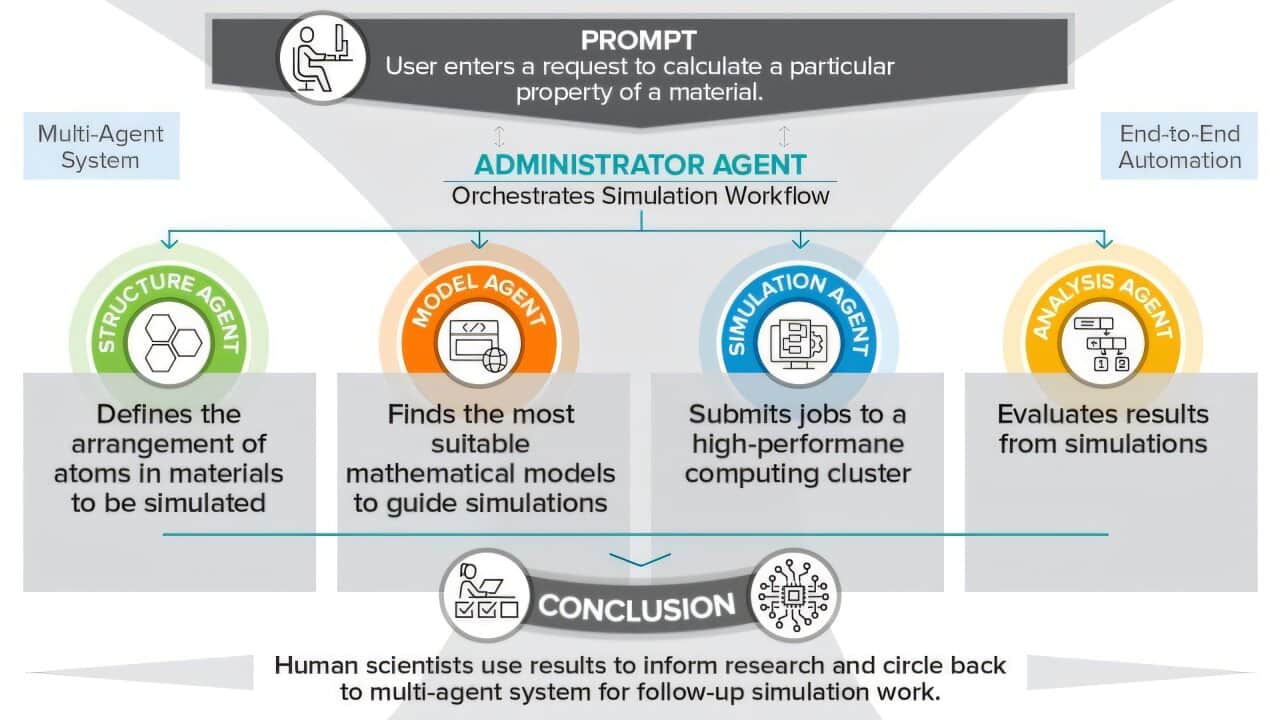
Image: TechXplore
Researchers at the U.S. Department of Energy’s Argonne National Laboratory have demonstrated a multi-agent AI system that automates atomistic simulations—from defining a material’s structure to analyzing the results. The work, published in Digital Discovery, is aimed at shortening a workflow that can currently take months or years.
The simulations model how atoms interact, helping researchers study properties such as strength, reactivity, elasticity and vibration. Those results can guide the development of materials for batteries, aerospace and electronics.
“By automating these exhaustive investigations, we can potentially reduce the time requirements for discovering new materials from months or years to just days.”
How Argonne’s multi-agent framework works
A researcher starts with a high-level request, such as calculating the melting point of a gold-copper alloy. An administrator agent then breaks that request into smaller tasks and delegates them to specialist agents.

Recommended reading
EU approves 348-satellite Starlink alternative for 2029
Those agents can:
- Define the arrangement of atoms in the material
- Search scientific papers and databases for suitable mathematical models
- Create simulation input files
- Submit jobs to high-performance computing systems
- Calculate specific material properties
- Analyze the resulting data
The system was designed to address a practical problem with atomistic simulations: the underlying tools are powerful but fragmented. Scientists traditionally have to configure, run and connect multiple programs in a precise sequence, often repeating the process dozens or hundreds of times while varying materials or experimental parameters.
A human remains involved. The administrator agent can request additional information about the simulation, while specialist agents may ask follow-up questions as they work. The framework was developed with researchers from Argonne’s Center for Nanoscale Materials, Argonne Leadership Computing Facility and Advanced Photon Source, along with the University of Illinois Chicago.
Results and availability
Argonne tested the system on end-to-end simulations involving several elements and alloys. The tests calculated crystalline structures, elastic behavior and vibration behavior on Carbon, a high-performance computing cluster at the Center for Nanoscale Materials.
The AI-generated calculations were described as remarkably close to manual simulations performed by human experts. Those manual runs took place at the National Energy Research Scientific Computing Center, a DOE facility at Lawrence Berkeley National Laboratory. Henry Chan, an Argonne staff scientist and study author, said the approach reduces bottlenecks and increases the throughput and scale of simulation pipelines.
The framework is publicly available and can be customized for different classes of materials. The researchers also said it could eventually support autonomous robotic laboratory experiments, extending the system beyond simulations into physical testing.
The reporting does not provide numerical error rates, a measured speedup, the computing cost of each run, or a detailed benchmark methodology. “As little as a few minutes” is given as the response time for a high-level request, but the article does not establish whether that figure applies to the full range of simulations or to a particular test.
That limits how strongly the results can be judged today. The system appears to make a technically difficult workflow far easier to operate and produced results close to expert baselines, which is a substantial usability advance. But without quantitative accuracy and performance data, it is evidence of credible automation—not yet proof that the framework will consistently turn materials discovery into a days-long process.
Frontier Editor
Dan is our resident futurist, covering electric mobility, space exploration, and the smart home. He's interested in atoms just as much as bits. Whether it's a new battery chemistry, a reusable rocket, or a protocol that finally makes IoT devices talk to each other, Dan breaks down the engineering that pushes humanity forward.
via TechXplore