• 3 min read
AMD’s AI surge exposes a risky customer bet
AMD’s profits surged 163%, but shares fell as investors weighed its reliance on a few AI customers and Nvidia-targeting Helios systems.
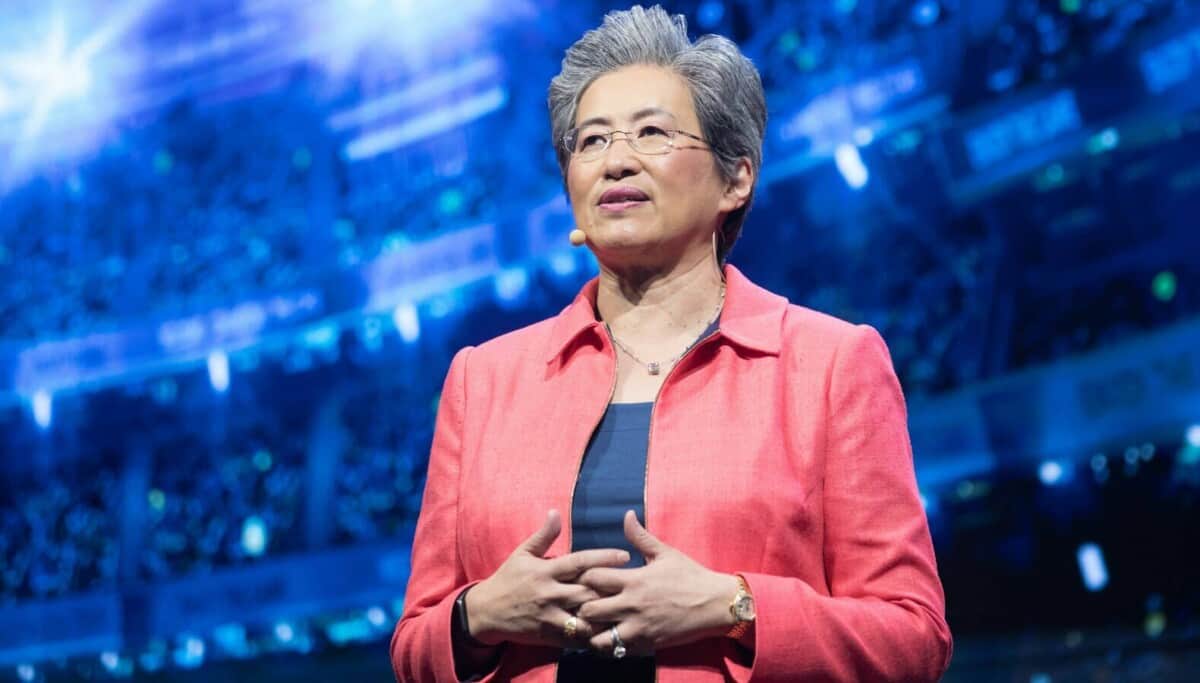
Image: The Register
AMD’s quarterly results were strong enough to send profits up 163% year over year, but investors pushed the company’s shares down 8.7% after the announcement. The reaction highlights the central tension in AMD’s AI strategy: its growth prospects increasingly depend on a small group of hyperscalers and frontier-model companies that have yet to prove their AI businesses can operate profitably.
AMD reported $11.5 billion in second-quarter revenue and forecast third-quarter revenue of $13 billion, plus or minus $300 million. The company is also projecting that its data-center segment revenue will more than double year over year in 2027, once its Helios rack systems and Instinct MI400-series GPUs reach customers.
AMD’s Helios commitments depend on a few major buyers
CEO Lisa Su said deployments of Helios and the MI450 series should drive significant data-center growth in the second half of the year, with that growth accelerating in 2027. AMD has secured multi-gigawatt commitments from OpenAI, Anthropic, and Meta, but the scale of those deals also exposes the company to concentration risk.

Recommended reading
The workers training AI that may replace them
“When we talked about the large frontier-model companies, OpenAI, Anthropic, Meta, they will be consuming through a number of CSPs. There are additional customers or lots of customers who are interested in Helios at, let’s call it, a more regular scale than gigawatt scale.”
The distinction matters. AMD may have many potential customers, but the largest orders are concentrated among a handful of companies. Microsoft, another major buyer of AMD’s latest AI hardware, supplies cloud capacity to both OpenAI and Anthropic. Meta is reportedly considering entering the GPU-cloud business itself, creating another possible shift in how these systems are bought and operated.
Helios targets Nvidia’s Vera Rubin platform
AMD’s answer to Nvidia is its new rack-scale Helios platform. Demonstrated at the company’s Advancing AI event in San Francisco last month, the system combines 72 Instinct MI455X GPUs. Each GPU includes 432GB of HBM4 memory.
On paper, The Register reported, Helios meets or exceeds Nvidia’s Vera Rubin platform on most performance metrics. That makes AMD a more credible alternative than it was before the launch of its MI300-series GPUs in late 2023, although the company still needs to turn commitments into deployed systems and revenue.
AMD is also targeting the CPU demand created by AI workloads. Su expects agentic AI sandboxes to become the biggest growth driver for the company’s Epyc processors. The newly announced Venice Epycs will offer up to 256 cores and 512 threads, support 16 memory channels, and reach memory bandwidth of up to 1.6TB/s per socket.
The CPU opportunity is not uncontested. AMD faces Intel as well as newer or expanding competitors including Nvidia, Arm, Qualcomm, AWS, Google, and Microsoft.
AI growth offsets weakness in gaming and PCs
AMD’s broader results show why the company is leaning so heavily on data-center AI. Its embedded business generated more than $977 million, up 19% from the same period last year. Client PC revenue rose 23% year over year to $3.1 billion.
But AMD warned that ongoing memory shortages — described in the source as the “RAMpocalypse” — could reduce PC sales over the next several quarters. Gaming revenue fell 31% to $779 million, as the end of a console sales cycle reduced demand for AMD’s semi-custom processors.
Su remains optimistic across the portfolio:
“Whether it’s server CPU, datacenter, AI, or our embedded business, and our PC business, we see them all benefiting from the AI tailwinds.”
The numbers support AMD’s AI momentum, but the market’s reaction points to the unresolved weakness underneath it. Helios can challenge Nvidia technically, and AMD has secured exceptionally large customer commitments; however, much of the company’s expected expansion still rests on a narrow set of buyers and an AI spending cycle whose profitability remains unproven.
Enterprise Editor
Marcus follows the money. He covers enterprise software, cloud architecture, and the tectonic shifts in Big Tech strategy. He translates dense earnings calls and complex M&A activity into actionable insights about where the industry is actually heading. If a tech giant makes a silent pivot, Marcus is usually the first to notice.
via The Register