• 3 min read
Agility Robotics opens in Tesla’s backyard
Agility Robotics is opening a 60,000-square-foot Fremont facility as its Digit humanoid expands commercial deployments and Tesla prepares Optimus.
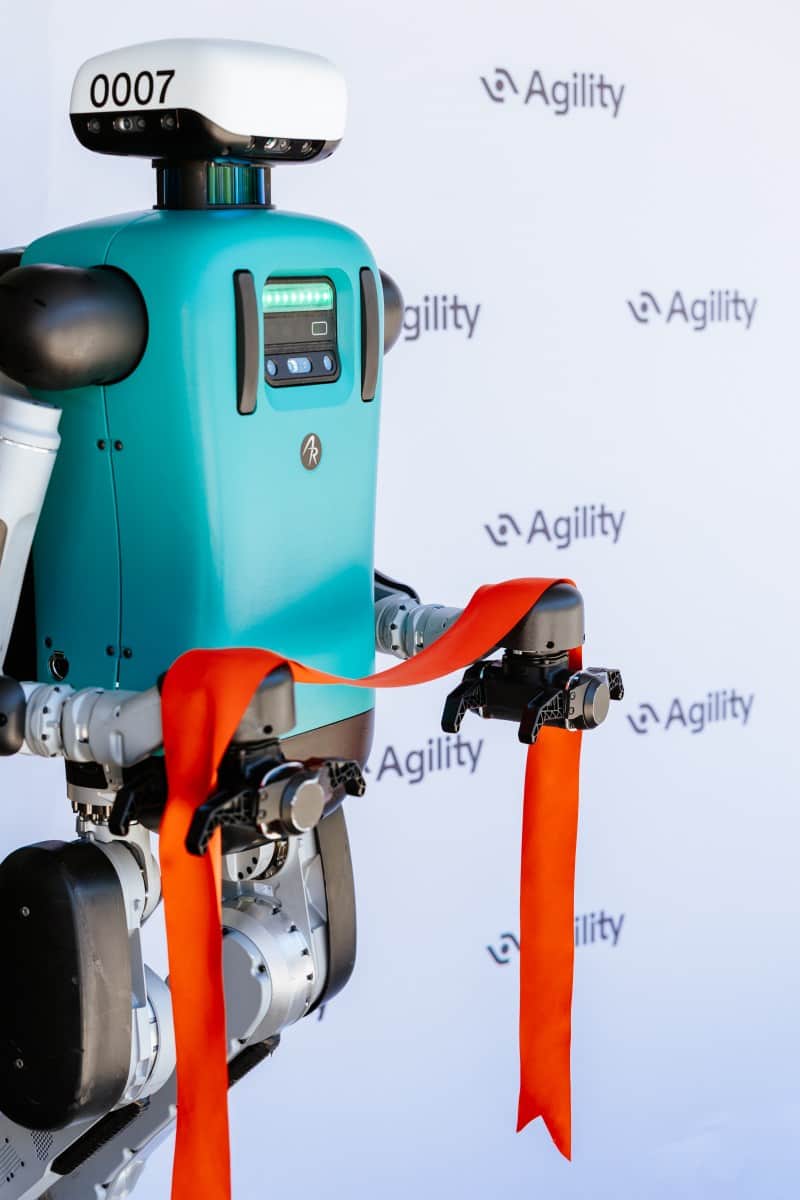
Image: TechCrunch
Agility Robotics is opening a 60,000-square-foot facility in Fremont, California, placing its humanoid robot business just up the highway from the Tesla factory where the automaker is expected to begin manufacturing Optimus this year.
Tesla has increasingly bet on Optimus. Elon Musk recently said he expects the robot to become “the biggest product ever” once it is “useful outside of Tesla sometime next year.” Agility has far less capital than Tesla, but its Digit humanoid is already generating revenue in manufacturing and warehouse operations.
Digit’s commercial deployments
Digit carries totes and bins for customers including Amazon, GXO, Schaeffler, and Toyota Motor Manufacturing Canada. Agility says it has secured $300 million in contract orders for its robots, although it has not disclosed how many Digits it has built or deployed. Outside observers estimate that dozens are operating in pilot or revenue-generating deployments.
The company has said Digits moved 100,000 totes at a GXO logistics facility. CEO Peggy Johnson said Agility’s early commercial deployments have helped it address the practical requirements of industrial customers.
“It’s great to have [Tesla] in the same area as us, because really, for a long time Agility was out there alone, and it’s good to have others in the humanoid space. We have commercialized. We now know what it takes to walk into these facilities and meet their safety bars, their regulatory bars, compliance, plug into their IT infrastructure, plug into their warehouse management system.”
Johnson is also leading Agility through a reverse merger expected to make the company the first pure-play humanoid robot company on the public markets later this year.

Recommended reading
Dimon warns Claude Mythos could become a cyber weapon
A practical approach to robot autonomy
Founded in 2015 by researchers who developed techniques for enabling robots to walk safely on two legs, Agility is seeking to capitalize on its lead over newer AI-focused robotics companies such as Figure, 1X, the Bot Company, and Sunday Robotics.
The company is using AI to expand what robots can do, but it does not want generative models controlling critical safety functions. Co-founder and chairman Damion Shelton compared that strategy with autonomous vehicles, where systems such as anti-lock brakes should not be placed under generative AI control.
“The analog with humanoids is all the safety stuff needs to go through a path that’s not generative AI, right? You don’t want to get creative with your safety stack.”
Generative AI can still help Agility address a major scaling problem: the range of tasks robots might perform is much larger than the number of engineers available to program them.
“The number of things you can imagine a robot doing is far larger than the number of engineers who can program robots. And generative AI answers that question definitively.”
Fremont facility and Digit version 5
The new facility will train Digit in environments resembling the manufacturing and logistics sites where it will work. Johnson said more than 30 customers are in discussions with Agility about deployments.
Unlike many newer humanoid companies, Agility does not plan to offer in-home robots soon. Digit currently operates in human-free spaces, but version 5, expected to be unveiled this fall, will be able to sense humans and will not need to remain in a robot-only zone.
Co-founder and chief robot officer Jonathan Hurst said manufacturing and logistics offer enough room for growth, from handling bins and totes to picking, kitting, cardboard, and loading and unloading tractor trailers.
“Let’s start with the bins and the totes, and then let’s do the picking and the kitting. And then let’s like start working on cardboard, which is really hard, and loading and unloading tractor trailers and things like that. Okay, now we’re at 100 million robots, you know? A trillion-dollar company.”

AI Editor
Ava covers the rapidly evolving world of artificial intelligence, from foundational models and research labs to the real-world economics of intelligence. With a background in computational linguistics, she cuts through the hype to find out what actually works. She firmly believes that benchmarks are just marketing until reproduced in the wild.
via TechCrunch