• 3 min read
100 kW superconducting aircraft motor clears first test
A 100 kW superconducting aircraft motor has completed its first working tests, giving Airbus-backed researchers at the University of Strathclyde in Glasgow a real foothold in the race to cleaner flight. The prototype is
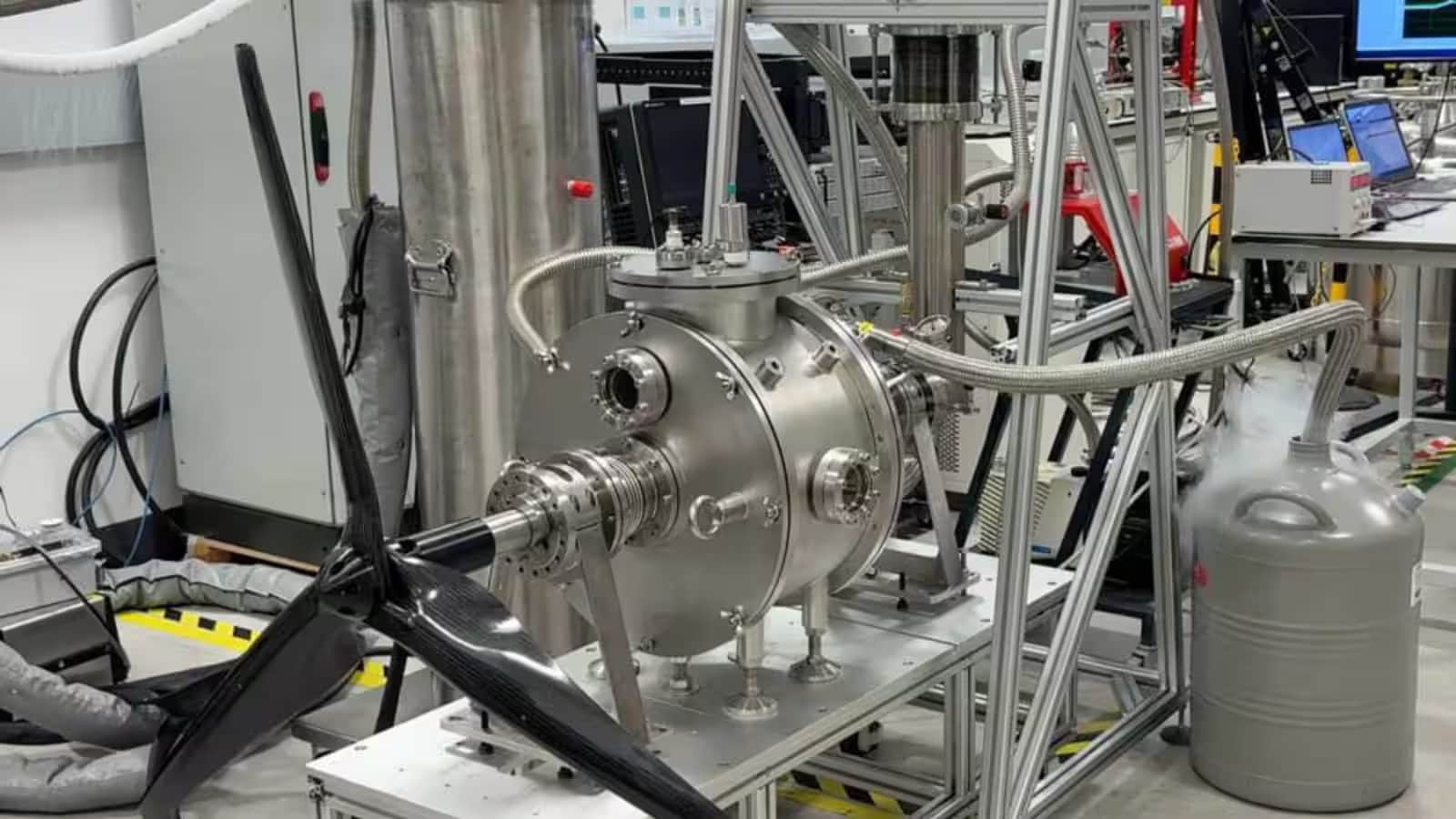
Image: ixbt.com
A 100 kW superconducting aircraft motor has completed its first working tests, giving Airbus-backed researchers at the University of Strathclyde in Glasgow a real foothold in the race to cleaner flight. The prototype is still far too small to lift a passenger jet, but it tackles the two things that make electric aviation stubbornly hard: weight and heat.
That matters because conventional copper windings hit a wall as power rises. More output usually means more mass and more waste heat, and both are poison for aircraft design. Superconductors flip that script by eliminating electrical resistance at very low temperatures, which lets motors pack in more power without the same penalty in size.
How the superconducting aircraft motor works
The team used so-called high-temperature superconductors rather than the extreme, liquid-helium-cold approach associated with classic superconductivity. Their operating range is roughly 20 to 77 K, or -253 to -196 °C, which is still icy enough to make the cooling system a major piece of the engineering puzzle.

Recommended reading
Nvidia commits $1 billion to South Korea’s AI buildout
The prototype combines superconducting windings with a brushless design and onboard cryogenic cooling that runs while the rotor spins. In plain English, it is not just a motor, but a tightly packaged cryogenic electromechanical unit. That is the sort of hardware aviation has been avoiding for decades because aviation hates complexity almost as much as it hates extra kilograms.
Why Airbus cares about hydrogen
The project sits inside Airbus’s ZEST program, and the hydrogen angle is where things get interesting. Airbus has been pushing liquid hydrogen as a route to lower-carbon aircraft, and superconducting motors could fit neatly into that picture because hydrogen can potentially do double duty as both fuel and coolant.
That synergy is not a free lunch, but it is smart systems thinking. If the same fuel stream helps keep the drivetrain cold, future aircraft architectures could become less awkward than today’s battery-first electric dreams, which still struggle with the unforgiving physics of range and mass.
What 100 kW can and cannot do
This is still a proof of concept, not a plane-ready powerplant. A passenger aircraft needs megawatt-class propulsion, so the next hurdle is scaling without losing the efficiency gains that make superconductors worth the hassle in the first place.
- Prototype power: 100 kW
- Superconducting operating range: roughly 20 to 77 K
- Goal: megawatt-scale motors for commercial aviation
Strathclyde is not alone here. Hinetics, HyFlux, Toshiba, and Raytheon are all working on superconducting electric propulsion of their own, which tells you this is no academic side quest. The first team to solve cooling, reliability, and manufacturing at scale gets a serious head start – and the rest get to explain why their elegant motor still weighs too much.
The real question now is whether the cryogenic plumbing stays manageable as the hardware grows. If it does, superconducting motors may move from lab curiosity to one of the few believable paths toward electric passenger aircraft that do more than taxi politely.
AI Editor
Ava covers the rapidly evolving world of artificial intelligence, from foundational models and research labs to the real-world economics of intelligence. With a background in computational linguistics, she cuts through the hype to find out what actually works. She firmly believes that benchmarks are just marketing until reproduced in the wild.
via ixbt.com