

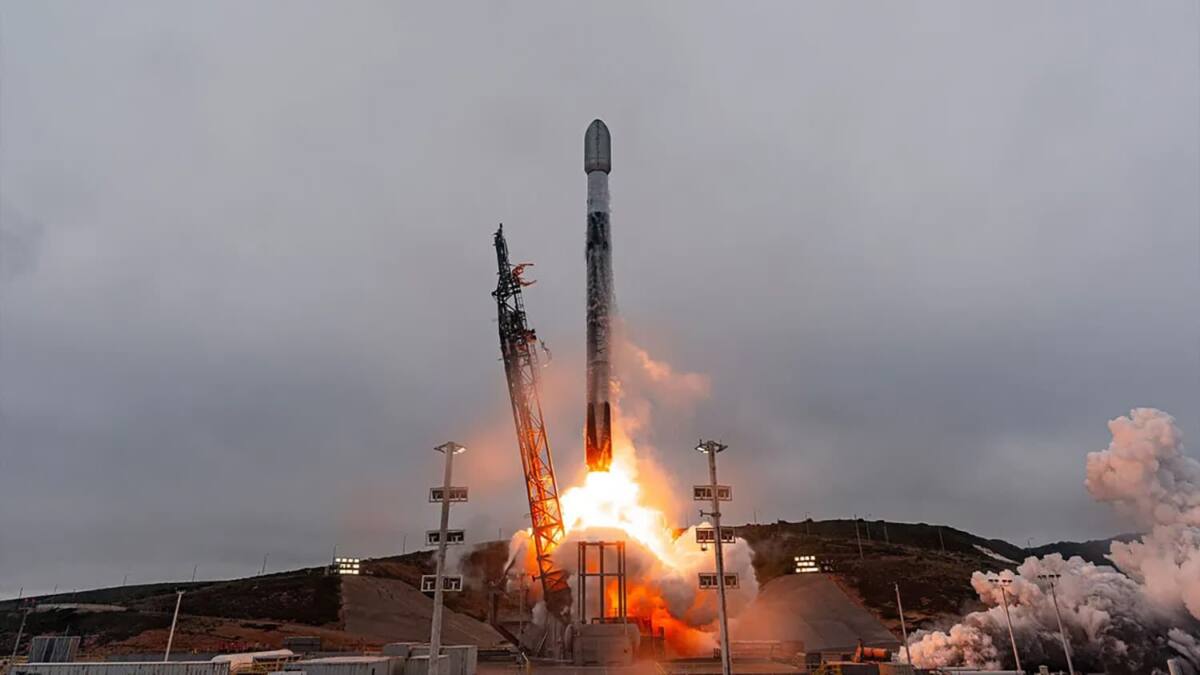
SpaceX has added another 24 Starlink satellites to orbit, just days after its historic Nasdaq debut, underscoring how relentlessly the company is still pushing its broadband network even while the financial spotlight is on Wall Street. The launch, carried out from California’s Vandenberg Space Force Base, pushed the number of active Starlink satellites to 10,660, according to astronomer Jonathan McDowell.
The Falcon 9 lifted off from Space Launch Complex 4 East on 15 June at 18:34 Moscow time, and SpaceX later confirmed that all 24 satellites had been deployed successfully. The first stage, booster B1093, also came back to Earth and landed on the ”Of Course I Still Love You” droneship in the Pacific Ocean after 8.5 minutes, marking its 14th flight. Reusable hardware is still the quiet superpower here: every successful recovery keeps SpaceX’s launch cadence high and its costs low, which is a big reason rivals keep staring at the company from a very long distance.
Falcon 9 keeps feeding the Starlink machine
This was SpaceX’s 69th Falcon 9 mission of 2026, and more than 80% of those launches have been tied to Starlink expansion. That kind of concentration shows where the company’s priorities really are: not just launches for hire, but building a giant internet utility in orbit.
- Launch site: Space Launch Complex 4 East, Vandenberg Space Force Base, California
- Launch time: 18:34 Moscow time on 15 June
- Payload: 24 Starlink satellites
- Active Starlink satellites after launch: 10,660
- Booster: B1093, 14th flight
Starlink’s reach is getting broader
Starlink is no longer just a rural broadband story. The network is now used by airlines for in-flight Wi-Fi and by some mobile operators for direct satellite-to-phone services, which is exactly why every batch of satellites matters even if the launch itself looks routine. Once a company reaches this kind of scale, ”routine” starts to look like industrial dominance.
A launch after IPO sends a clear signal
The timing matters. SpaceX began trading on Nasdaq under the ticker SPCX on 12 June, and the company says the offering raised 85.7 billion dollars, making it the largest IPO in history. That also pushed Elon Musk into a new financial bracket, with a net worth said to exceed 1 trillion dollars. The message is hard to miss: even with a record-breaking listing in the rearview mirror, SpaceX is behaving like a company that still has a lot more work to do.
The obvious question is whether this pace can hold. With Starlink still absorbing the majority of Falcon 9 activity, the next milestone to watch is less about the stock price and more about how quickly SpaceX can keep adding capacity without slowing its launch rhythm.