

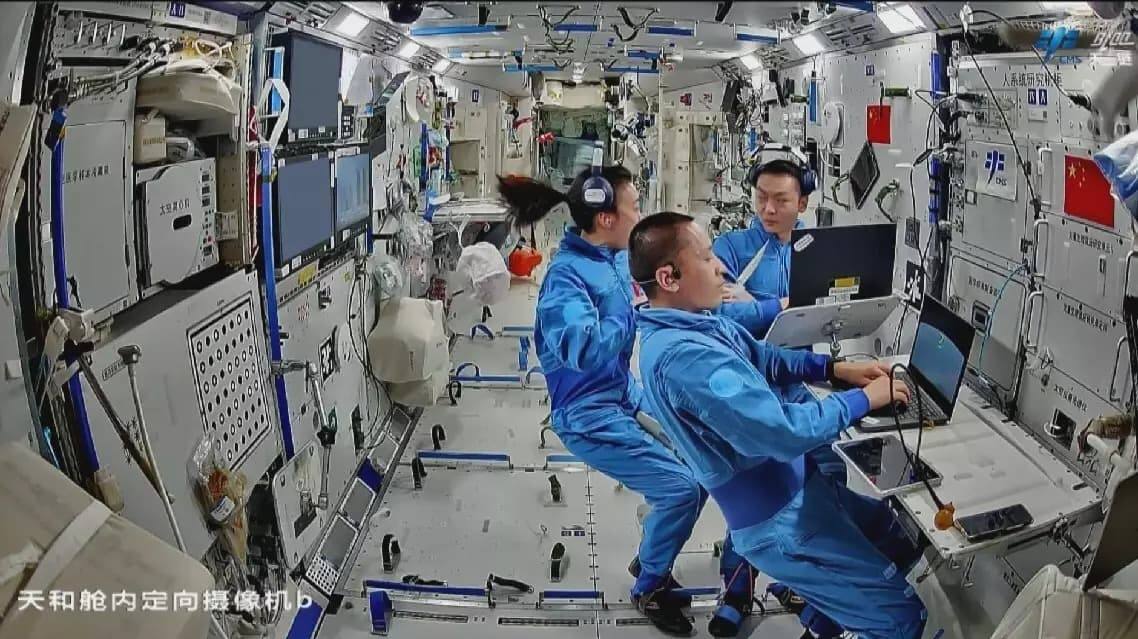
China’s Shenzhou-23 crew has carried out its first medical rescue drill in microgravity after reaching the Tiangong space station, while also beginning a year-long orbital experiment designed to test how humans cope with extended missions. The three taikonauts – Zhu Yangzhu, Zhang Zhiyuan, and Li Jiaying – are doing more than ticking a training box: they are helping China stretch the limits of long-duration spaceflight without pretending space is friendly to the human body.
The China Manned Space Agency says the exercise focused on emergency assistance procedures in weightlessness, where even simple movements and force distribution change enough to make routine medical care awkward at best. That is the sort of detail space agencies like to bury under polished mission photos, but it is exactly where future deep-space missions either become manageable or go badly wrong.
Medical drills in microgravity
In orbit, there is no bracing yourself against the floor, no easy leverage, and no quick way to pin a struggling patient in place. A rescue drill on Earth is standard procedure; in microgravity it becomes a test of coordination, restraint, and improvisation. That makes this first onboard medical exercise a practical milestone for Tiangong, not just a ceremonial photo op.
The timing matters too. China has been building toward longer stays in orbit for years, and agencies with ambitions beyond low Earth orbit need crews that can handle health problems without immediate ground support. NASA and other rivals have been pushing similar human-performance research for the same reason: if you want astronauts to stay away longer, you first have to prove they can stay functional.
What the Shenzhou-23 crew is studying on Tiangong
Alongside the rescue training, the crew has started a broad set of experiments aimed at long missions. One uses a space spectrometer to study the link between gut microbiota and nutrition metabolism during extended time in orbit, a reminder that deep-space travel is as much about digestion and adaptation as it is about rockets.
Other tests are looking at visual motion processing, ”intuitive physics” in microgravity, emotion recognition, and decision-making in emergencies. Put plainly, China is trying to measure how weightlessness affects both thinking and behavior, because a mission that breaks the body is bad enough; a mission that quietly erodes judgment is worse.
- Mission: Shenzhou-23
- Crew: Zhu Yangzhu, Zhang Zhiyuan, Li Jiaying
- Station: Tiangong
- Launch date: 24 May
- Key feature: planned year-long orbital experiment
The year-long Shenzhou-23 mission is the real test
Shenzhou-23’s standout feature is the planned year in orbit, which puts it squarely in the camp of missions meant to prepare for even longer human journeys. The year-long stay is less about breaking records for their own sake and more about finding out what degrades first – muscles, mood, reflexes, or decision-making under pressure.
If China can keep crews productive, medically aware, and psychologically steady for that long, Tiangong becomes more than a station. It becomes a proving ground for the next phase of crewed spaceflight, and the question from here is whether the hardware, the procedures and the humans can all keep pace with the plan.