

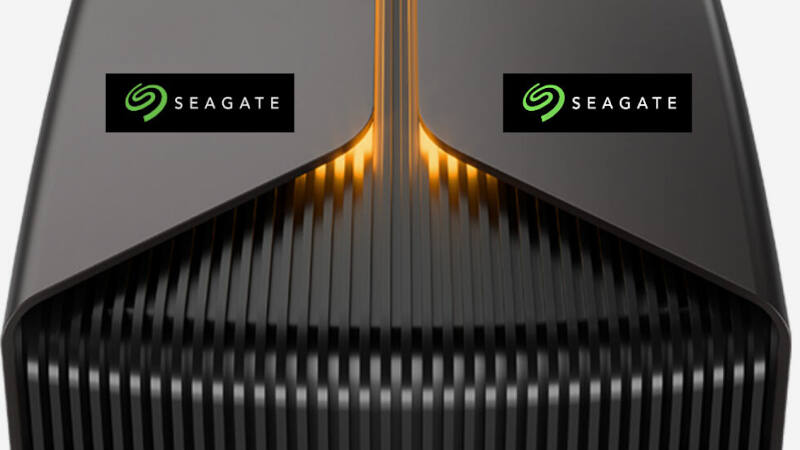
Seagate has broadened its external storage lineup with three very different products: a consumer desktop drive that tops out at 24TB, a gaming-focused unit with RGB lighting, and a LaCie eight-bay system that reaches 256TB and pushes Thunderbolt 5 to 2800MB/s. The pitch is simple enough: as AI tools, game libraries, and video projects keep swallowing more space, Seagate wants to sell the box that catches up with the mess.
OneTouch brings up to 24TB to the desk
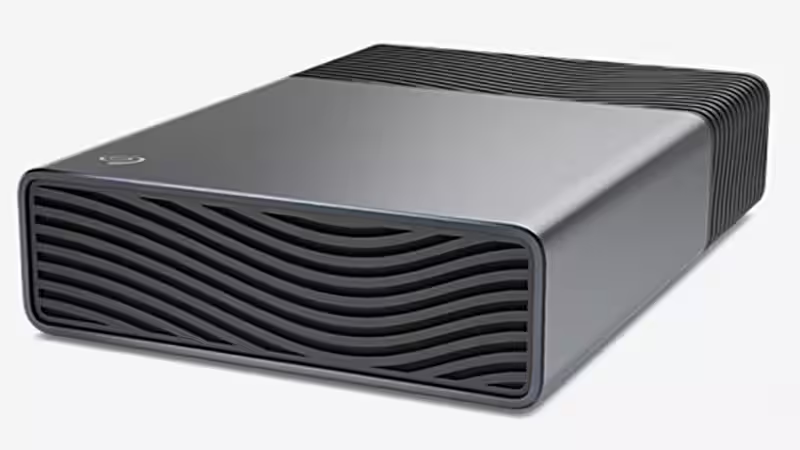
The OneTouch is the most ordinary of the trio, which is exactly the point. It is a 3.5-inch desktop external hard drive with USB-C for both data and power, available in 8TB, 20TB, and 24TB versions, and it works with Windows and Mac. Seagate also bundles its Toolkit software, automatic backup tools, and Rescue Data Recovery Services, while the 8TB model starts at $259.99.
FireCuda X Vault leans into gaming habits
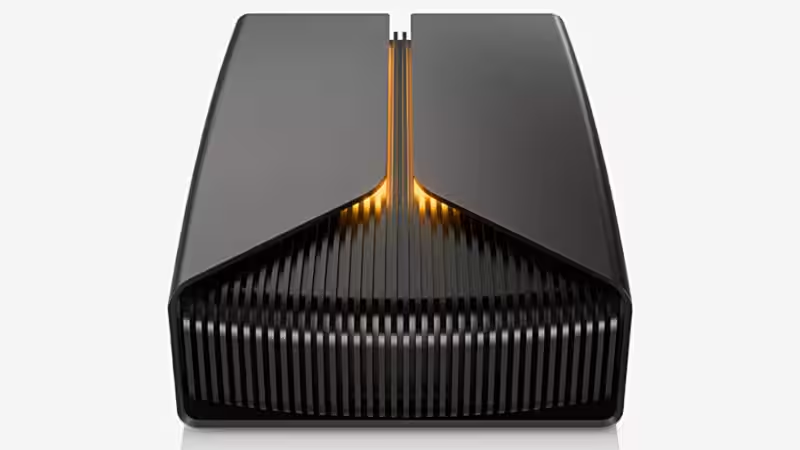
FireCuda X Vault is aimed at players and streamers, and Seagate is not being shy about the use case: massive game installs, recorded sessions, and captured clips are the new excuse for more spinning rust. It comes in 8TB and 20TB versions, skips the 24TB option found in OneTouch, and adds customizable RGB lighting with Windows Dynamic Lighting support, Xbox certification on PC, and a trial of Xbox Game Pass. The starting price is $269.99, which is a tidy premium for mood lighting and branding, but that is how the gaming tax works.
LaCie 8big Pro5 is the serious hardware
The most aggressive product is LaCie 8big Pro5, an eight-bay storage system built for 4K and 8K video work and AI-heavy creative jobs. It uses Thunderbolt 5, delivers up to 2800MB/s in RAID 0 and 2500MB/s in RAID 5, and ships in 32TB, 64TB, 128TB, 192TB, and 256TB configurations with hot-swappable drives. Seagate also loads it up with RAID 0, 1, 5, 6, 10, 50, and 60 support, JBOD, and nested RAID arrays, which is the sort of spec sheet that makes IT people nod and everyone else quietly leave the room.
There is more connectivity too: four USB-C ports, including one Thunderbolt 5 port that supplies 140W to the host, two Thunderbolt 5 hub ports rated at 30W each, and a USB 20Gb/s port at 15W. The chassis is large at 297 x 232 x 215 mm and has a carry handle, because 256TB of storage is not something you casually slip into a backpack. Pricing starts at $5,979.
Seagate is clearly reading the room better than vendors that still pretend cloud storage alone solves everything. AI-generated media, higher-resolution video, and bigger local game libraries all push storage back onto the desk, and the company is splitting the market neatly: simple, flashy, and expensive enough to make professionals blink. The open question is whether Thunderbolt 5 and larger external arrays become a mainstream upgrade path, or stay exactly where they have long lived – in the hands of people with deadlines and very deep pockets.