• 4 min read
Samsung S95H review: OLED brilliance, divisive design
Samsung’s S95H is a bright, feature-packed flagship OLED with superb gaming performance, but its divisive design and lack of Dolby Vision remain drawbacks.
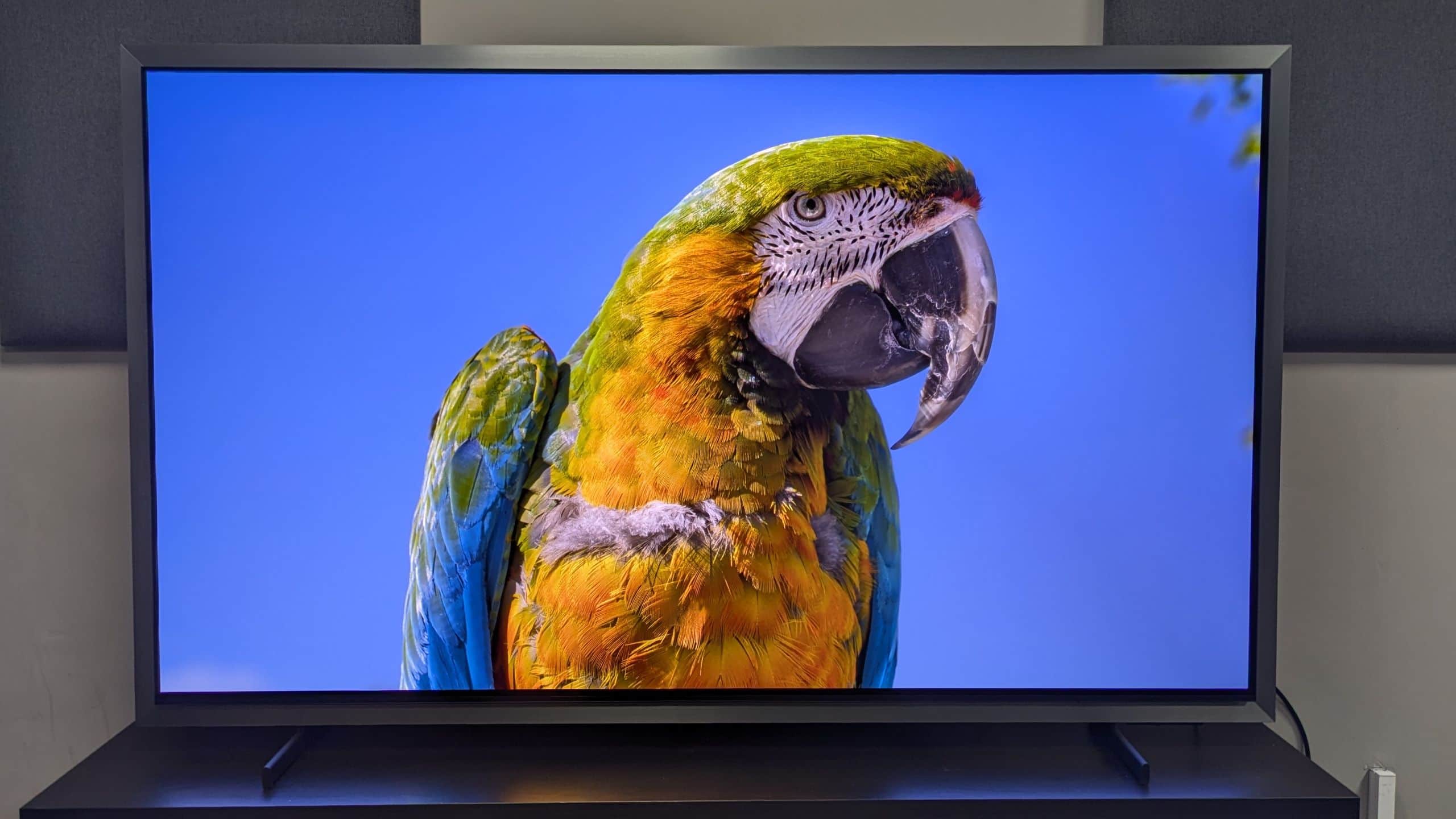
Image: TechRadar
Samsung’s S95H is the flagship OLED in the company’s 2026 TV lineup, and it delivers an exceptionally bright, colorful and contrast-rich picture. It also brings a comprehensive set of gaming features, effective anti-reflection and Samsung’s latest Vision AI tools.
The trade-offs are a divisive redesign, a high price, weaker-than-ideal built-in sound and the continued absence of Dolby Vision support. The new silver frame, which Samsung calls FloatLayer Design, may also create space problems for some wall-mounted setups.
Samsung S95H price and availability
The S95H launched in June 2026, sitting above the mid-range S90H and budget S85H. Listed launch prices are:
- 55-inch: $2,299 / AU$3,999
- 65-inch: $3,299 / AU$5,299
- 77-inch: $4,299 / AU$7,999
- 83-inch: $6,299 / AU$9,999
The 65-inch model tested costs $3,399 / AU$5,299 in the review, placing it firmly in the premium TV market. Prices had remained mostly unchanged in the first few weeks after release, although Australian discounts included up to AU$1,500 off the 83-inch model. The launch prices are lower than those of the S95F and the rival LG G6, although the G6 has been available longer and has had more time to fall in price.
Picture quality and OLED performance
The S95H recorded peak HDR brightness of 2,739 nits in Filmmaker Mode, 2,831 nits in Standard mode and 2,751 nits in Movie mode. Its fullscreen HDR brightness reached 449 nits in Filmmaker, 460 nits in Standard and 450 nits in Movie mode.

Recommended reading
Roborock’s LiDAR Mower Skips Satellites
That is a substantial increase over the S95F, which reached 2,132 nits and 2,135 nits in HDR Filmmaker and Standard modes, respectively, with fullscreen results of 380 nits and 390 nits.
The matte OLED Glare Free screen is particularly effective in bright rooms, reducing mirror-like reflections while preserving the panel’s vivid color and deep black levels. Filmmaker Mode can look too dim with the lights on, but Movie mode provides a brighter alternative. Motion handling is generally smooth and natural for films and sport, although testing found some black crush in darker scenes.
Color reproduction is a major strength. The S95H covered 89.2% of the BT.2020 color space and 99.97% of DCI-P3. Movies including Speed Racer produced bold reds, bright blues and neon-like greens, while La La Land showed punchy but accurate yellows and realistic pink and purple gradients.
The TV also upscales SDR and HD content effectively, sharpening textures and delivering a convincing 4K-like level of detail. Auto HDR Remastering Pro increased brightness and texture sharpness during testing, but its results looked too artificial for the reviewer’s preference.
Features, gaming and design
Samsung’s NQ4 AI Gen 3 Processor powers tools including AI Motion Enhancer Pro, 4K AI Upscaling Pro, Auto HDR Remastering Pro, AI Sound and AI Sound Controller Pro. The TV also introduces AI Soccer Mode Pro, which is designed to optimize picture and sound for soccer.
The QD-OLED panel used in the tested 65-inch model is not confirmed by Samsung, although the review’s measurements indicate that it is. The 83-inch version will use an LG W-OLED panel because QD-OLED panels are not available in that size.
Gaming performance is among the S95H’s strongest areas. It has four HDMI 2.1 ports supporting 4K at up to 165Hz, full VRR, AMD FreeSync Premium Pro, Nvidia G-Sync, HGiG, HDR10+ gaming and ALLM. Input lag measured 9.5ms at 60Hz. A Game Hub provides access to cloud services including Xbox and Luna.
The biggest physical change is the wider silver frame, which replaces the previous model’s cleaner design. The central pedestal stand has also been replaced by two plastic feet. Samsung removed the One Connect Box, returning the ports to the TV’s rear panel, although its Wireless One Connect Box can be added separately. That can bring the total to eight HDMI 2.1 ports—four built in and four on the optional box.
The built-in audio system is a 4.2.2-channel, 70W setup with Dolby Atmos, Object Tracking Sound+, Adaptive Sound Pro and Active Voice Amplifier Pro. It delivers accurate, well-positioned sound, punchy bass and a potentially wide soundstage, but the picture quality warrants a fuller system, making a soundbar or external speakers a sensible addition.
The EOTF measurements performed well across all three target brightness tests without calibration. A separate spectral power distribution measurement chart shows the intensity of light across different color wavelengths.
Samsung’s Tizen platform supports major streaming apps including Netflix and Prime Video, alongside Samsung TV Plus. Navigation is generally smooth, although auto-playing Samsung TV Plus can be frustrating. Tizen also includes Generative Wallpaper, Art Mode and the Vision AI companion, but it remains less polished than LG’s webOS. The TV supports HDR10+, HDR10 and HLG, Dolby Atmos and not DTS, while its built-in tuner is ATSC 1.0 rather than ATSC 3.0.

Frontier Editor
Dan is our resident futurist, covering electric mobility, space exploration, and the smart home. He's interested in atoms just as much as bits. Whether it's a new battery chemistry, a reusable rocket, or a protocol that finally makes IoT devices talk to each other, Dan breaks down the engineering that pushes humanity forward.
via TechRadar