• 3 min read
Quantum randomness helps neural networks fix bad guesses
Quantum randomness improved handwritten-digit classification on three quantum platforms, while hardware noise showed signs of helping some predictions.
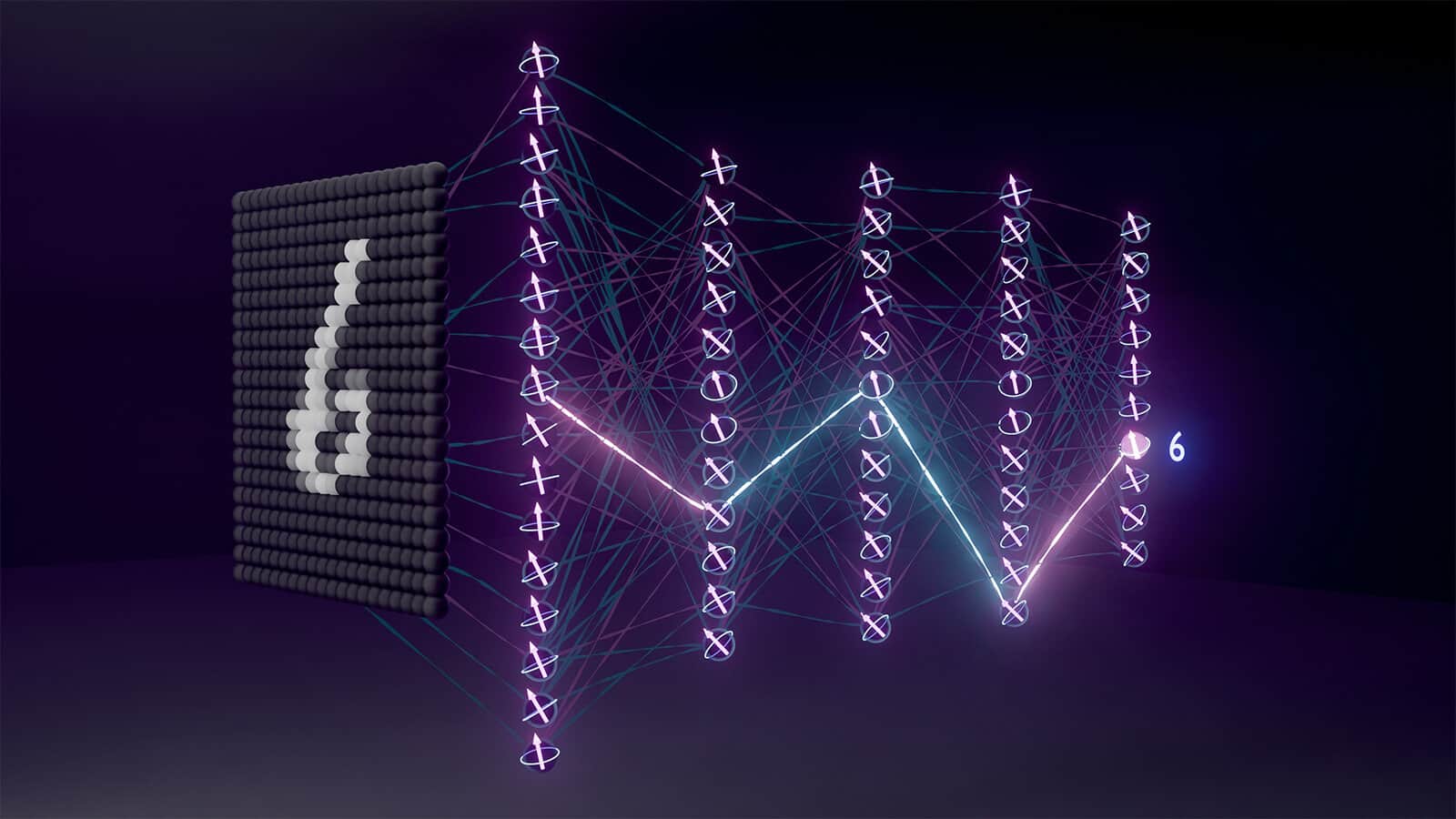
Image: TechXplore
A neural network running on quantum computers performed better at recognizing some handwritten digits when researchers added a controlled amount of quantum randomness. The experiments, led by researchers at the Joint Quantum Institute (JQI), also suggest that noise from imperfect quantum hardware may sometimes help rather than hurt.
The team included JQI Fellows Alaina Green, Norbert Linke and Victor Galitski, along with colleagues at IBM. Their findings were published as an Editors' Suggestion in Physical Review Letters.
How the quantum neural network works
The researchers used a neural network designed to classify handwritten numbers from the MNIST dataset, a standard benchmark for image recognition. The model was trained on traditional computers, then run on quantum hardware.

Recommended reading
OpenAI plans deeper ChatGPT access for wearables
In the architecture proposed by Galitski and two graduate students in 2025, qubits act as artificial neurons. The team uses superposition and measurement to control how much randomness enters the network during each identification attempt. They can also run the system with no intentional randomness by leaving the qubits in fixed states.
A qubit produces one of two states when measured, but can occupy a superposition beforehand, with each possible outcome assigned a probability. Adjusting that superposition changes the likelihood that the network’s intermediate results will flip, potentially changing its final digit prediction.
Results across three quantum platforms
The researchers tested the model on three systems: IBM’s superconducting-circuit quantum computer, plus trapped-ion systems built by Green and Linke. The trapped-ion experiments used both microwave and laser light to manipulate the ions.
All three platforms showed the same broad pattern: a limited amount of measurement-driven randomness improved classification compared with a deterministic version, but too much randomness degraded performance. The researchers described the optimal level as a “golden spot.”
“We showed that for this architecture, you can see improvement in classification of images when you tune the quantumness from zero to some golden spot.”
The team then focused on images the network consistently misclassified without quantum randomness. With the optimal setting, the trapped-ion computer identified a selected troublesome digit almost every time, while IBM’s system succeeded around 90% of the time.
The effect resembles the role randomness can play in conventional machine learning, where it can help an optimization process escape an incorrect answer that is close to correct. In this experiment, however, randomness was introduced during inference—the identification step—rather than only during training.
Quantum noise as a resource
The researchers also examined noise produced by current quantum hardware, including random errors caused by effects such as heat fluctuations. Results varied slightly when identical versions of the network were run on the same platform, and the hardware often performed better than simulations predicted. The team attributed those differences partly to device-specific imperfections contributing additional randomness.
“We’re living in the era of what’s called NISQ—noisy intermediate-scale quantum computing. So the question is, rather than this being a bad thing, can we harness the noise to positive ends?”
The researchers do not claim that this architecture is the best neural network, or even the best quantum neural network. Instead, they present it as a controllable way to study when quantum effects help or harm machine learning. Their next target is entanglement, which links quantum particles across distance, as they continue looking for tasks where quantum computing and neural networks can reinforce each other.
AI Editor
Ava covers the rapidly evolving world of artificial intelligence, from foundational models and research labs to the real-world economics of intelligence. With a background in computational linguistics, she cuts through the hype to find out what actually works. She firmly believes that benchmarks are just marketing until reproduced in the wild.
via TechXplore