• 3 min read
Perovskite solar cells get a C60 replacement
A carborane-based electron contact raised perovskite cell efficiency by up to 2.4 points and is already headed to market via Dyenamo.
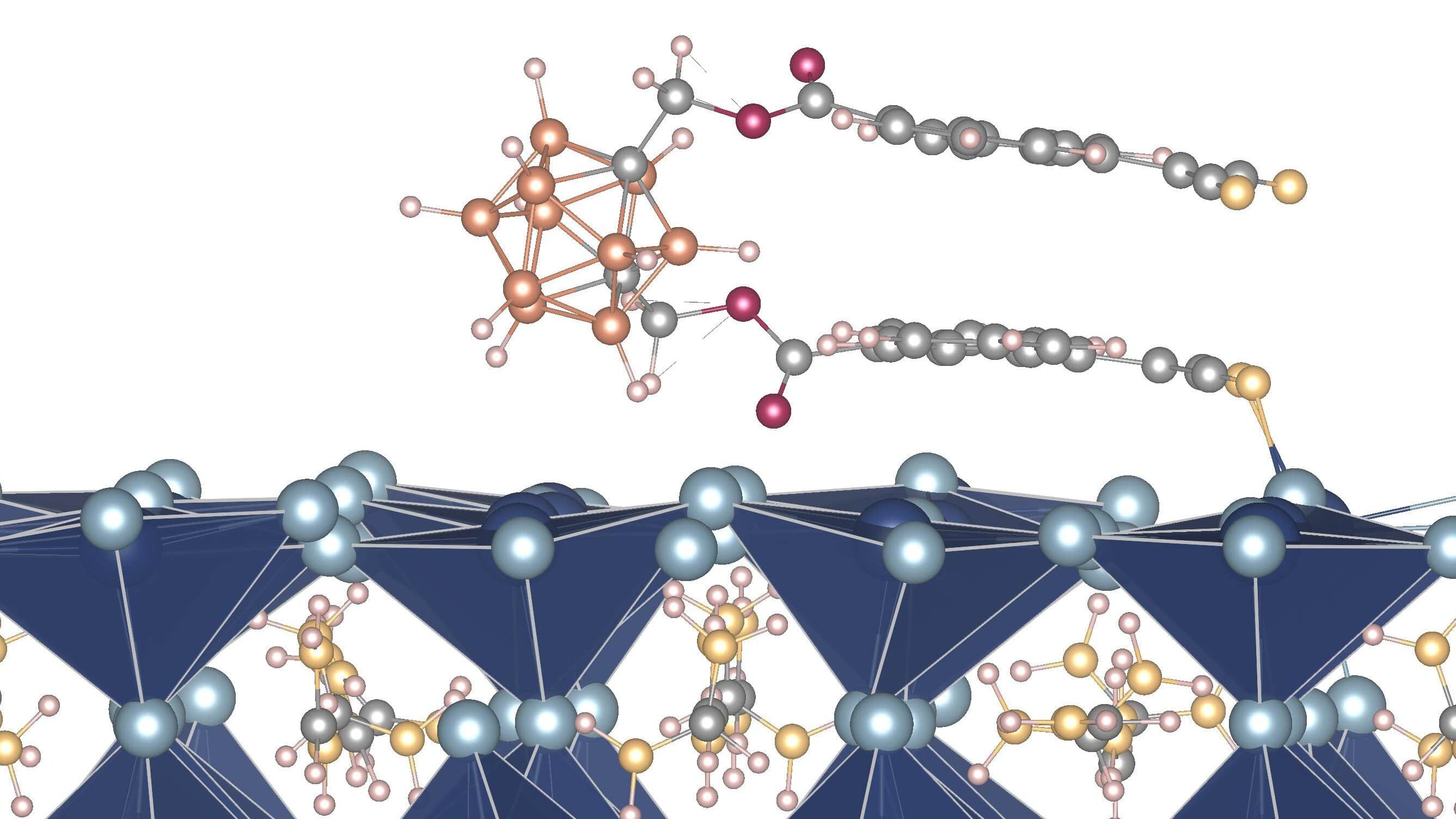
Image: TechXplore
A new electron contact material based on a carborane molecule could solve a persistent weakness in perovskite solar cells: the losses and stability problems tied to the standard C60 transport layer. In work led by Steve Albrecht’s team at HZB, the material improved both single-junction perovskite cells and perovskite/silicon tandem cells, and it has already been patented and made commercially available.
Perovskite cells are attractive because they are cheap to produce and already deliver high performance. Single-junction devices can convert more than 27% of sunlight into electricity, while perovskite-silicon tandem cells have reached more than 35%. But the usual electron-transport layer, made from “football molecules” C60, comes with tradeoffs: charge carriers are lost at the interface with the perovskite absorber, the material is relatively expensive, and it can delaminate over time, hurting long-term stability.
Working with researchers from Kaunas University of Technology (KTU) in Lithuania and other partners, the HZB team developed a replacement called mCB-FMN. The molecule uses a meta-carborane core with two 9-fluorenylidene malononitrile functional groups.
Compared with C60, the new thin film can be deposited from the vapor phase at lower temperatures, cutting energy use and reducing thermal stress on manufacturing equipment. The team says mCB-FMN forms a more uniform layer on the perovskite absorber, while measurements including transient surface photovoltage (trSPV) and photoluminescence (PL) showed more effective electron transport and fewer interfacial losses.

Recommended reading
LINK Fixed in Orbit Ahead of Swift Rendezvous
Additional tests pointed to broader advantages. He-I ultraviolet photoemission spectroscopy (He-UPS) showed favorable energy alignment between the transport layer and absorber. Density functional theory (DFT) calculations suggested the material passivates surface defects. Electron microscopy and in situ ellipsometry during deposition of the overlying SnOx buffer layer indicated improved film growth, while mechanical testing found stronger interfacial adhesion and better stability in the perovskite/ETM/SnOx stack.
The efficiency gains were notable:
- Single p-i-n perovskite cells improved by 1.5 percentage points in absolute terms when mCB-FMN replaced C60.
- Perovskite-silicon tandem cells improved by up to 2.4 percentage points in absolute terms versus the reference cell.
The tandem boost also came from lower parasitic absorption, which allowed more light to reach the photoactive layers.
“We have developed a very high-performance substitute material for fullerenes in perovskite solar cells, and we have demonstrated its benefits through different measurements.”
The material has already drawn academic and industrial attention, including a “Best Scientific Content Award” at the 2025 TandemPV International Workshop. A European patent application has been filed — EP 25175871.0 — covering mCB-FMN, its derivatives, and their use in solar cells.
According to Albrecht, Dyenamo has already brought the material to market. The group now wants to extend the approach beyond this first result, after earlier work on self-assembling monolayers (SAMs) for hole-contact layers.
“We are currently working flat out on developing further novel materials in this class, and we believe that this class of materials could also revolutionize tandem solar cells.”
The study is: Lea Zimmermann et al, “A novel carborane-based electron transport material for high-performance perovskite/silicon tandem solar cells,” Energy & Environmental Science (2026). DOI: 10.1039/d6ee01246a

Frontier Editor
Dan is our resident futurist, covering electric mobility, space exploration, and the smart home. He's interested in atoms just as much as bits. Whether it's a new battery chemistry, a reusable rocket, or a protocol that finally makes IoT devices talk to each other, Dan breaks down the engineering that pushes humanity forward.
via TechXplore