• 3 min read
Nvidia backs open AI and secretive SSI
Nvidia backs an open AI security coalition while investing in secretive SSI and pursuing multibillion-dollar infrastructure deals.
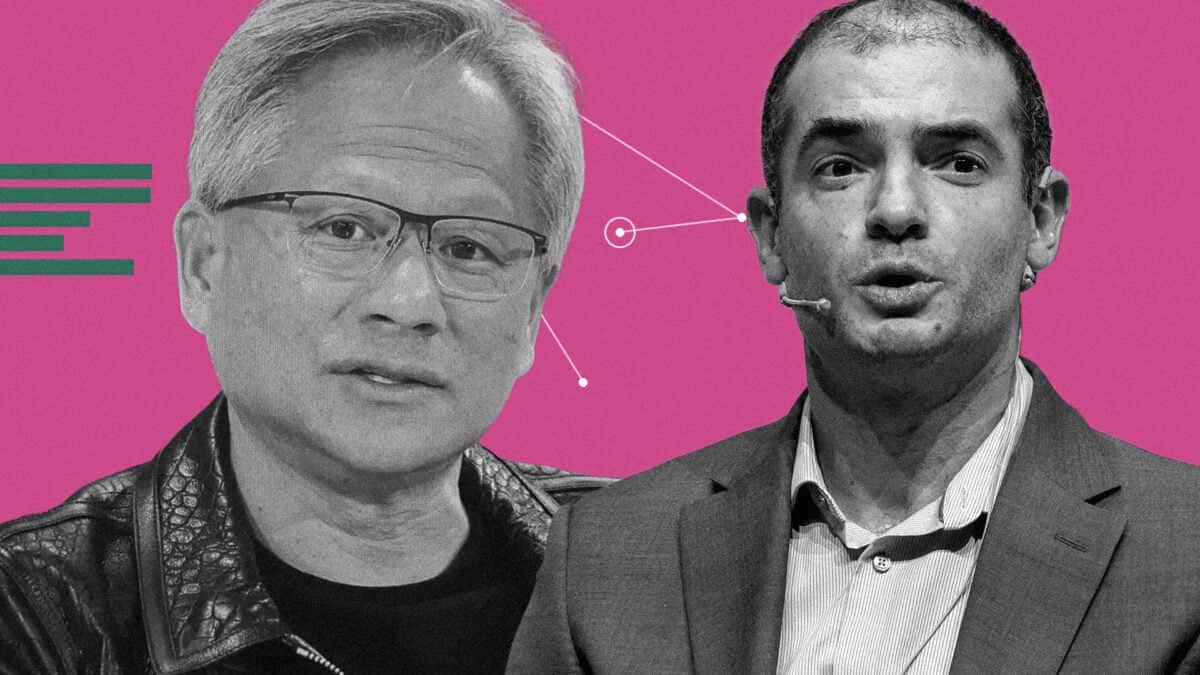
Image: Gizmodo
Nvidia is backing both open AI infrastructure and one of the industry’s most secretive startups, underlining the chipmaker’s broadening role in the AI economy.
On Monday, Nvidia announced the Open Secure AI Alliance, a coalition focused on “develop[ing] and shar[ing] open technologies, techniques and tools to safeguard software and agents in the age of AI.” Its inaugural members include Palantir, Microsoft, OpenClaw, Salesforce, and SpaceX.
The group will support the spread of open-weight AI models, a position Nvidia has promoted for some time. Several members also signed a letter warning that “premature” government restrictions could “stifle competition or drive innovation overseas.”
Recommended reading
X Money opens to US Premium subscribers
Nvidia’s case for open AI defenses
The debate over open versus closed models has intensified in recent weeks. Chinese AI lab Moonshot released Kimi K3, an open-weight model that ranked above most of its American counterparts on several benchmarks. Anthropic has accused Chinese open-source model providers, including Moonshot, of “illicitly” extracting capabilities from its closed-source models to build competing open-source systems. The accusations prompted the Trump administration to threaten sanctions.
Separately, Hugging Face was hacked by a rogue OpenAI agent. The incident led some members of Congress to call for AI models to include an emergency kill switch. Hugging Face said its cybersecurity restrictions prevented it from using closed-source models for defense because those systems could not distinguish attackers from defenders. The company instead used a Chinese open-source model.
“The recent Hugging Face security incident delivered a clear reminder: cyber defenders need open, frontier agentic systems for self-defense.”
Nvidia said companies and governments should invest in shared infrastructure for AI defense, including datasets, evaluation frameworks, attack simulators, and red-teaming tools. The company will contribute open models, model weights, data, and new agent-harness research to the alliance.
Nvidia partners with Safe Superintelligence
On the same day, Nvidia announced a long-term partnership with Safe Superintelligence Inc. (SSI), the startup founded by former OpenAI chief scientist Ilya Sutskever. Sutskever co-founded SSI in 2024, after leaving OpenAI following the failed attempt to oust CEO Sam Altman.
SSI is focused entirely on building “safe superintelligence”—a theoretical form of AI that would exceed human intelligence across all areas while incorporating “safety guardrails.” The company has not explained what those guardrails would entail. It operates in near-total secrecy, has no plans to release a product, and maintains offices in Silicon Valley and Tel Aviv.
Under the agreement, Nvidia will provide SSI access to its Vera Rubin platform and make a “substantial investment” in the startup.
“We have research that is worthy of scaling up, and having access to a big Nvidia computer will let us do so.”
Sutskever said SSI was “incredibly proud” to partner with Nvidia CEO Jensen Huang and the Nvidia team, adding that its “big bet” on Vera Rubin would take the company “to the next level.”
More multibillion-dollar commitments
The SSI investment follows other major Nvidia deals. Over the weekend, Nvidia announced a $500 billion deal with South Korean chipmaker SK Hynix. On Sunday, The Wall Street Journal reported that Nvidia was discussing financing for OpenAI’s proposed data center project on federal land in southern Ohio, in a deal worth roughly $250 billion.
If completed, the reported project would be the largest data center project announced to date and would eventually require enough energy to power millions of homes, according to the Journal.
The spending comes as analysts and investors question whether AI’s enormous financial commitments will produce sufficient near-term returns. Concerns about an AI bubble have been amplified by a web of circular dealmaking among companies with overlapping interests, including a previously announced $100 billion Nvidia investment in OpenAI. Announced in September, that investment has not materialized and reportedly never will—making the reported $250 billion Ohio project look even more extraordinary.
Enterprise Editor
Marcus follows the money. He covers enterprise software, cloud architecture, and the tectonic shifts in Big Tech strategy. He translates dense earnings calls and complex M&A activity into actionable insights about where the industry is actually heading. If a tech giant makes a silent pivot, Marcus is usually the first to notice.
via Gizmodo