• 2 min read
Muscle radar could guide future robotic limbs
University of Queensland researchers use ultra-wideband radar to measure muscle forces noninvasively for future prosthetic and robotic devices.
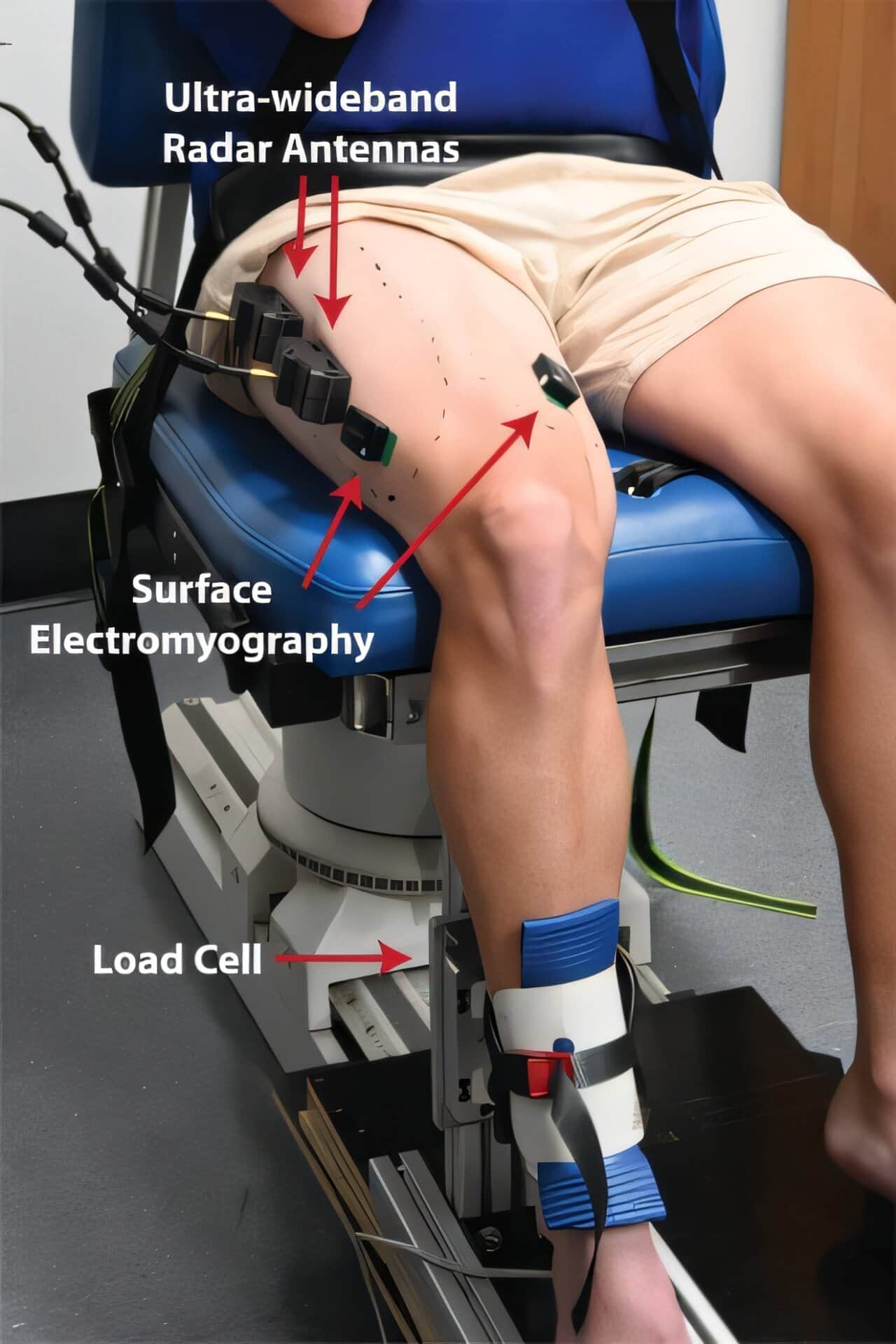
Image: TechXplore
Ultra-wideband radar measures muscle forces in a moving leg. Credit: Chris Bird/The University of Queensland
Researchers at the University of Queensland (UQ) have developed noninvasive sensors that measure the mechanical forces produced by muscles as they contract. The system uses ultra-wideband radar to detect electromagnetic changes inside moving muscles, offering a way to collect force data without invasive procedures.
The work, published in Science Robotics, could support wearable robotic mobility devices, exoskeletons and prosthetic limbs. The researchers say accurate force measurements could help such systems determine when a user needs assistance and how much support to provide.
“Up until now there hasn’t been a way to accurately measure the mechanical forces being produced by muscles when they contract without invasive procedures.”
How the muscle-force sensors work
Radar antennas positioned on the skin send electromagnetic pulses into the muscles. They then record how the transmitted and reflected signals change as the muscles contract. This allows the system to estimate the forces being generated beneath the skin while the leg is moving.

Recommended reading
Apple services hit by second outage in a week
Existing exoskeletons typically use external measurements to decide when support is needed. The new approach is intended to provide a more direct measure of the user’s muscle activity, although the researchers' stated next step is to make force measurement work in real time for practical device control.
“The results were better than I had hoped for.”
Potential uses in rehabilitation and aged care
Associate Professor Taylor Dick of UQ’s School of Biomedical Sciences said the technology could have applications in rehabilitation, injury prevention and recovery, and aged care.
Electrical stimulation is sometimes used to activate muscles in people who have lost voluntary control, but the muscles can fatigue quickly and tissue damage can occur. According to Dick, there has previously been no tool to measure how or when that damage will happen.
The sensors could also help injured athletes assess when to return to training with a lower risk of reinjury, while giving clinicians and patients more information before surgical or rehabilitative decisions. The researchers did not provide a release date, product name or pricing for a finished device.
Real-time control is the next step
The research team ultimately wants the sensors to calculate muscle forces in real time and feed that information into assistive devices.
“Having a real-time sensor calculating the forces being produced under the skin, telling a device when it should be providing assistance, that’s an exciting development.”
The study is “Ultra-wideband radar to measure in vivo muscle forces,” by Christopher S. Bird et al., published in Science Robotics in 2026. DOI: 10.1126/scirobotics.aed5865.
Sadie Harley, BSc Life Sciences & Ecology
Robert Egan, bachelor’s in mathematical biology and master’s in creative writing
Computing Editor
Tomas lives in the terminal. He covers chips, laptops, and operating systems with a focus on performance and efficiency. He reads kernel changelogs the way other people read fiction, and he's always on the hunt for the perfect mechanical keyboard switch. If it processes data, Tomas has an opinion on it.
via TechXplore