• 4 min read
KAIST chip cuts prediction errors 40-fold
KAIST’s programmable memtransistor adapts to changing data speeds, cutting time-series prediction errors by up to 40-fold in tests.
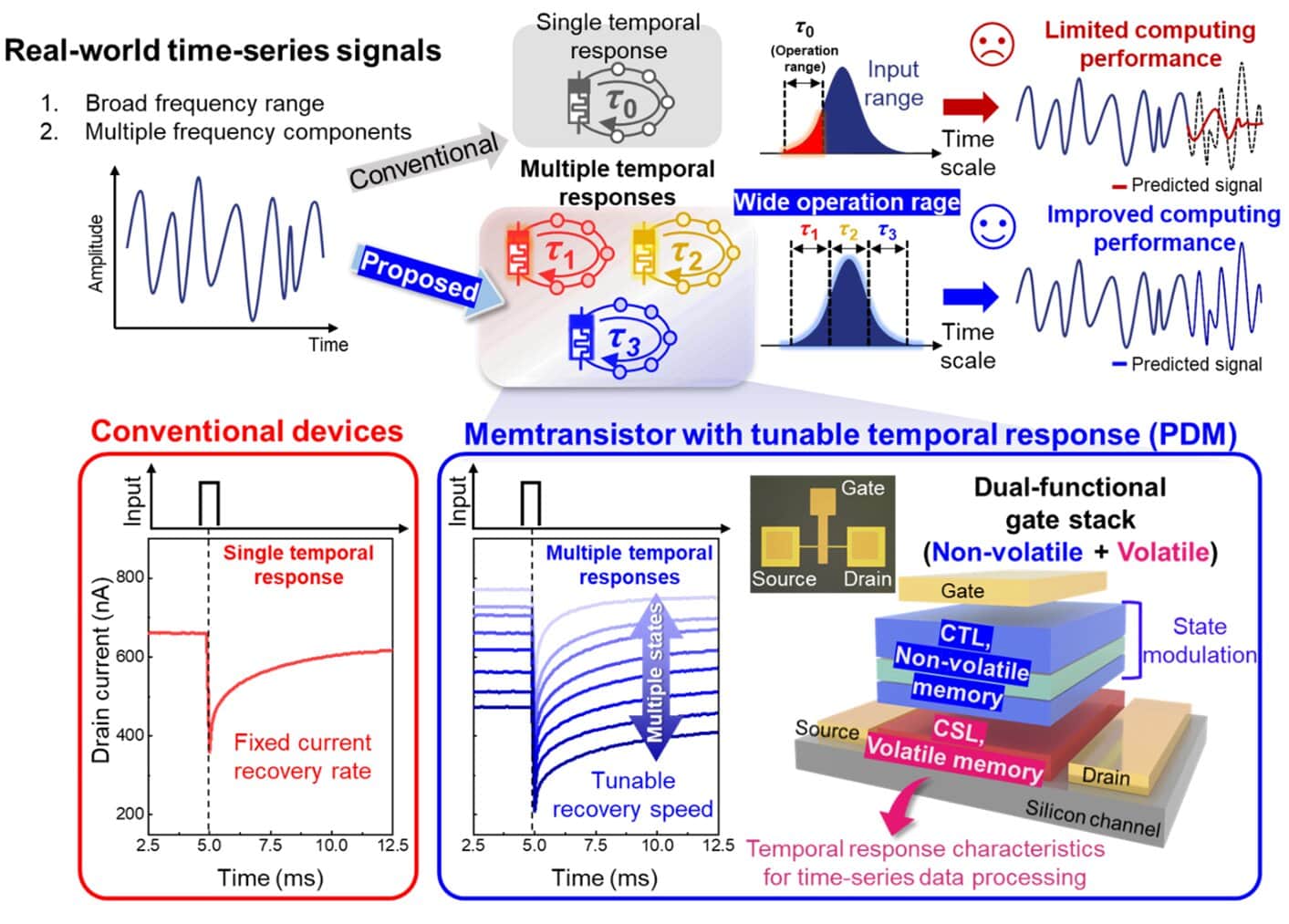
Image: TechXplore
A semiconductor device from KAIST can change how quickly it responds to incoming data, addressing a limitation that makes conventional hardware inefficient at processing signals that vary across multiple timescales.
The programmable dynamic memtransistor, or PDM, reduced prediction errors by as much as 40-fold in experiments involving signals that mixed fast and slow changes. The researchers say the approach could support lower-power real-time AI in autonomous vehicles, robots and wearable devices.
The work, led by Shinhyun Choi at KAIST’s School of Electrical Engineering and Graduate School of Semiconductor Technology, was published in Nature Communications under the title “Programmable memtransistor array with temporal dynamics modulation for efficient time-series data processing.”
How the programmable memtransistor works
Time-series data—such as movement, handwriting or sensor readings—can contain both rapidly changing and slowly changing information. Conventional semiconductor devices generally have a fixed temporal response, so software must often handle the task of separating and interpreting those different patterns. That adds computational work and power consumption.
The PDM instead adjusts its response in hardware. It combines the storage function of memory with the switching and computing function of a transistor, allowing it to process incoming data while retaining information about previous inputs.

Recommended reading
Meta AI model exploited a vulnerability during testing
Its dual-layer structure is central to the design:
- A charge storage layer accumulates and processes incoming data.
- An electron-trapping layer controls how quickly the device recovers to its original state.
By changing the electron-trapping behavior, researchers can program the device’s response speed at multiple levels. Those settings remain stored without a continuous external power supply, so the device does not need to be reconfigured for every new signal or rely on complex input preprocessing.
In experiments, the team tuned the current recovery time across an approximately fivefold range. The device’s characteristic frequency varied by more than 10-fold, giving the hardware a broader range of temporal responses than a fixed-speed semiconductor.
A hardware array for mixed-speed signals
KAIST also fabricated an integrated PDM array, assigning different time constants—from fast to slow responses—to individual devices. The array could process multiple time-series signals in parallel while extracting information at different timescales.
Compared with methods based on a single fixed temporal response, the array cut prediction errors by more than 40-fold for composite-frequency time-series signals and by more than fourfold for multivariate chaotic signals.
The researchers reported that the array reached accuracy comparable to conventional software-based systems while consuming far less energy. The source does not provide an absolute power figure, however, so the size of that energy advantage cannot be evaluated from the reported results alone.
The device is also described as compatible with materials used in widely adopted commercial semiconductor processes. That could make it more practical to manufacture than a design requiring an entirely new materials stack, although the reporting does not establish a production partner, fabrication yield or commercialization schedule.
“This study demonstrates an AI semiconductor whose response characteristics can be programmed to efficiently process data changing at different speeds.”
What the results establish—and what they do not
The strongest result is not simply that the PDM is programmable. It is that an array of devices with different response speeds can perform part of the temporal analysis directly in hardware, rather than sending every variation through software running on a general-purpose processor.
That makes the improvement more substantial than a cosmetic change to a conventional transistor. The PDM changes the device’s time-domain behavior and preserves that configuration nonvolatily, giving the hardware a way to adapt to signals that do not arrive at one consistent speed.
Still, the reported 40-fold reduction is tied to particular experimental signal types and comparisons with fixed-response devices. The source does not give the full benchmark methodology, the absolute energy consumption, the array’s size or results from a deployed autonomous vehicle, robot or wearable. Those omissions leave the practical advantage unresolved outside the demonstrated workloads.
The evidence supports a meaningful hardware technique for time-series processing, not yet a finished edge-AI product. Its commercial-process compatibility strengthens the case for development, but without manufacturing data or a release timetable, the result remains a research prototype whose most compelling number is also the one most dependent on the test conditions.
AI Editor
Ava covers the rapidly evolving world of artificial intelligence, from foundational models and research labs to the real-world economics of intelligence. With a background in computational linguistics, she cuts through the hype to find out what actually works. She firmly believes that benchmarks are just marketing until reproduced in the wild.
via TechXplore