

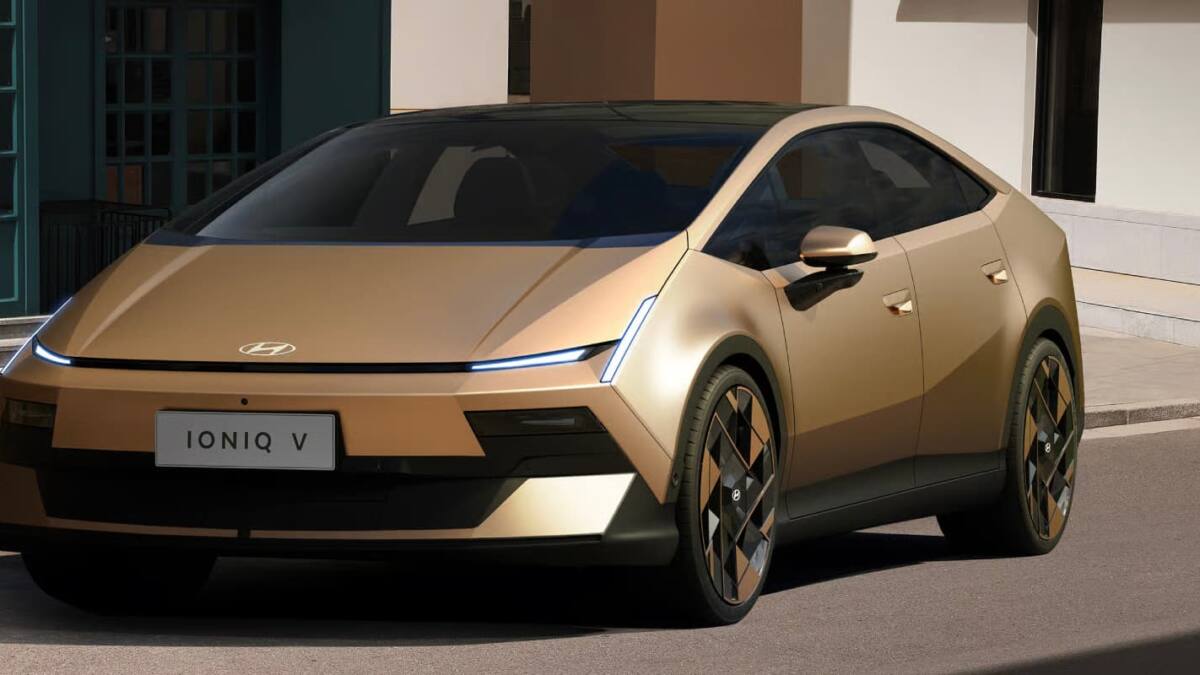
Hyundai’s new Ioniq V has surfaced in China with two battery options, two power outputs, and one very Cybertruck-adjacent design. The headline numbers are the sort automakers like to put on posters: up to 650 km of range, a claimed energy use of 10 kWh per 100 km, and an 800-volt platform that should make fast charging less painful than most EV ownership paperwork.
The catch, as usual, is that these figures come from China’s CLTC test cycle, which is generous enough to keep spec sheets smiling. Still, Hyundai is clearly aiming at the part of the market where range anxiety is fought with bigger numbers and sharper sheet metal, while rivals such as Tesla and BYD keep pushing Chinese buyers toward ever more aggressive EV value plays.
Hyundai Ioniq V battery and power options
According to filings with China’s Ministry of Industry and Information Technology, the base Ioniq V uses a 53.5 kWh lithium-iron-phosphate battery paired with a 188 hp motor. That version is rated for 520-540 km of range under CLTC. Step up to the larger 66.8 kWh pack, and output rises to 225 hp, with a claimed 620-650 km range.
- Base version: 53.5 kWh battery, 188 hp, 520-540 km CLTC range
- Higher-spec version: 66.8 kWh battery, 225 hp, 620-650 km CLTC range
- Architecture: 800-volt platform
- Claimed consumption: 10 kWh per 100 km
Fast charging details are still hidden
Hyundai has not published official charging specs yet, but the 800-volt setup is the real clue here. On other Ioniq models, that architecture supports fast charging up to 250 kW, which puts the Ioniq V in the same broad technical conversation as some pricier premium EVs, even if the final charging numbers may not quite match the brochure fantasy.
The filing also mentions a range-extended version with a combustion engine that charges the battery, though Hyundai has not said how it will work. That’s a useful hedge in a market where pure EVs are still fighting infrastructure reality, and where Chinese buyers have repeatedly shown they’ll consider any setup that reduces charging downtime without turning the car into a compromise.
China launch first, export plans unclear
Pricing is still under wraps, and the model is expected to go on sale in China before the end of the year. Hyundai has said nothing firm about sales outside China, but an export launch has not been ruled out, which is exactly the sort of non-answer automakers use when they want the option open without promising anything useful.
If Hyundai does take the Ioniq V beyond China, the car could end up as one of those curious EVs that looks like a concept sketch and lands in showrooms with unexpectedly sensible hardware underneath. The real test will be whether that combination travels as well as the design language does.