

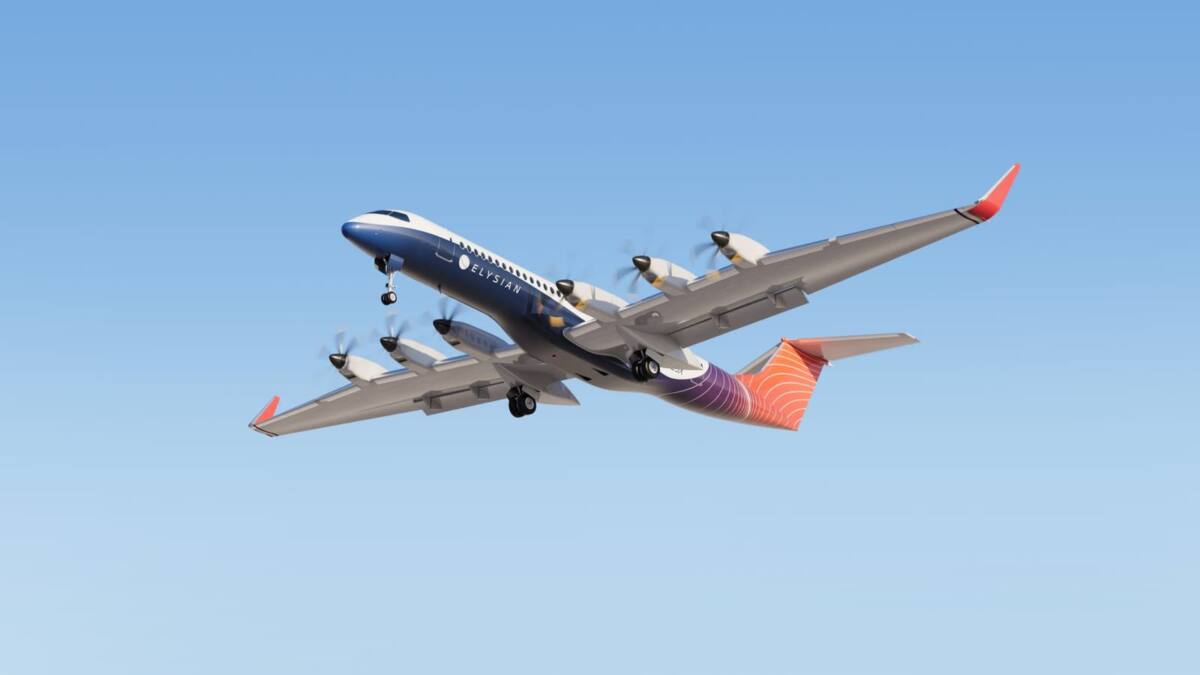
Two companies that know a thing or two about long shots are betting that regional aviation can go electric. Dutch startup Elysian Aircraft and Taiwan’s ProLogium Technology have agreed to co-develop lithium-ceramic batteries for the Elysian E9X, a 100-seat concept airliner that aims to fly 750 to 1000 kilometers without direct CO2 emissions.
The Elysian E9X is designed as a fully electric regional airliner for 88 to 100 passengers. It would use six electric motors, have a wingspan of about 50 meters, and a maximum takeoff weight of around 82.5 tons. ProLogium’s goal is to adapt its lithium-ceramic battery technology for commercial aircraft use, with a target energy density of 320-420 Wh/kg.
What the Elysian E9X is supposed to be
The pitch is straightforward: build batteries light and energy-dense enough to make short-haul passenger flights practical, then package them into an aircraft that can actually carry people rather than just optimism. That is a high bar. Airlines live and die on weight, safety, and turnaround times, and aviation tends to punish battery dreams much faster than the automotive industry does.
Why battery density is the whole game
The numbers explain why this is so hard. Battery systems have improved quickly in cars, but aircraft ask for far more: lower mass, stricter safety margins, and stable performance under punishing loads. That is why most electric aviation concepts still focus on regional routes rather than anything resembling a transcontinental schedule.
- Target energy density: 320-420 Wh/kg
- Planned capacity: 88-100 passengers
- Estimated range: 750 to 1000 kilometers
- Engines: six electric motors
- Maximum takeoff weight: around 82.5 tons
A new use case for ProLogium’s batteries
For ProLogium, the deal is a chance to move beyond the car business and into a sector that is both larger and pickier. The company is known for solid-state and lithium-ceramic batteries, but aviation could be the real stress test for whether those chemistries can graduate from lab promise to commercial hardware.
Elysian also sounds realistic about the bigger picture: electric aircraft will need an ecosystem, not just a battery pack. That means suppliers, maintenance support, charging or swapping infrastructure, and an operational model airlines can live with. The first region to get that stack in place will have a serious head start. The rest will keep watching from the gate.