

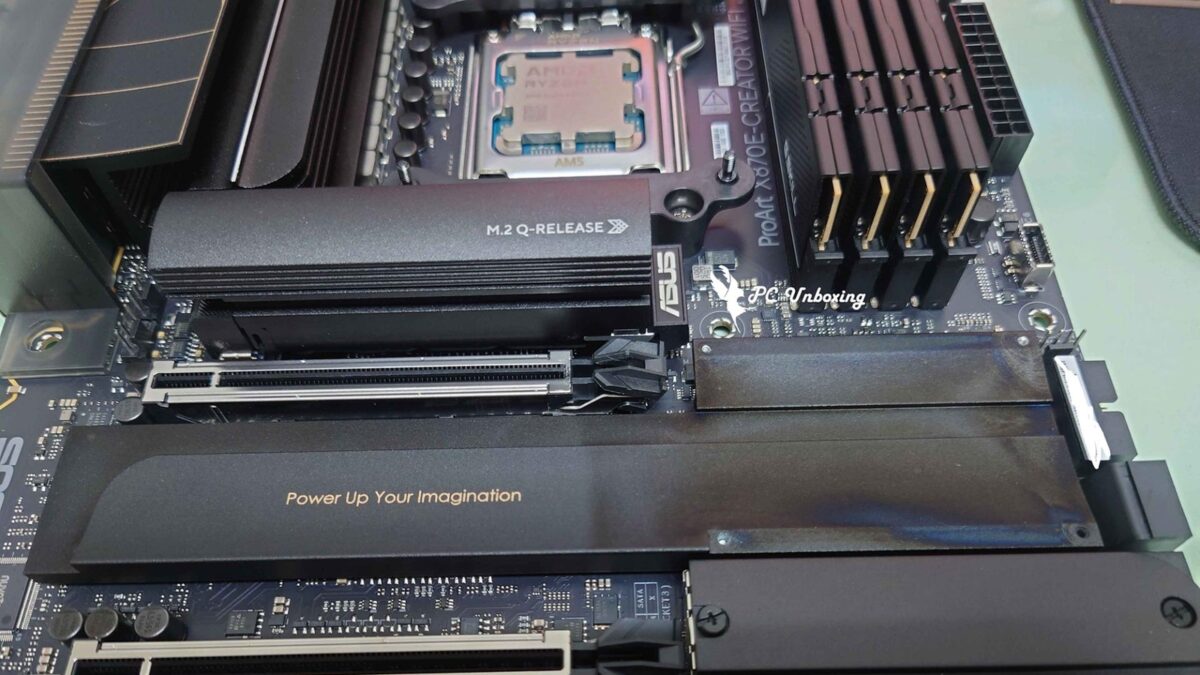
A Taiwanese user says an Asus ROG Astral RTX 5090 running alongside an Asus ProArt X870-E Creator WiFi motherboard in a ProArt PA602 case left visible heat damage on the board’s chipset heatsink. The setup had been used for AI content work for about half a year, and after disassembly the heatsink showed discoloration from heat that could only be partially cleaned away.
The report centers on the Asus ROG Astral RTX 5090 and a ProArt X870-E Creator WiFi motherboard. Under full load, the RTX 5090 is said to draw about 700 W, with short power spikes that can reach 1000 W. High-end GPUs have been flirting with thermal drama for several generations; this one just makes the flirting more expensive.
What changed on the motherboard
According to the report, the most obvious damage was not a dead board but a heatsink that changed color from prolonged heating. A damp cloth removed some of the stain, but not enough to restore the original finish. Some commenters pointed out that motherboard heatsinks are often coated with heat-resistant paint, and that coating can wear down over time when exposed to constant heat.
The case is a useful reminder that flagship graphics cards do not live in isolation. Put a power-hungry GPU next to a fast CPU, a compact enclosure, and a board packed with premium cooling hardware, and the whole system starts acting like a tiny space heater with RGB. The real loser is usually the component sitting closest to the exhaust path.
RTX 5090 power draw and 16-pin concerns
This is also not the first headache around the GeForce RTX 5090 family. Earlier reports focused on problems with the card’s 16-pin power connector, which has already become a familiar source of anxiety for anyone paying flagship prices. That makes incidents like this easier to believe, even if they are still anecdotal rather than a formal product defect.
- GPU: Asus ROG Astral RTX 5090
- Motherboard: Asus ProArt X870-E Creator WiFi
- Case: ProArt PA602
- Reported GPU power draw: about 700 W under full load
- Reported instantaneous spikes: up to 1000 W
Extreme PC builds are pushing cooling limits
Expect more of these stories as builders keep pairing the most power-hungry consumer GPUs with premium creator boards. The hardware itself is getting faster; the cooling and power-delivery margins are not always keeping up. If anything, the next wave of gaming and AI rigs may need better case airflow, smarter cable management, and a lot less optimism.