

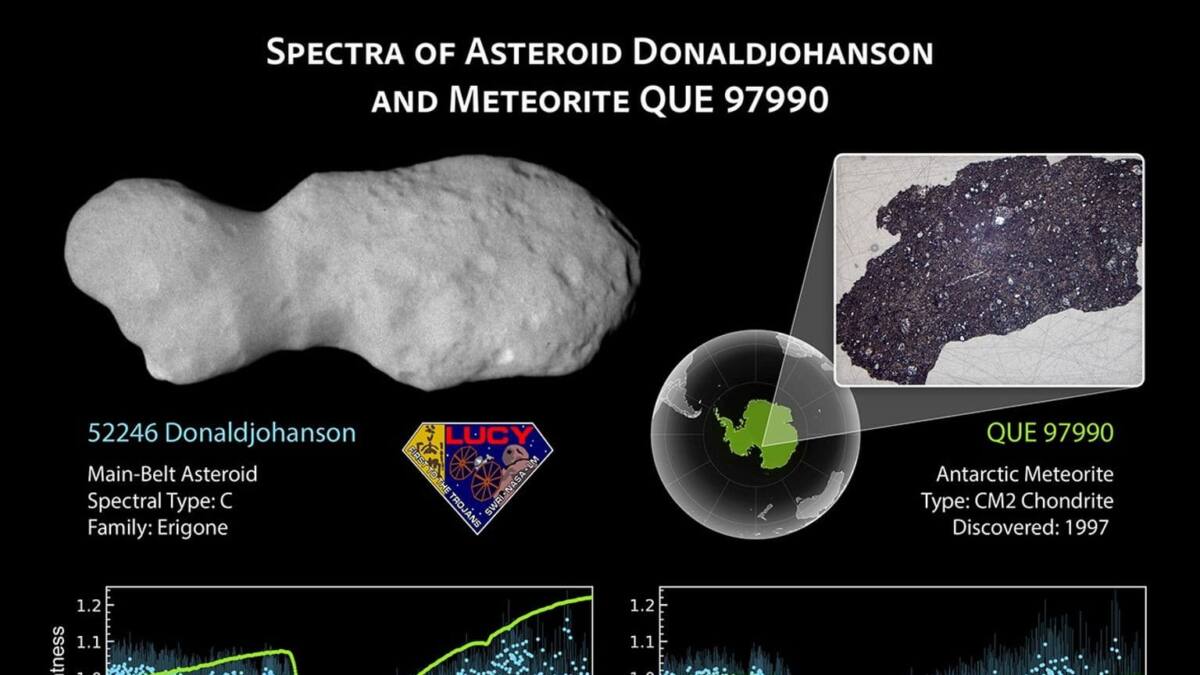
NASA’s Lucy spacecraft has turned a brief flyby into a surprisingly rich science haul. During its 20 April 2025 close approach to asteroid Donaldjohanson, Lucy passed just 1,050 kilometres above the surface and captured the first detailed images and measurements of a small body that behaves less like a tidy spinning rock and more like a drunken top. The findings, published in Science, give astronomers a clearer view of how the Lucy asteroid flyby reveals small asteroids evolve under stress, sunlight, and collisions.
The results also set the stage for Lucy’s main job: visiting the Trojan asteroids of Jupiter. The spacecraft’s first Trojan encounter will be with Eurybates on 12 August 2027, after this rehearsal on a more modest target.
A peanut shape with a complicated spin
Donaldjohanson does not rotate in the simple, planet-like way most people imagine. Lucy’s data show it completes one spin in 10.5 Earth days, while its long axis also wobbles with a 26.5-day cycle. That combination explains the asteroid’s odd, unsettled motion and helps confirm that small bodies can be far more mechanically messy than they look from a distance.
The close-up images also revealed the asteroid’s peanut, or dumbbell, shape. Scientists think that two larger asteroids collided about 155 million years ago, and their fragments later stuck together under mutual gravity. For a body that young in cosmic terms, it has already had a rough ride.
Sunlight has been reshaping Donaldjohanson for millions of years
Lucy’s instruments suggest Donaldjohanson used to spin at least 10 times faster. Over the last 20 to 60 million years, that rotation slowed, most likely because of the YORP effect, where uneven heating by the Sun creates a tiny but persistent torque. On a loose rubble pile, even a whisper of force can move material downhill, smooth out craters, and leave the surface looking worn in all the right places.
Spectrometers also picked up iron-rich clay minerals on the surface. That points to water in the asteroid’s distant past, or in the parent body it came from. The signal is different from the magnesium-rich clays found on Bennu and Ryugu, which suggest longer contact with water; Donaldjohanson appears to have had a shorter wet phase, which makes it a useful comparison point rather than just another oddly shaped rock.
Why Lucy spent time on Donaldjohanson first
There is a strategic reason for this detour. Lucy’s real destination is Jupiter’s Trojan asteroids, and the spacecraft’s first Trojan encounter will be with Eurybates on 12 August 2027. NASA’s logic is pretty straightforward: test the instruments on a nearby target, learn what the spacecraft can really resolve, then bring that experience to a far more important set of objects.
Donaldjohanson is also younger than Bennu and Ryugu, which are thought to be 1-2 billion years old, and it has stayed in the main belt all this time. That makes it a cleaner snapshot of asteroid evolution without the extra baggage of a long wandering history. The comparison is useful because the solar system rarely hands scientists two objects that are this similar in makeup and this different in age.
Lucy has now done exactly what a good rehearsal should do: exposed the quirks, sharpened the questions, and left the audience waiting for the main act.