

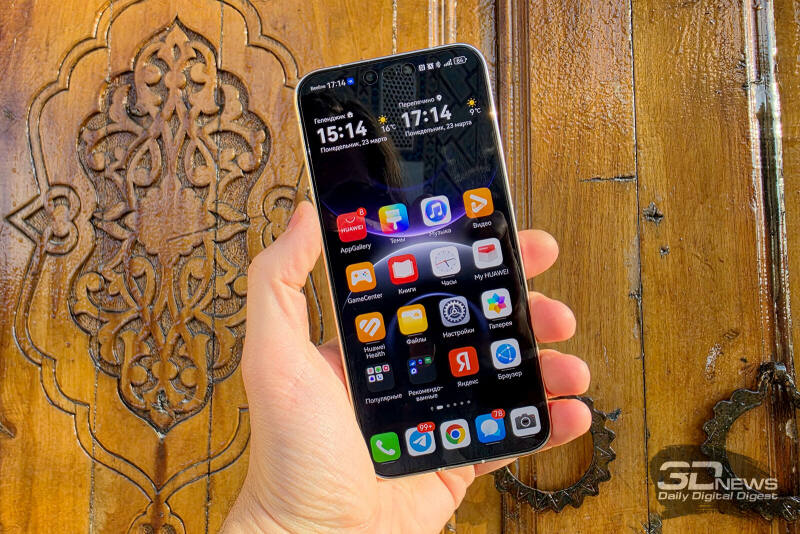
HUAWEI likes to split its flagship phones into two jobs: Pura gets the camera theatrics, while Mate is the all-rounder that usually debuts the company’s newest hardware and software. The HUAWEI Mate 80 Pro does not get the showpiece dual telephoto setup, and the company is not exactly shouting about its camera first. That is a little misleading, because in Bangkok this phone behaves less like a workhorse and more like a very capable travel camera with a SIM slot.
If you are looking for the short answer, the HUAWEI Mate 80 Pro is more than just a business phone: it shoots strong travel photos, especially in daylight, at night, and when you lean on the telephoto lens for zoom and macro shots. The setup is familiar on paper, but it performs well in real-world use.
The camera system includes:
- 50MP main camera with a 24 mm equivalent lens and a variable aperture from ƒ/1.4 to ƒ/4
- 48MP telephoto camera with 93 mm equivalent optics, ƒ/2.1 aperture, optical stabilization, and a 5 cm minimum focusing distance
- 40MP ultrawide camera with a 13 mm equivalent lens and ƒ/2.2 aperture
Nothing there screams ”special” until you start shooting.
Bangkok is a good stress test for color and zoom
Daytime Bangkok is not the kindest city for camera marketing photos. The light is harsh, the colors are restrained, and the skyline is more functional than dramatic. That is exactly why the Mate 80 Pro is interesting: it handles wide-angle street scenes cleanly, with strong detail and a solid dynamic range, then switches into zoom shooting without falling apart. The 7x optical and 10x hybrid shots hold together far better than they have any right to, and that makes the phone useful for more than just postcard framing.
At temples and palaces, where gold and bright paint do most of the heavy lifting, HUAWEI’s XMAGE processing leans into saturation without turning the scene into a clown suit. The colors stay punchy but still believable, which is the harder trick. Samsung and Apple can both do excellent travel color, but HUAWEI still has a way of making bright architecture look expensive rather than overcooked.
Night shots are where the variable aperture pays off
Bangkok after sunset is where the Mate 80 Pro stops being a decent camera phone and starts looking like a specialist tool. Neon, dusk, and reflected city light give the phone a lot to work with, and it responds with well-controlled color and strong low-light performance across the main and telephoto cameras. The adjustable aperture helps here in a very old-school, very satisfying way: closing down toward ƒ/2.5 to ƒ/4 produces star-shaped highlights around lamps and signs, which gives night photos a little extra drama without needing a filter app to pretend it knows what it is doing.
That does come with a catch. Smaller apertures raise the risk of blur, so you need a steady hand or a wall, railing, or table to lean on. Still, the payoff is real, and it is one of the rare times a phone camera feature feels engineered for people who actually take pictures rather than people who read spec sheets for fun.
The telephoto lens also pulls double duty for macro
The Mate 80 Pro’s telephoto camera is not just for distant buildings and skyline details. Its 5 cm focusing distance turns it into a macro tool as well, which makes it more flexible than the usual ”one lens, one job” telephoto module. That matters on a trip, because the best travel photos are often small things: food, textures, signs, and odd details that would be lost if you had to switch to a separate close-up mode with less useful optics.
There is also a front camera in the mix, and it does what you would expect from a high-end HUAWEI flagship: no drama, no obvious weakness, just another competent piece of the package. The bigger story is that Mate 80 Pro quietly covers a wider range of shooting situations than HUAWEI seems interested in advertising. That is a smart move. In a market where every premium phone promises to be a camera king, the less flashy device that actually handles a three-day trip better is usually the one that wins real-world loyalty.
Could HUAWEI push this harder against rivals with more aggressively marketed camera systems? Absolutely. But the more interesting question is whether the company even needs to. If a ”business” flagship can produce convincing street, night, portrait, and macro shots in Bangkok without begging for special treatment, the line between travel camera and everyday phone gets pretty blurry.