

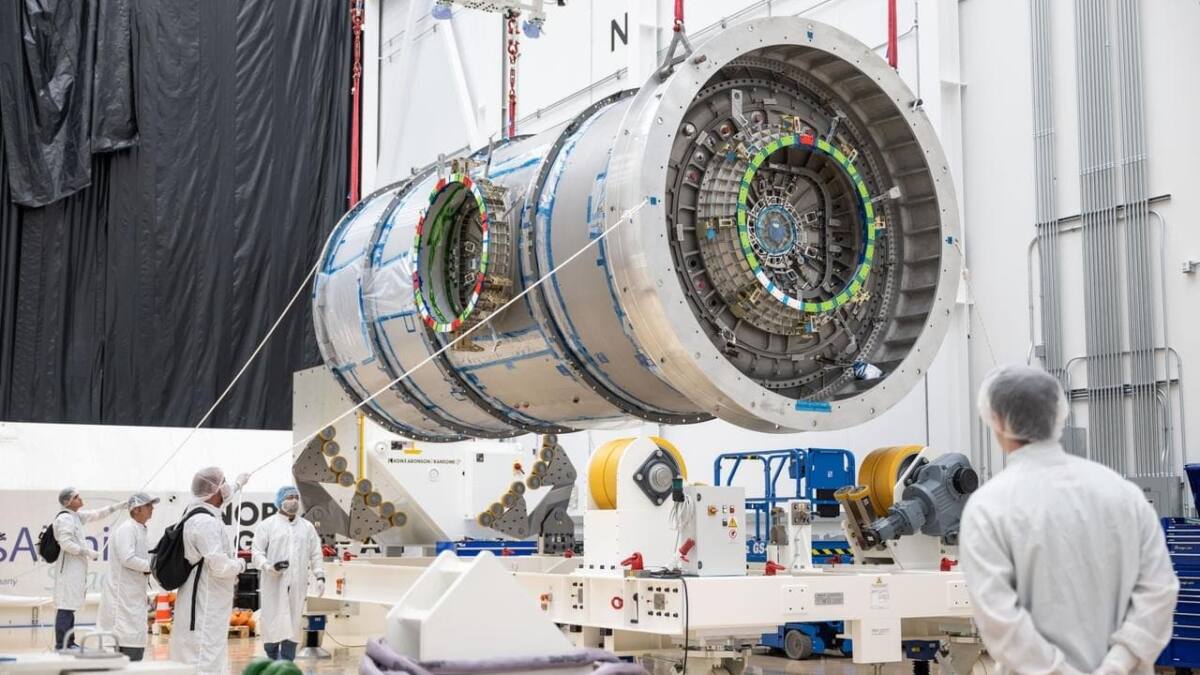
NASA is effectively freezing work on HALO, the habitat module that was meant to anchor Lunar Gateway, and that move does more than delay hardware: it raises fresh doubts about whether the orbiting station still fits the agency’s lunar strategy. HALO, short for Habitation and Logistics Outpost, was supposed to be the pressurized heart of the outpost, but NASA’s focus is shifting toward building infrastructure on the Moon itself.
The HALO module was designed as a roughly 6-meter-long living and working compartment for astronauts on missions around the Moon. Contracts for its development and integration with a power module had already climbed past $1.1 billion with Northrop Grumman, while Paragon Space Development had been handling life-support work under a contract valued at more than $100 million.
What HALO was supposed to do
The module was not just another component bolted onto a station diagram. It was intended to be the main inhabited section of Gateway, where astronauts would spend most of their time during missions in lunar orbit. At full configuration, it was expected to weigh about 8-9 tons, which helps explain why a station built for orbital operations can become awkward once the mission emphasis shifts to the Moon’s surface.
That tension is not unique to NASA. Human spaceflight programs have a habit of surviving long enough to be overtaken by their own priorities, and Gateway has already been reworked more than once. If the new plan is to put more effort into surface infrastructure, an orbital hub starts to look less like the center of the architecture and more like an expensive detour.
Northrop Grumman and Paragon are being shifted elsewhere
Formally, nobody is calling HALO dead. Northrop Grumman says the module could be repurposed for other lunar or deep-space missions, and most employees assigned to it are expected to move to other programs. NASA says the future of Gateway components is still being discussed as part of its updated strategy, which favors building on the lunar surface rather than orbiting it.
The messy part is that ”discussion” is often code for ”we have not yet found a politically painless way to say this is changing.” NASA has not given an official reason for halting HALO, but the combination of mass, delivery complexity, and possible technical issues such as corrosion problems makes the pause look less like a surprise and more like a program reprioritization with a long fuse.
What happens to Lunar Gateway now
Gateway was already a project built on compromise, and HALO’s suspension makes the station’s role even less certain. Without its central habitat module moving forward, the station loses the part that made it feel like a destination rather than a set of disconnected hardware plans. The big question now is whether NASA still wants an orbiting outpost at all, or just the paperwork that comes with having one.