• 2 min read
Claude Code sessions can now message each other
Claude Code v2.1.224 lets sessions on macOS and Linux exchange summaries, coordinate work, and hand off findings without sharing full history or files.
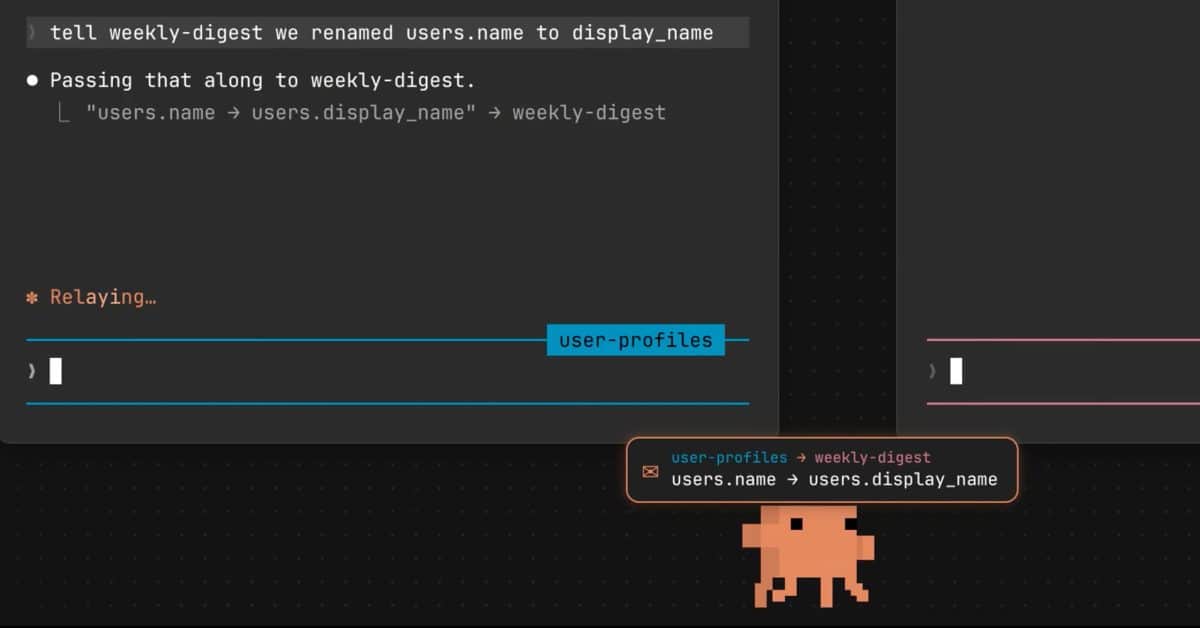
Image: 9to5Mac
Claude Code sessions can now communicate with one another, giving developers a way to coordinate multiple agents working on the same project. The feature is available in Claude Code v2.1.224 on macOS and Linux.
How cross-session messaging works
A user can ask one Claude Code session to send a finding, question, or status update to another. Claude creates the message itself from the relevant prompt, rather than requiring the user to compose a detailed handoff.
Anthropic says the feature sends a summary, not the originating session’s full history or files. The receiving session can then continue from that context instead of forcing the user to repeat the task or explain the project again.

Recommended reading
OpenAI’s first gadget may be a $400 ChatGPT donut
“New in Claude Code: your sessions can now message each other. Instead of having to re-explain yourself in another session, you can now tell Claude to do it. It sends a summary (not your history or files), and the other session picks it up mid-task.”
The company describes several intended uses: handing off a discovery, coordinating work across parallel worktrees, checking progress on long-running tasks, and responding between sessions running on different machines. One session can also warn another when a change has broken something it is building.
Permission controls still apply
Messaging does not turn sessions into an unrestricted control channel. Cross-session messages cannot approve permission requests or change configurations. Commands such as /compact arrive as plain text rather than executable commands, and any action requiring permission still triggers an approval prompt in the receiving session.
That distinction matters: the update improves coordination, but it does not remove Claude Code’s existing user-approval boundaries. It also means the feature is closer to structured agent handoffs than shared access to every session’s files and state.
Anthropic has not said in the supplied announcement whether cross-session messaging is available on other platforms, nor does it provide performance data showing how much time the feature saves. The concrete change is nevertheless substantial for developers already running several Claude Code sessions: the sessions can now exchange concise, task-specific context without duplicating the user’s instructions.
AI Editor
Ava covers the rapidly evolving world of artificial intelligence, from foundational models and research labs to the real-world economics of intelligence. With a background in computational linguistics, she cuts through the hype to find out what actually works. She firmly believes that benchmarks are just marketing until reproduced in the wild.
via 9to5Mac