• 3 min read
BYD unveils its first in-house 4nm driving chip
BYD has turned a safety pledge into a hardware story. The Chinese automaker says it is now covering losses tied to its “God’s Eye” Urban Navigate on Autopilot system in China, while also unveiling XUANJI A3, its first cu
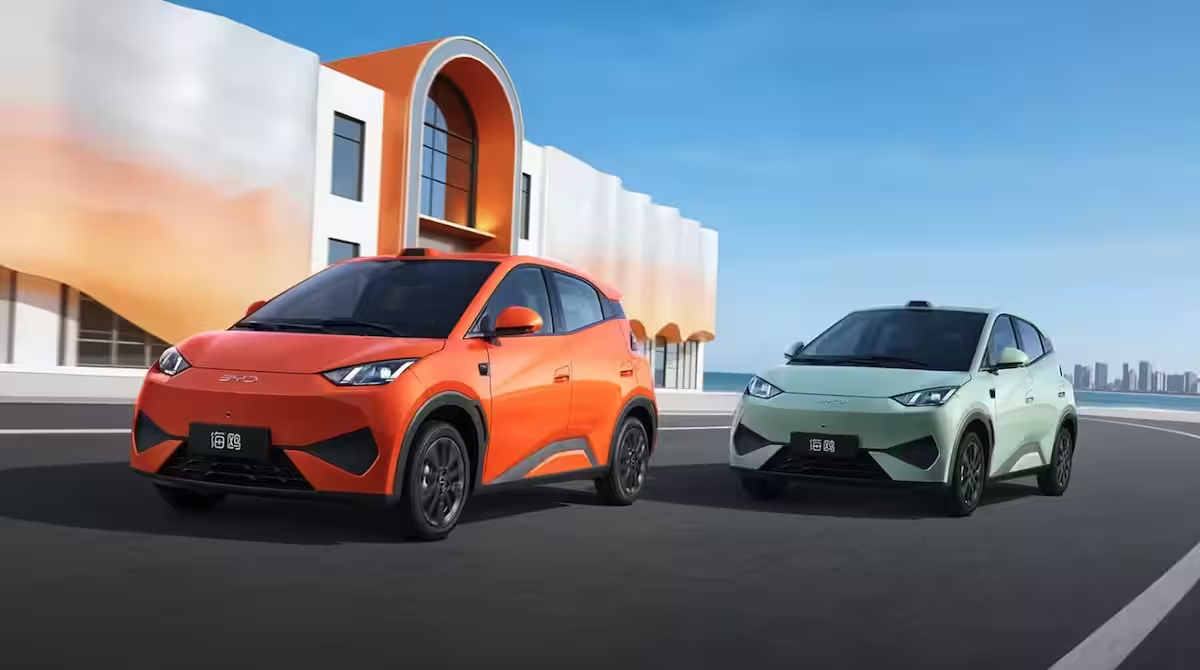
BYD has turned a safety pledge into a hardware story. The Chinese automaker says it is now covering losses tied to its “God’s Eye” Urban Navigate on Autopilot system in China, while also unveiling XUANJI A3, its first custom 4nm automotive-grade driving chip, as it pushes deeper into self-driving and cockpit AI.
The move is classic BYD: move fast, cover your exposure, and build the stack yourself. With rivals racing to bundle driver-assist software, insurance-style protection, and proprietary silicon, the company is trying to make its EVs look less like assembled products and more like vertically integrated computers on wheels.
God’s Eye gets full damage coverage
BYD says its Full Damage Coverage applies to the Urban NOA feature in China and includes a one-year policy for both new buyers and existing owners upgrading to God’s Eye 5.0. The company says it will cover economic losses from legally liable accidents that happen while Urban NOA is operating.
That makes BYD the first automaker to offer dual coverage for both intelligent parking and advanced city-driving assistance systems. It is also a neat bit of risk management: if you’re going to market autonomy-adjacent features aggressively, you may as well put some money behind the pitch.
Scale, sensors and the XUANJI upgrade path
BYD says the coverage is supported by data from more than 3.15 million intelligent vehicles logging more than 124 million miles daily, plus an automotive R&D team of 5,000 engineers. It also says its full lineup can now be optionally equipped with the God’s Eye LiDAR Version, which is set for four major upgrades.
Recommended reading
Lucid bankruptcy rumor rattles the whole EV sector
- XUANJI Architecture 2.0 with satellite sensor functionality
- An upgraded physical AI large model
- A self-evolving data flywheel
- Expansion of the God’s Eye LiDAR Version across the lineup
That is a lot of jargon in one breath, but the direction is clear: BYD wants tighter integration between sensors, software and data, the same playbook Tesla and several Chinese rivals have been following with varying degrees of swagger and success.
DiLink AI cockpit and a 4nm chip
BYD also introduced the DiLink AI Intelligent Cockpit, which includes a digital assistant designed to execute tasks proactively and handle deeper reasoning. The bigger hardware statement, though, is XUANJI A3, the company’s own 4nm automotive-grade driving chip.
BYD says XUANJI A3 natively supports L3 and L4 autonomous driving, and that a three-chip setup can deliver over 2,100 TOPS of computing power per vehicle while using 20% less power per TOPS than competing hardware. If those numbers hold up in production, it gives BYD a sharper answer to the expensive compute race that has been shaping EV development in China and beyond.
What BYD is really building
The real story here is not just a new chip. It is BYD trying to own more of the stack – from driver assistance to cockpit AI to the silicon underneath – so it can control cost, performance and feature rollout more tightly than competitors that still rely more heavily on outside suppliers.
The next question is whether this turns into a genuine advantage or just a louder spec sheet. In a market where every automaker is suddenly allergic to being seen as average, BYD at least has a plan that is easy to explain: build it, back it, and keep the blame at home.

Frontier Editor
Dan is our resident futurist, covering electric mobility, space exploration, and the smart home. He's interested in atoms just as much as bits. Whether it's a new battery chemistry, a reusable rocket, or a protocol that finally makes IoT devices talk to each other, Dan breaks down the engineering that pushes humanity forward.