

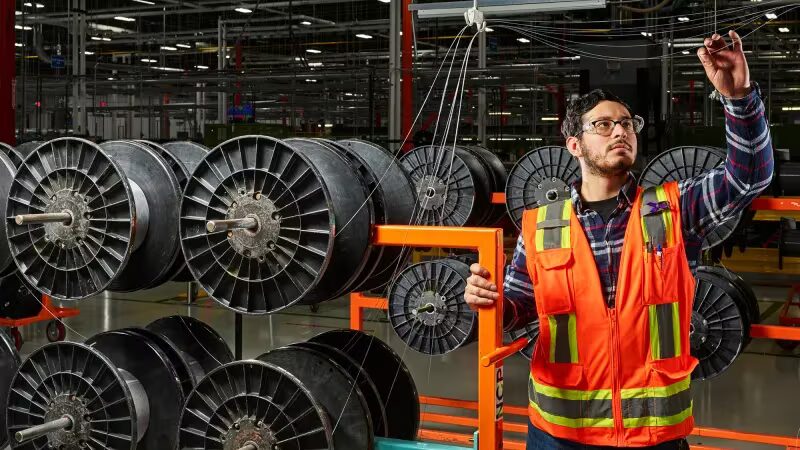
Amazon has secured a multiyear, multibillion-dollar deal with Corning to supply optical fiber, cables, and related solutions for its US data centers. While contract details like duration and exact value remain under wraps, this pact cements Amazon’s access to critical infrastructure components vital for scaling its AI operations. For Corning, the partnership represents another significant anchor client amid surging demand from hyperscale cloud providers.
Beyond product delivery, Corning plans to create roughly 1,000 new manufacturing jobs in North Carolina, with additional construction jobs expected to arise from factory expansions. Amazon, Corning, and Catawba Valley Community College are also launching a training program aimed at developing fiber optic specialists, signaling a commitment to workforce development alongside infrastructure growth.
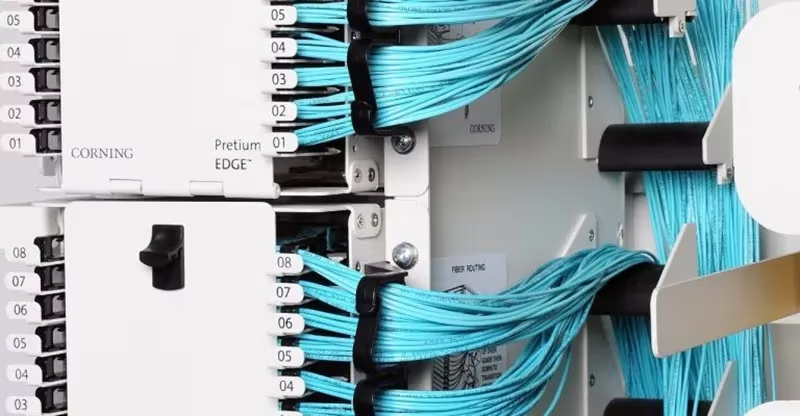
Optical fiber is becoming a consumable material on an industrial scale within AI-powered data centers. Clusters housing tens of thousands of GPUs demand dense, high-quality interconnects between racks and rooms. The shift to 400G and 800G Ethernet drastically raises the bar for both fiber count and cable infrastructure quality. Suppliers like Corning are no longer just back-end vendors but integral players in building the backbone of computational power.
Amazon hasn’t specified which projects will consume this new supply volume, but the timing is telling. US hyperscalers are simultaneously expanding AI clusters, boosting network capacity, and localizing component production that was once easier to source internationally. According to Synergy Research Group, global hyperscale data centers are projected to surpass 1,100 by the end of 2025, with many new builds focused on accelerators and high-speed interconnects.
Details on the Amazon and Corning fiber optics agreement
This deal marks Corning’s third major fiber contract within the AI infrastructure ecosystem this year. In January, it signed a supply agreement with Meta* covering optical fiber cables for AI data centers through 2030, potentially worth up to $6 billion. The Meta contract was paired with plans to expand manufacturing capacity in Hickory, North Carolina, where Meta is expected to be the primary customer.
In May, Corning secured another investment, this time from NVIDIA. The chipmaker committed $500 million toward a long-term partnership supporting three new production sites for optical equipment in North Carolina and Texas. If certain targets are met, the agreement could swell to $3.2 billion, expanding Corning’s US optical manufacturing capacity roughly tenfold.
Earlier in 2025, Microsoft signed a pact with Corning and Heraeus focused on hollow-core fiber technology for ultra-low-latency inter-data center connections. This points to a more specialized layer of the market. While Meta, NVIDIA, and Amazon contracts cover volume needs for conventional AI cluster operations, Microsoft is experimenting with premium fiber for latency-sensitive workloads.
Taken together, these contracts illustrate a shift in purchasing strategies among major cloud providers. They now reserve manufacturing capacity not only for chips, servers, and transceivers but also for fiber, cables, and assemblies. This mirrors trends seen in 2023-2025 around transformers and power infrastructure, where lead times ballooned to years, extending the same long-term procurement tactics to optical hardware.
For North Carolina, this is an industrial coup. The state is methodically assembling a supply chain for AI data center infrastructure-from cables to network components-competing against Texas, Ohio, and Arizona for new factories and tax revenue. Amazon benefits from shorter logistics and reduced reliance on imports, while Corning secures guaranteed demand to justify its factory expansions.
The future hinges heavily on how fast AWS rolls out new AI capacity. If demand for AI training and inference remains robust, fiber procurement contracts could become as routine for hyperscalers as long-term power and accelerator purchases. Corning already counts the three biggest AI infrastructure buyers as clients, an unusual position for suppliers who often stay invisible despite being essential to every data center powering AI workloads.
*Meta is owned by Meta Platforms and is recognized as an extremist organization with activities banned in Russia.