

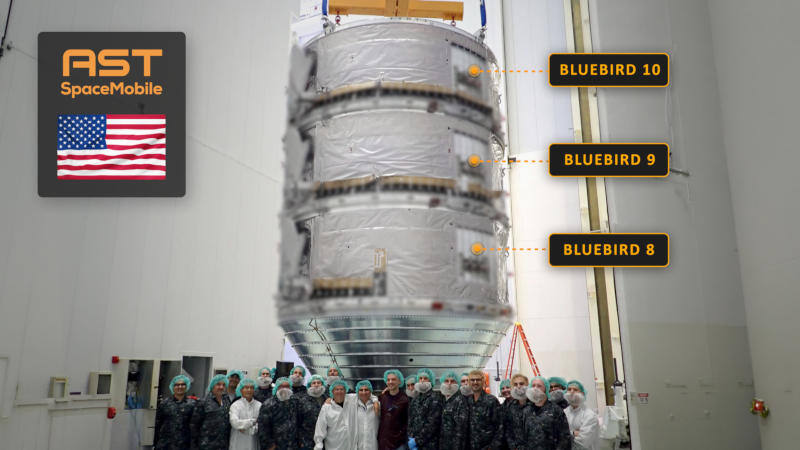
AST SpaceMobile says its next big push to bring mobile broadband straight to ordinary phones will lift off on 17 June 2026, when a SpaceX Falcon 9 launches BlueBird 8, 9, and 10 from Cape Canaveral. The mission is meant to add three more satellites to a network that promises voice, video, and data without special handsets – a tidy idea, and a brutally hard one to execute at scale.
The company is leaning hard into a model that looks increasingly familiar in space: build more capability in-house, launch as often as you can, and let rivals chase the same direct-to-device prize. That race is no longer theoretical, with Starlink and Lynk Global also pushing similar services and the pressure now shifting from demos to actual coverage.
BlueBird 8, 9 and 10 to launch on Falcon 9
The launch will carry the latest BlueBird satellites, which use a new modular AST SpaceMobile architecture and advanced carbon-composite structures designed to speed up deployment of the constellation. They also keep the company’s very large orbital hardware philosophy intact: like the earlier BlueBird 6, the three new satellites deploy communication antennas of about 223 m², among the largest on a commercial spacecraft.
AST SpaceMobile says the new spacecraft will deliver double the peak performance of its first satellite, BlueBird Block 1. That earlier satellite can provide standard smartphones with downlink speeds of up to 98.9 Mbit/s, which is a strong public benchmark even if real-world service will depend on geography, congestion, and the usual laws of physics that tend to ignore marketing slides.
A network built on carrier deals
The company says it has agreements with almost 60 mobile operators worldwide, covering more than 3 billion subscribers. Those partners include AT&T, Verizon, Vodafone, Rakuten, Google, Bell, Telus, stc Group, and American Tower, giving AST SpaceMobile a distribution base that most satellite startups would happily steal in a week.
AST SpaceMobile also says about 95% of the technologies used in its satellites were developed internally, and that it handles production itself. That kind of vertical control can be expensive, but it also reduces the company’s dependence on outside suppliers at a time when launch access remains the bottleneck.
Why SpaceX is doing most of the lifting
The operator has deals with several launch providers, including Blue Origin, which is developing New Glenn, but for now it is relying mainly on SpaceX and Falcon 9. That is a reminder that even ambitious satellite companies still live or die by launch schedules, and SpaceX remains the easiest way to get hardware into orbit on something approaching a predictable cadence.
The broader fight is moving quickly. Direct-to-phone satellite service is no longer a science project, and AST SpaceMobile’s combination of a 98.9 Mbit/s demo claim, oversized antennas, and a huge carrier roster puts it near the front of the pack. The real test is whether that lead turns into consistent coverage before rivals narrow the gap.