• 3 min read
Abu Dhabi quietly builds an AI-native state
Abu Dhabi runs core public services through the TAMM app, offering “autonomous” government while raising surveillance and governance questions.
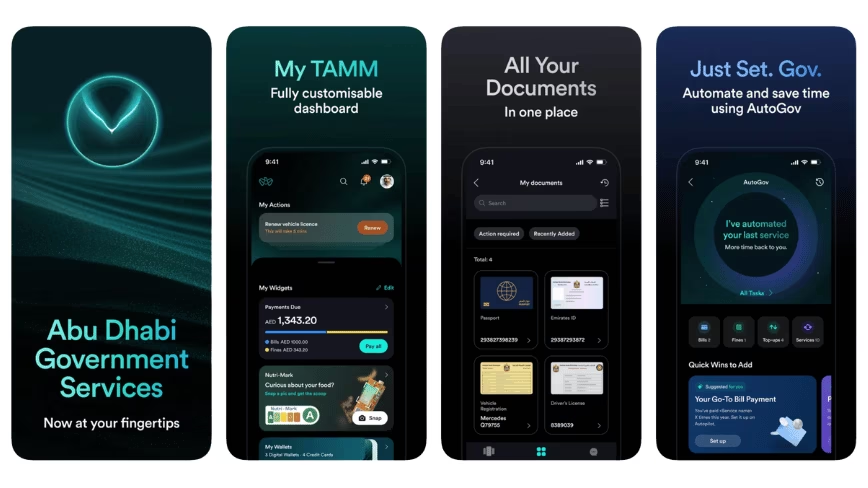
Image: TNW
A government that runs through one app
While the US and Europe argue over how to regulate AI, Abu Dhabi has already wired it into day‑to‑day governance.
In the UAE capital, a single app called TAMM — Arabic for “consider it done” — is the default front door for the state. Through TAMM, residents can renew IDs, book doctor appointments, and pay parking fines, in many cases before they even ask.
Most governments are still drafting their first AI strategy. Abu Dhabi is already running on one.
TAMM and “AutoGov”: services that act first
According to Axios’s Mike Allen, TAMM has near‑universal adoption across the emirate. The app tracks when your national ID, health insurance, or vehicle registration is about to expire.
Its “AutoGov” feature pushes the idea further. It handles the paperwork around those events and pays what you owe automatically, acting on your behalf without a fresh request each time.

Recommended reading
Mira Murati’s lab unveils Inkling, a 975B open model
The system is run by Mohamed Al Askar, director general of TAMM, who describes it as an AI-native government that treats citizens as customers. Snap a photo of a broken streetlight and TAMM routes it to the right department; that department cannot close the ticket until you confirm the fix.
A decade-long AI state-building project
None of this appeared overnight. The UAE named the world’s first AI minister in 2017. Two years later, it opened MBZUAI in Abu Dhabi, which calls itself the first graduate university devoted entirely to AI.
The capital has since poured money into what it casts as sovereign AI, at a scale that few states can match. It is part of a broader push to build a future beyond oil, anchored in data and compute rather than hydrocarbons.
The national strategy sets an explicit target: by 2031, the UAE wants to be a magnet for the world’s AI talent. Consultancy PwC estimates that AI could add $320 billion (roughly €295 billion) to the Middle East economy by 2030.
The control problem democracies can’t import
There is a catch that “does not travel.” Abu Dhabi can rebuild government around AI because an all‑powerful royal family controls both the state and the economy.
As Axios notes, that political structure allows wholesale change no elected government could easily force through. The same centralization that lets TAMM automate bureaucracy also raises harder questions.
An app that acts on your behalf, run by a state that sees every ID renewal and parking fine, is both convenience and surveillance system. The same infrastructure that pays your fine also knows a great deal about you.
Between Washington and Beijing
Abu Dhabi’s AI bet is now entangled with geopolitics and conflict. The war with Iran has rattled the Gulf, but the UAE says it remains all‑in on AI, and plans to work with both the United States and China to get there.
Washington is responding. The Wall Street Journal reported that the Trump administration is widening the UAE’s access to coveted AI chips, a move framed as a reward for Abu Dhabi’s help in the war and the culmination of a yearslong push for US technology.
That leaves Abu Dhabi as a live test case for everyone else. Its AI systems do the paperwork and its agents act autonomously — while the rest of the world asks whether a model built on absolute control can mean anything for governments that answer to voters.

AI Editor
Ava covers the rapidly evolving world of artificial intelligence, from foundational models and research labs to the real-world economics of intelligence. With a background in computational linguistics, she cuts through the hype to find out what actually works. She firmly believes that benchmarks are just marketing until reproduced in the wild.
via TNW