• 3 min read
MIT’s 3D-Printed Bridge Targets 76% Less Concrete
An MIT framework designs printable concrete structures around real printer limits, revealing that thinner beads could cut material use by 76%.
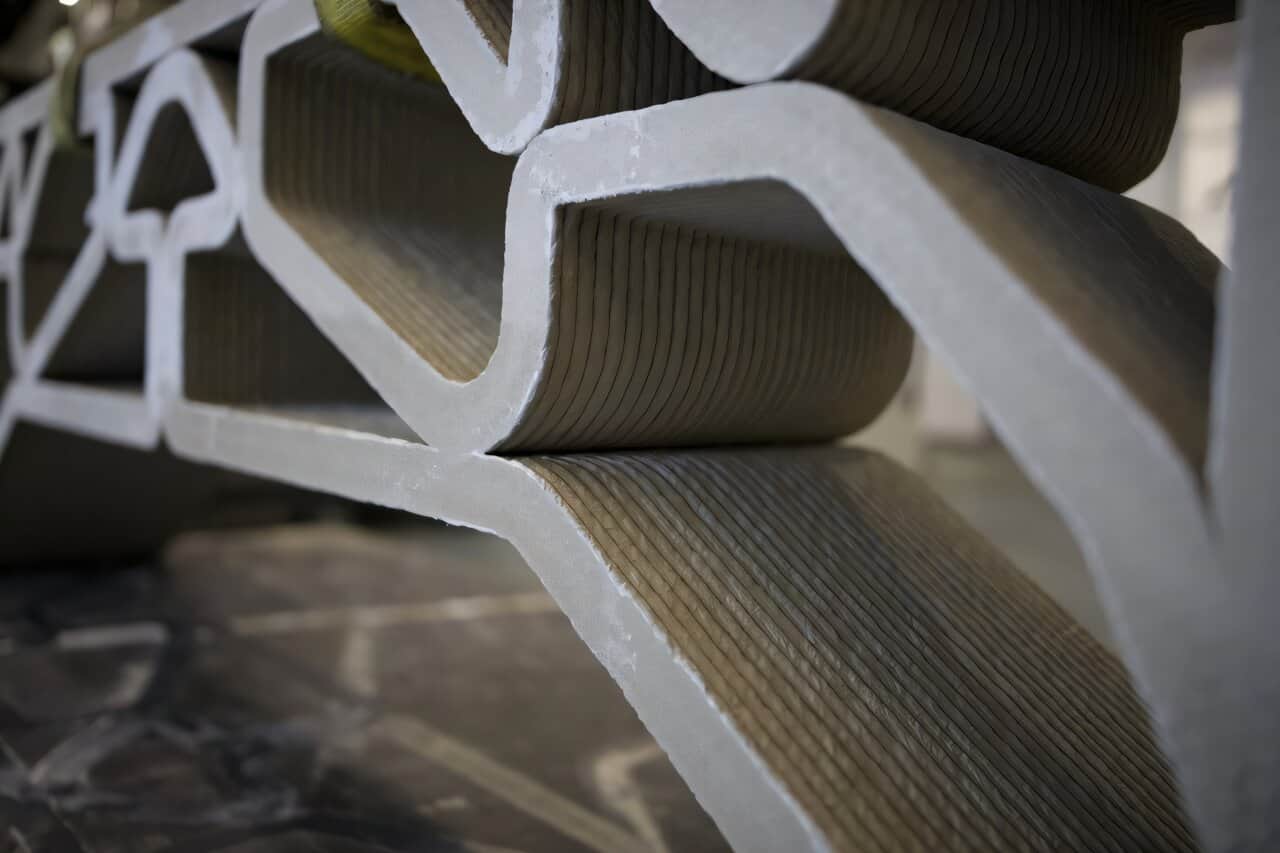
Image: TechXplore
Concrete is the most widely used building material on Earth—and producing it is one of the largest sources of carbon emissions. 3D printing could reduce that footprint by placing concrete only where a structure needs it, while eliminating the labor-intensive formwork used for conventional casting.
The challenge is that computer-generated designs are often impossible for large-scale printers to build. Topology optimization can produce strong, lightweight structures with intricate, spider-web-like geometries, but it does not automatically account for thick nozzles, limited turning angles or the requirement to print in one continuous motion.
A team of MIT researchers has developed a framework that incorporates those fabrication limits directly into the optimization process. The resulting designs require little or no manual redesign. In a demonstration, the team designed, printed and load-tested a 2.3-meter-long (7.5-foot-long) concrete bridge.
“We were finding a lot of cracks you can fall through when it comes to translating these super-optimal designs into manufacturable designs. Those cracks were like chasms.”
Optimizing designs for concrete printers
To identify practical constraints, the researchers worked with operators of large-scale printing machines at Autodesk’s facility in Boston. Their discussions highlighted three restrictions:

Recommended reading
AI browsers want to become your second set of hands
- The required thickness of each extruded concrete bead
- How sharply the nozzle can turn
- The need to print the structure in a single continuous line
The team translated each limitation into mathematical rules. Existing approaches generally optimize a shape first and then require extensive post-processing, a process that can take days. The new framework produced fully printable designs in about two minutes on a laptop.
When the team needed to make the bridge slightly smaller on the day of printing, it reran the optimization and received an updated design 5–10 minutes later. The method uses mixed-integer optimization, which researchers had long considered too computationally difficult for this kind of problem.
“You go back five, 10 years ago, the solver we used, even three years ago, could not solve these problems. This field has been avoided because everyone thinks that’s not an avenue we can go down. But with new algorithms and resources, it’s becoming a way we can start to frame problems.”
A 76% material-saving opportunity
The bridge took about 30 minutes to print using off-the-shelf mortar. Weighing roughly 900 pounds (410 kilograms), it supported more than 2,000 pounds (910 kilograms) of concrete blocks spread across its top with virtually no measurable bending, closely matching the simulations.
The test also showed that current printing equipment—not the concrete’s strength—sets the lower limit for material use. For loads from zero to 200,000 pounds (91,000 kilograms), the design was governed almost entirely by whether the printer could physically build it. Only above that threshold did structural physics become the dominant factor.
The analysis identified bead width as the most influential hardware constraint. The bridge used a 4-centimeter bead, but a printer capable of laying a 1-centimeter bead could reduce material consumption by as much as 76% while remaining well within safety margins, according to senior author Josephine Carstensen.
The structure was designed so every part remained in compression, taking advantage of concrete’s strength under pushing forces and weakness under tension. That design choice also exposed its limits: after testing, the bridge broke when a worker lifted one corner a few inches to sweep underneath it, putting sections into tension.
“It’s optimal in one way, but it’s definitely not optimal in every way.”
The researchers' next step is reinforced concrete, including the challenge of feeding rebar into a printed structure. Carstensen also sees potential for disaster relief, where mold-free printing could enable infrastructure to be built quickly without producing formwork.
The research is reported in Additive Manufacturing: Hajin Kim-Tackowiak et al., “Effect of fabrication restrictions on topology optimized 3D printed concrete structures” (2026), DOI: 10.1016/j.addma.2026.105283.

Computing Editor
Tomas lives in the terminal. He covers chips, laptops, and operating systems with a focus on performance and efficiency. He reads kernel changelogs the way other people read fiction, and he's always on the hunt for the perfect mechanical keyboard switch. If it processes data, Tomas has an opinion on it.
via TechXplore