

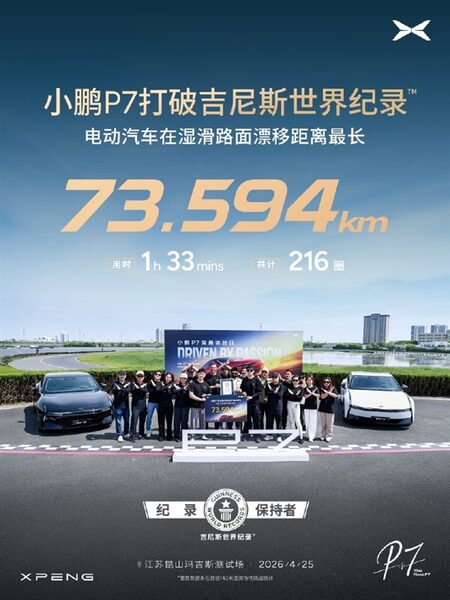
XPeng has turned a party trick into a Guinness World Records entry: the updated P7 completed 73.594 km of continuous drift on a wet surface, staying sideways for 1 hour 33 minutes across 216 laps in Suzhou. That is the sort of headline that sounds absurd until you remember modern EV makers are under pressure to prove their cars can do more than accelerate hard and look tidy in a showroom.
The company says the run took place on a specially prepared wet ceramic surface with a friction coefficient of about 0.3, meant to mimic ice and snow. In other words, this was not a stunt on a closed track for Internet applause alone; it was also a brutal systems test for chassis control, electric power delivery, and stability when grip disappears.
What XPeng actually proved
Drift records are niche, sure, but they are also a neat way to show that software, motors, and traction logic can keep a heavy EV balanced when the laws of physics stop being polite. That matters because Chinese EV brands are now competing not just on range and screens, but on engineering theatre with a point.
- Distance: 73.594 km
- Duration: 1 hour 33 minutes
- Laps: 216
- Surface: wet ceramic with about 0.3 friction coefficient
Why the XPeng P7 record stands out
Guinness records in the auto world are often about spectacle, but they still shape perception. Tesla, BYD, and Xiaomi all lean heavily on performance narratives; XPeng is now trying to claim a lane where high-tech control systems are part of the brand, not an afterthought. Xiaomi founder Lei Jun even chimed in with a public congratulations, which tells you the local EV rivalry is as much social theater as product comparison.
XPeng did not say this record changes the P7’s everyday driving personality, and it shouldn’t. But it does reinforce the broader message: electric cars are increasingly being judged by how intelligently they behave at the edge, not just by how fast they hit 100 km/h or how far they travel on a charge.
The new P7 is also about range, not just smoke
The record arrives soon after XPeng showed the P7+ 2026 model year, offered in both battery-electric and hybrid versions with claimed CLTC range of up to 725 km and 1550 km respectively. That combination of headline-grabbing stunts and long-range claims is deliberate: XPeng wants the P7 family to be seen as both technically ambitious and practical enough for daily use.
The open question is whether this kind of record becomes a one-off bragging right or a repeatable way for EV brands to demonstrate control software under extreme conditions. Given how quickly Chinese carmakers borrow and outdo one another, betting on more unusual Guinness attempts would not be a bad guess.