

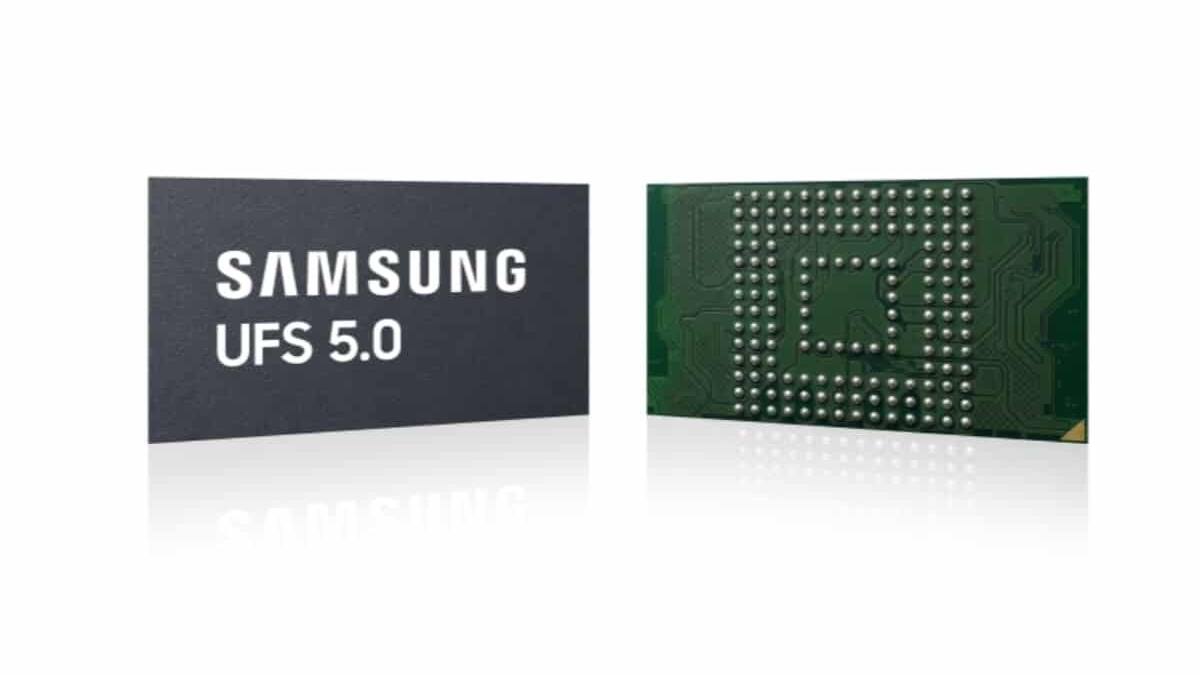
Samsung has announced UFS 5.0, its next-generation embedded storage standard, and the headline is simple enough: it’s built to make future Galaxy phones faster, more efficient, and better at handling on-device AI. The company says the new standard roughly doubles performance versus UFS 4.1, while also cutting power use and shrinking the hardware footprint.
That matters because storage is one of the quiet bottlenecks in modern smartphones. It doesn’t get the fanfare of a new camera sensor or chipset, but it affects app launches, file transfers, and how quickly large language models can respond without leaning on the cloud. Samsung is clearly aiming this at the next wave of Galaxy devices, where speed alone is no longer the pitch; speed per watt is the real flex.
UFS 5.0 specs and performance
Samsung says UFS 5.0 is based on JEDEC’s latest embedded storage interface specification and delivers sequential read speeds of up to 10.8GB/s, plus sequential write speeds of up to 9.8GB/s. The company also claims more than 40% better power efficiency than UFS 4.1, along with a 16.7% smaller overall size.
- Sequential read speed: up to 10.8GB/s
- Sequential write speed: up to 9.8GB/s
- Power efficiency: more than 40% better than UFS 4.1
- Size: 16.7% smaller
- Capacity: up to 1TB
Why the AI angle is doing the heavy lifting
The AI pitch is the interesting part here. Samsung says the faster storage should reduce latency and improve response times for on-device LLMs, which is exactly the kind of claim phone makers are leaning on as they try to make AI features feel local instead of remote. Competitors are headed the same way: Apple has been pushing more processing on-device, while Android rivals from Qualcomm to Google are trying to make memory and storage less of a drag on inference.
Mass production of UFS 5.0 is scheduled to begin in the fourth quarter of this year. That timing suggests the standard is being readied for premium phones rather than mainstream handsets first, which is usually how these things go: the expensive models get the shiny parts, everyone else waits politely.
What future Galaxy phones could gain
For buyers, the payoff should show up in the dull-but-important stuff: quicker app installs, faster photo and video handling, and less waiting around when a device is juggling AI tasks in the background. UFS 5.0’s 1TB ceiling also leaves plenty of room for the kind of large media libraries and offline AI models vendors now love to brag about.
The open question is how quickly Samsung will ship the standard in actual consumer phones. Announcements are nice; shipping is nicer. If UFS 5.0 appears first in the most expensive Galaxy models, expect every other Android flagship maker to answer with its own ”fastest ever” slide deck soon after.