• 3 min read
Ex-OpenAI team unveils Inkling with 975B parameters
Thinking Machines Lab has launched its first major open-weight model, Inkling, a 975B-parameter MoE system tied to its Tinker enterprise platform.
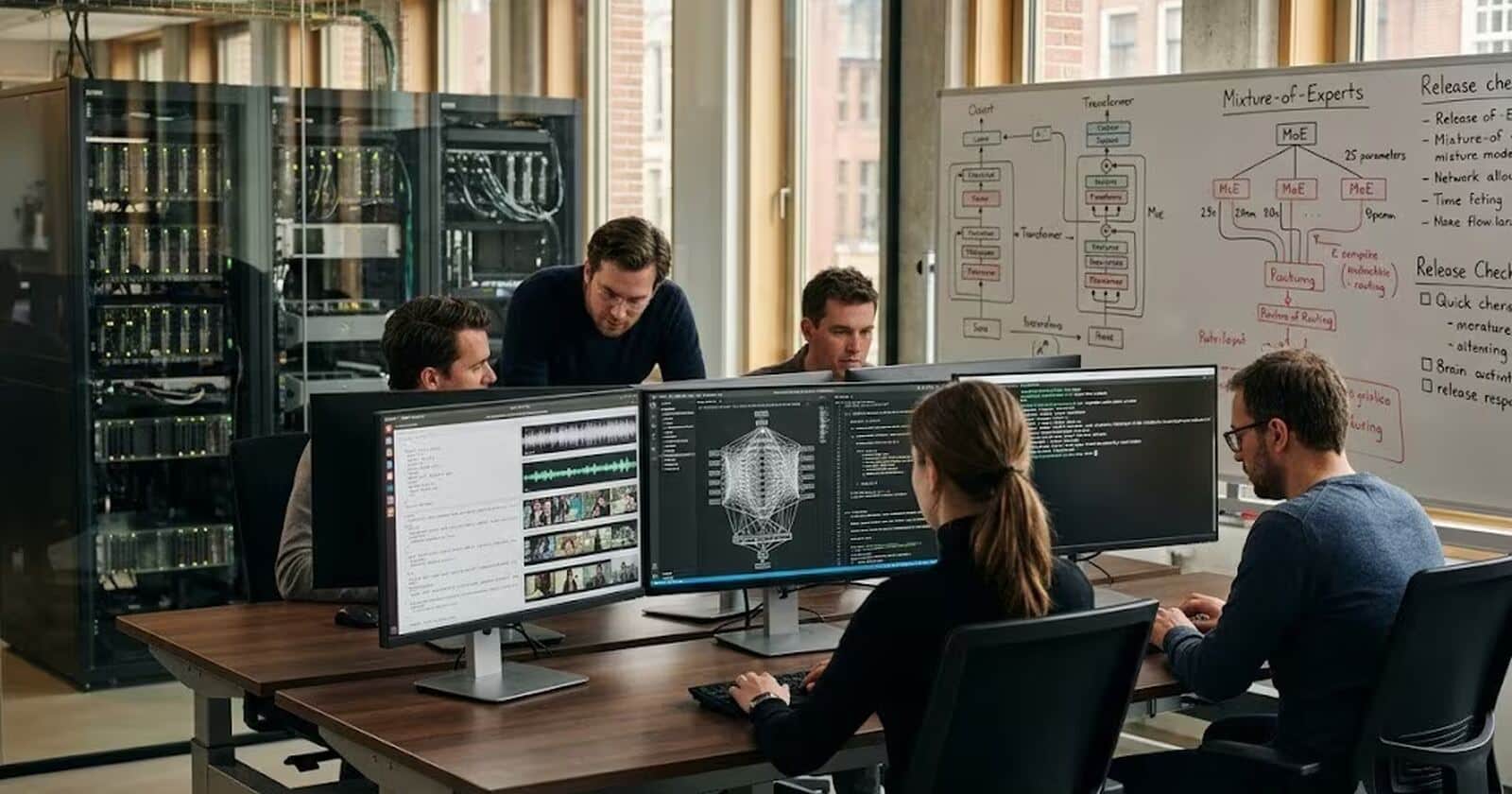
Image: ITzine
Thinking Machines Lab, the startup led by former OpenAI CTO and interim CEO Mira Murati, has unveiled its first large model: Inkling. The company is taking an explicitly practical approach from the start. The model’s weights are open, so customers can download it, run it on their own infrastructure, and fine-tune it on their own data.
Inkling uses a Mixture of Experts architecture with 975 billion parameters in total, though only about 41 billion are activated per request. That setup has become common in large models because it helps preserve quality without sending inference costs soaring. The source notes that DeepSeek-V3 also uses MoE, while Meta has been focusing newer Llama generations on cheaper inference as businesses pay close attention to operating costs.
The model supports a context window of up to 1 million tokens. From scratch, it was trained to handle not just text but also audio and video, with developers separately highlighting coding and logical reasoning. Alongside the flagship release, the company also introduced Inkling-Small, a lighter version with 12 billion active parameters, positioned as faster and cheaper to run.
Rather than chasing the top line on benchmarks, Thinking Machines Lab says its bet is on customization. To support that, it has tied Inkling to its own Tinker platform, which lets companies fine-tune the model on internal data and deploy it within their own infrastructure. With data storage and compliance rules tightening in Europe and the US, that is increasingly a mainstream enterprise requirement rather than an enthusiast niche.

Recommended reading
Hack points to Suno scraping 2 million songs
One of the more notable details emerged during training. According to the developers, Inkling at one point stopped producing intermediate reasoning in natural language on its own, effectively deciding that doing so was a waste of compute. The feature was later restored because users and customers still want to see how the model reached an answer, even in simplified form.
Funding, rivals, and the enterprise push
Thinking Machines Lab was founded only in February 2025, but it has already become one of the most highly valued new AI startups. Its leadership includes Mira Murati, OpenAI co-founder John Schulman, and former OpenAI VP of safety research and robotics Lilian Weng. At the seed stage, the startup raised $2 billion at a $12 billion valuation.
Before Inkling, the company had shown Tinker, a voice system for interacting with AI, and several research papers, but it did not yet have a full model on the market. With Inkling, it moves into a segment already occupied by DeepSeek, Alibaba with Qwen, Meta with Llama, and Mistral.
The broader trend is also clear: more developers are trying to sell open or semi-open models that companies can control themselves, rather than only closed APIs. According to Menlo Ventures, enterprise spending on generative AI in 2025 exceeded $13 billion, with a notable share going to custom deployments.
That gives Thinking Machines Lab a distinct position. While OpenAI and Anthropic primarily monetize closed services, the new startup is trying to sit between the base model and enterprise customization. In that market, raw model strength is only part of the equation. Fine-tuning workflows, data control, and predictable inference costs matter just as much.
The Inkling training story also feeds into a broader debate over interpretability. In 2025 and 2026, researchers at Anthropic, OpenAI, and Google repeatedly showed that visible chain-of-thought answers do not always match a model’s real internal process. Inkling does not overturn that debate, but it reinforces a point the industry is still grappling with: transparency has to be designed separately, and sometimes added back by hand.

AI Editor
Ava covers the rapidly evolving world of artificial intelligence, from foundational models and research labs to the real-world economics of intelligence. With a background in computational linguistics, she cuts through the hype to find out what actually works. She firmly believes that benchmarks are just marketing until reproduced in the wild.
via ITzine