

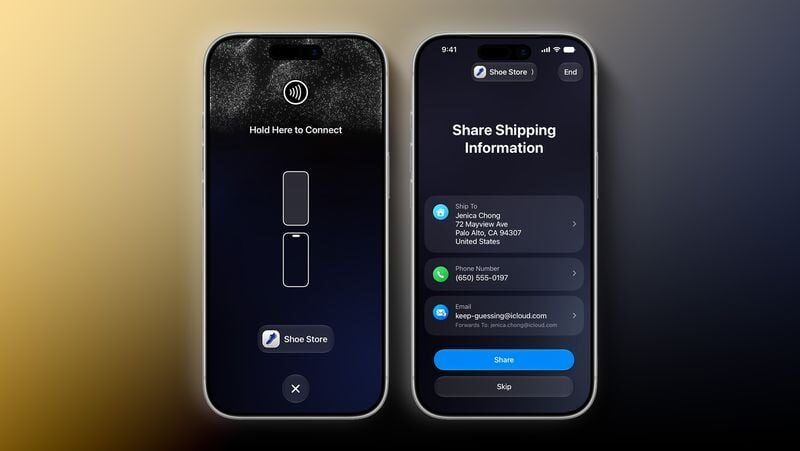
Apple is adding a new NFC handoff trick to the iPhone with iOS 27. Called Tap to Share, it lets merchants use their phone to pull customer details, passes, and payments from a nearby iPhone during an active Tap to Pay session – a small but useful upgrade for tiny businesses that would rather not buy more hardware than necessary.
The feature sits on top of Tap to Pay on iPhone, which already lets sellers accept contactless payments without a separate POS terminal. In practice, that means a customer can tap an iPhone, Apple Watch, contactless card, or another supported payment method against the merchant’s iPhone, and the transaction goes through over NFC the same way Apple Pay does. Apple is quietly turning the iPhone into a checkout counter, membership desk, and receipt kiosk all at once.
What Tap to Share does
During an active Tap to Pay session in iOS 27, shoppers can share contact information for loyalty sign-ups, enter a delivery address or email for receipts, add or share Apple Wallet passes, review the basket, and finish the purchase with Apple Pay. That is a sensible expansion: the less a cashier has to type, the fewer chances there are for bad data and awkward back-and-forth.
- Requires iPhone 12 or later
- Works through NFC
- Built on Tap to Pay on iPhone
- Not available in the European Economic Area
Where Apple is drawing the line
The hardware requirement is straightforward: iPhone 12 or newer. The geographical restriction is less charming. Tap to Share is currently unavailable in the European Economic Area, which includes all EU countries plus Iceland, Liechtenstein, and Norway. Apple has a habit of rolling useful features out unevenly, and merchants outside its favored launch zones usually end up watching from the sidelines first.
Apple is also chasing a familiar direction in mobile payments. Square, Stripe, and a growing crop of payment firms have spent years pushing phones into the role of card readers, and Apple’s advantage is obvious: it already owns the wallet, the device, and the checkout flow. The company’s bet is that bundling all of that into one seamless motion will be enough to make small-business owners care more about convenience than about the missing plastic terminal.
AirDrop looks faster in iOS 27
There is another small iOS 27 wrinkle here: early tests reportedly found AirDrop running much faster in real-world use than in iOS 26. Apple has not exactly been shy about using connectivity as a quiet selling point, and better local transfer speed pairs nicely with a checkout feature that depends on fast device-to-device handoff. The more friction Apple removes between two phones, the more sticky its payment ecosystem becomes.
The open question is whether Tap to Share stays a niche convenience for markets, pop-ups, and small shops, or becomes the default way Apple wants merchants to capture customer data on the spot. If the rollout is broad enough, traditional card readers may start to look a lot more old-fashioned than they already do.