

Why rural schools are getting Starlink first
Paraguay is following a pattern Starlink has repeated in other hard-to-reach places: schools and clinics go first because they are easy to justify politically and hard to wire traditionally. Kenya and Bolivia have already seen similar deployments, which suggests SpaceX is turning rural connectivity into a global sales pitch as much as a public-service project.
That also exposes the gap between satellite internet hype and practical deployment. The hardware is only part of the story; the win comes from pairing it with government services that actually use the bandwidth instead of letting it sit there like a very expensive roof ornament.
What the new Starlink network changes on the ground
For the communities involved, the immediate gains are straightforward: online learning, access to social programmes, and better links to healthcare infrastructure. Paraguay’s president, Santiago Pena, framed the rollout as a step toward development and a narrower digital divide, which is the polite way of saying the country is trying to skip the painful, expensive business of laying fiber through nowhere.
The real test is whether the deployment reaches the end of 2026 on schedule and whether those 500 points stay funded, maintained, and actually used. Starlink has already shown it can connect the unconnected; the bigger question is how many governments will keep paying to make that connectivity stick.
Why rural schools are getting Starlink first
Paraguay is following a pattern Starlink has repeated in other hard-to-reach places: schools and clinics go first because they are easy to justify politically and hard to wire traditionally. Kenya and Bolivia have already seen similar deployments, which suggests SpaceX is turning rural connectivity into a global sales pitch as much as a public-service project.
That also exposes the gap between satellite internet hype and practical deployment. The hardware is only part of the story; the win comes from pairing it with government services that actually use the bandwidth instead of letting it sit there like a very expensive roof ornament.
What the new Starlink network changes on the ground
For the communities involved, the immediate gains are straightforward: online learning, access to social programmes, and better links to healthcare infrastructure. Paraguay’s president, Santiago Pena, framed the rollout as a step toward development and a narrower digital divide, which is the polite way of saying the country is trying to skip the painful, expensive business of laying fiber through nowhere.
The real test is whether the deployment reaches the end of 2026 on schedule and whether those 500 points stay funded, maintained, and actually used. Starlink has already shown it can connect the unconnected; the bigger question is how many governments will keep paying to make that connectivity stick.
- Service partner: SpaceX, Paraguay’s government and COPACO
- Initial rollout: 18 access points active in Chaco
- Planned total: up to 500 points by the end of 2026
- Reported speeds: up to 280 Mbit/s, with around 200 Mbit/s guaranteed minimum
Why rural schools are getting Starlink first
Paraguay is following a pattern Starlink has repeated in other hard-to-reach places: schools and clinics go first because they are easy to justify politically and hard to wire traditionally. Kenya and Bolivia have already seen similar deployments, which suggests SpaceX is turning rural connectivity into a global sales pitch as much as a public-service project.
That also exposes the gap between satellite internet hype and practical deployment. The hardware is only part of the story; the win comes from pairing it with government services that actually use the bandwidth instead of letting it sit there like a very expensive roof ornament.
What the new Starlink network changes on the ground
For the communities involved, the immediate gains are straightforward: online learning, access to social programmes, and better links to healthcare infrastructure. Paraguay’s president, Santiago Pena, framed the rollout as a step toward development and a narrower digital divide, which is the polite way of saying the country is trying to skip the painful, expensive business of laying fiber through nowhere.
The real test is whether the deployment reaches the end of 2026 on schedule and whether those 500 points stay funded, maintained, and actually used. Starlink has already shown it can connect the unconnected; the bigger question is how many governments will keep paying to make that connectivity stick.
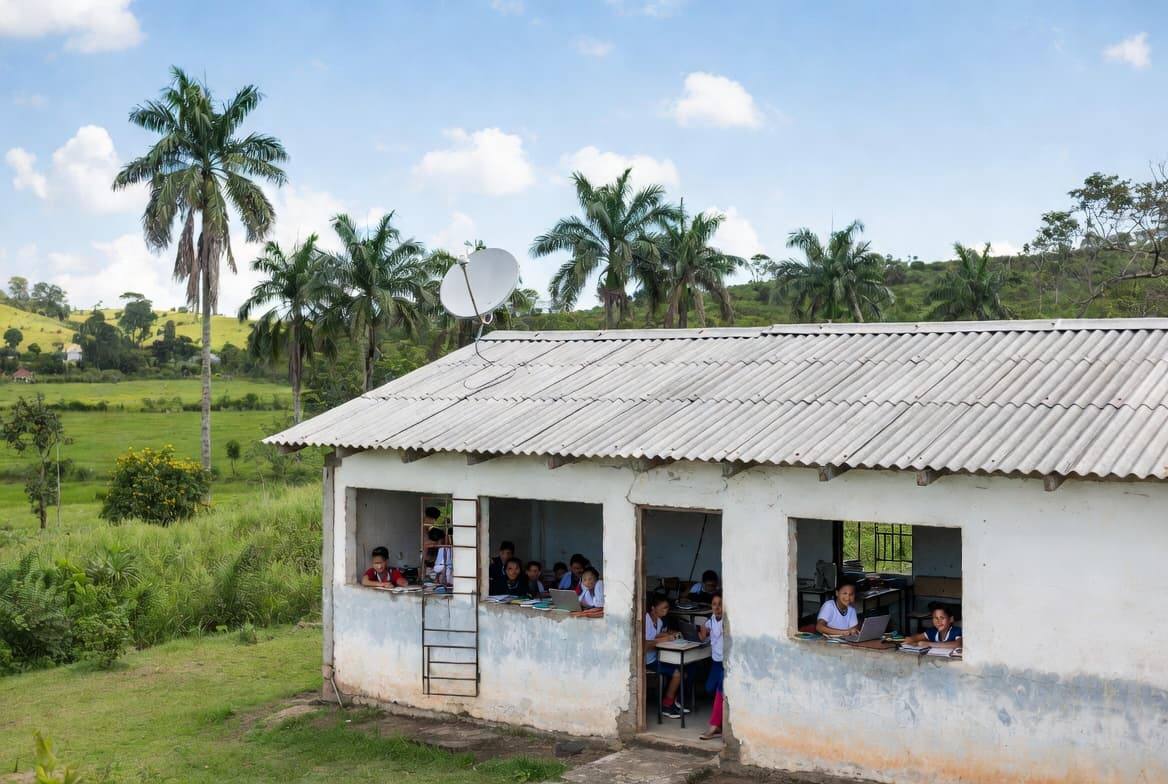
SpaceX is rolling out Starlink across hundreds of schools and health centres in Paraguay, bringing reliable internet to areas that have largely lived off the grid. The first wave is already live in the Chaco region, where the service is being installed with the government and state operator COPACO, and some schools are seeing speeds of up to 280 Mbit/s.
The Paraguay Starlink rollout is modest by urban standards and transformative by rural ones. For many of these communities, especially indigenous schools, this is the first real shot at stable connectivity, which means digital classes, access to public services, and a far better chance of keeping clinics plugged into national systems instead of operating as islands.
500 Starlink access points across remote Paraguay
The project calls for as many as 500 access points in remote districts where dependable internet was previously missing altogether. By the beginning of 2026, 18 had already gone live in Chaco, covering the departments of Presidente Hayes and Boquerón.
- Service partner: SpaceX, Paraguay’s government and COPACO
- Initial rollout: 18 access points active in Chaco
- Planned total: up to 500 points by the end of 2026
- Reported speeds: up to 280 Mbit/s, with around 200 Mbit/s guaranteed minimum
Why rural schools are getting Starlink first
Paraguay is following a pattern Starlink has repeated in other hard-to-reach places: schools and clinics go first because they are easy to justify politically and hard to wire traditionally. Kenya and Bolivia have already seen similar deployments, which suggests SpaceX is turning rural connectivity into a global sales pitch as much as a public-service project.
That also exposes the gap between satellite internet hype and practical deployment. The hardware is only part of the story; the win comes from pairing it with government services that actually use the bandwidth instead of letting it sit there like a very expensive roof ornament.
What the new Starlink network changes on the ground
For the communities involved, the immediate gains are straightforward: online learning, access to social programmes, and better links to healthcare infrastructure. Paraguay’s president, Santiago Pena, framed the rollout as a step toward development and a narrower digital divide, which is the polite way of saying the country is trying to skip the painful, expensive business of laying fiber through nowhere.
The real test is whether the deployment reaches the end of 2026 on schedule and whether those 500 points stay funded, maintained, and actually used. Starlink has already shown it can connect the unconnected; the bigger question is how many governments will keep paying to make that connectivity stick.