

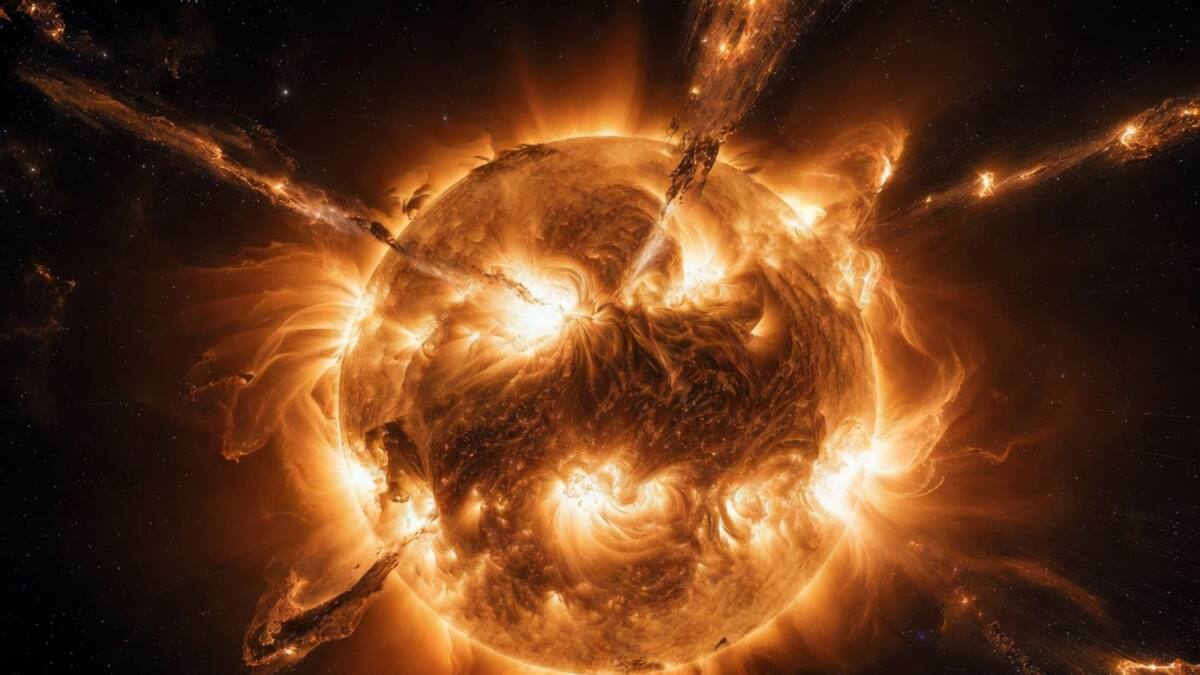
The Sun has just reminded everyone that ”quiet” is a temporary setting. Over the weekend, coronagraphs picked up several powerful eruptions and plasma outflows on the far side of the star, pointing to a fresh uptick in solar activity after roughly 2-3 weeks of relative calm.
The sources appear to be newly formed sunspot groups not yet added to catalogs, along with region 4436, which has suddenly come back to life. Some of those spots are already rotating toward the Earth-facing side, but so far they are not producing flares there, which is a relief for anyone hoping to keep satellites, radio links, and geomagnetic headlines boring for a while.
What the coronagraphs picked up
Solar Orbiter had earlier seen signs that these structures were breaking apart quickly, so one plausible explanation is that weakened fragments are now drifting into view. That would fit the current reading: more disturbance, but not yet a polished flare factory.
There is still a lot of motion in the solar plasma, though, and that means caution beats certainty. The Sun can turn a sleepy patch into a problem child faster than forecasters would like, which is why observers are watching these regions as they cross into view.
Flare odds stay low for now
- Estimated chance of top-class flares: 5-10%
- Current assessment: low for this phase of the solar cycle
- Immediate threat to Earth: none observed
That is a lower-stress forecast than earlier ones, which had looked more tense. For now, the laboratory tracking the Sun says the situation is under close observation, and the bigger question is whether these far-side eruptions are a brief flare-up or the first sign that the star is waking up again.