

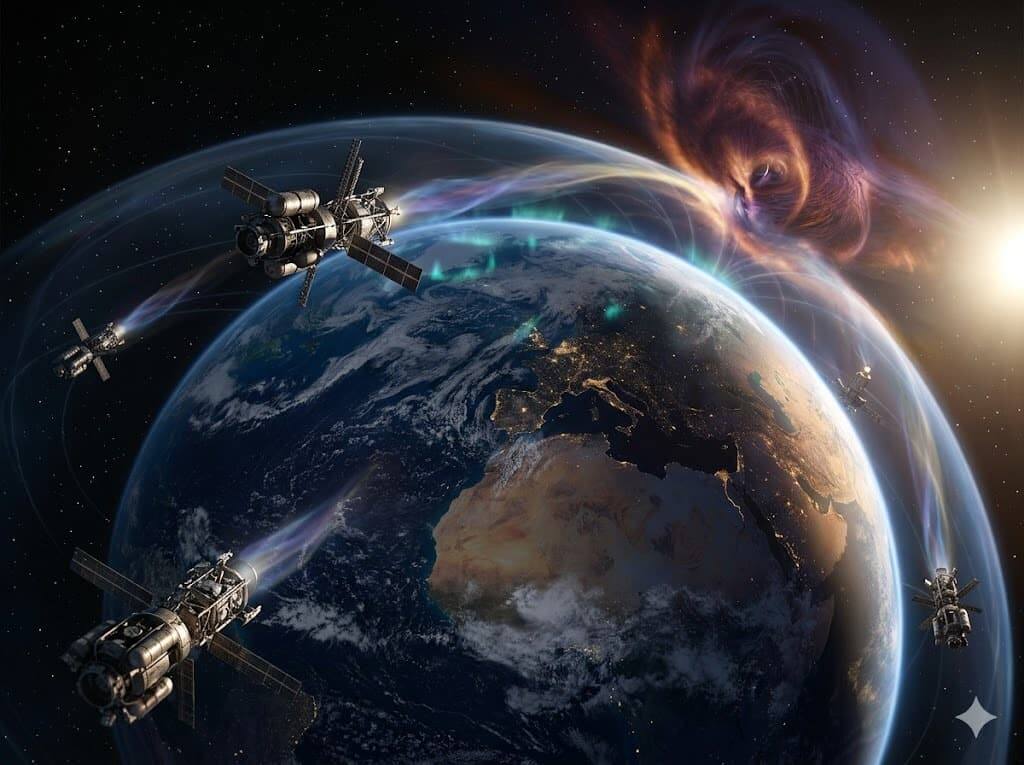
Scientists in Boston have floated a very large answer to a very old problem: if Earth’s magnetic field cannot fully shrug off an extreme solar storm, why not give it temporary backup in space? Their proposed system, StormWall, would use a cloud of plasma near the edge of the magnetosphere to weaken the blow from powerful coronal mass ejections, and their modelling says it could cut the impact of the strongest geomagnetic storms roughly in half.
The idea is part emergency planning, part engineering flex. Solar storms can knock out radio links, satellites, and power grids; the May 2024 event reportedly caused GPS failures in farm equipment across the US and cost farmers about $500 million. Researchers say a once-in-a-century storm could be vastly more expensive, with more than $2.4 trillion in grid damage on the line. That is the sort of number that tends to make ”impossible” projects sound a lot more reasonable.
How StormWall would work
The proposal calls for six spacecraft in geostationary orbit, each releasing ionizable material such as barium or lithium toward the magnetosphere. Sunlight would strip electrons from the atoms, creating plasma that temporarily boosts the magnetic shield and interrupts the energy transfer from the storm to Earth. According to the researchers, the released material would not fall back into the atmosphere and would clear naturally in about six hours.
That short lifespan is also the catch. If the goal is sustained protection rather than a one-off demo, StormWall would need repeat missions, which is where the economics start to bite. The team estimates the payload would be equivalent to about twelve tanker trucks of material, enough to require six launches of SpaceX’s Starship. SpaceX has not officially confirmed that kind of delivery capability to geostationary orbit, so the launch plan is still more aspiration than timetable.
Starship launch capacity for geostationary orbit
That dependence on Starship is doing a lot of heavy lifting in this concept. If the rocket cannot yet do the job as advertised, then the whole project shifts from ”space weather defense” to ”very expensive physics experiment.” The researchers do suggest cost-cutting alternatives, including using a transfer orbit and releasing the material more slowly to stretch the system’s operating time.
For now, StormWall stays firmly in the theoretical bucket, but the premise points to a bigger shift in thinking: space weather is starting to look less like a natural hazard we simply endure and more like one we may eventually engineer around. The unanswered question is whether the first serious attempt will be a scaled-down test, a military-style contingency system, or another paper that makes launch providers sweat and plasma physicists grin.