

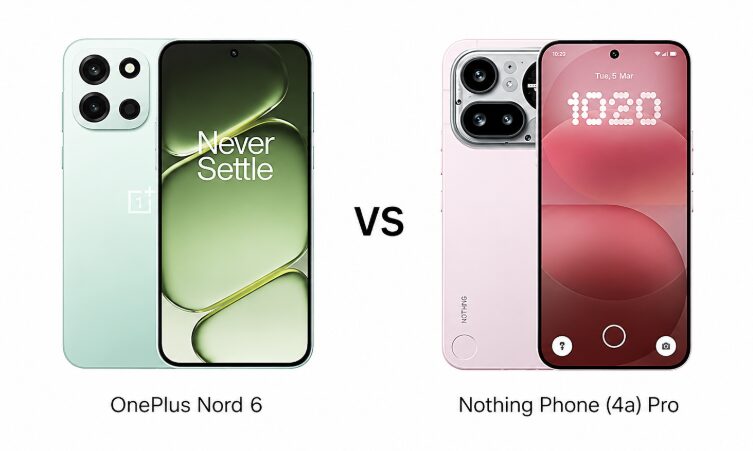
The OnePlus Nord 6 and Nothing Phone (4a) Pro are chasing the same buyer, but they take very different routes to get there: OnePlus leans hard into raw hardware, while Nothing spends more of its budget on design flair and camera flexibility. If you’re comparing the OnePlus Nord 6 vs Nothing Phone (4a) Pro, the short answer is that OnePlus wins on performance, battery, and charging, while Nothing wins on design and zoom camera versatility.
If you want the short version, the Nord 6 is the bruiser, and the Nothing phone is the showpiece. One looks built to survive rough treatment, the other looks built to be admired on a desk – and, yes, both expect you to notice that.
Durability and display are split between toughness and polish
OnePlus gives the Nord 6 a glass front, plastic frame, and plastic back, but backs that modest construction with IP68/IP69K protection, MIL-STD-810H certification, Mohs level 8 screen protection, and an IR blaster. That is an aggressively practical spec sheet, the kind that hints at fewer cracked screens and more living-with-it confidence.
Nothing goes the other way with an aircraft-grade aluminum unibody, aluminum rear panel, Gorilla Glass 7i protection, and its Glyph lighting system with 137 individually addressable LEDs. On paper, both phones use AMOLED panels with HDR10+ support, but the Nord 6 pushes a 165Hz refresh rate and higher PWM dimming, while the Phone (4a) Pro answers with slimmer bezels and a 5,000-nit peak brightness.
Snapdragon 8s Gen 4 gives the Nord 6 the performance lead
This is where the gap gets ugly for Nothing. The Nord 6 runs on the Snapdragon 8s Gen 4 with UFS 4.1 storage, alongside Wi-Fi 7 and Bluetooth 6.0, so it is the more convincing pick for gaming, heavy multitasking, and longer-term headroom.
The Phone (4a) Pro uses the Snapdragon 7 Gen 4 and UFS 3.1 storage. That is still perfectly fine for everyday use, and Nothing OS 4.1 should keep things feeling tidy, but it does not change the basic math: OnePlus has more muscle, and it shows up everywhere that speed matters.
- OnePlus Nord 6: Snapdragon 8s Gen 4, UFS 4.1, Wi-Fi 7, Bluetooth 6.0
- Nothing Phone (4a) Pro: Snapdragon 7 Gen 4, UFS 3.1
Battery capacity is where Nothing starts to look underfed
The Nord 6 also wins the endurance fight by a wide margin. Its global version carries a 7,500mAh battery, while the India model stretches to 9,000mAh, both paired with 80W charging and bypass charging support. That is the sort of battery setup that makes many rivals look a bit embarrassed.
The Phone (4a) Pro offers 5,080mAh globally and 5,400mAh in India, with 50W charging. Reasonable? Absolutely. Competitive against OnePlus here? Not really.
The camera fight is closer than the spec gap suggests
Nothing claws back ground with a more versatile rear camera setup. The Phone (4a) Pro pairs its 50MP main sensor with a 50MP periscope telephoto camera with 3.5x optical zoom and OIS, plus an 8MP ultrawide lens. That telephoto module is the difference between a basic phone camera and one that can actually stretch for portraits and distant subjects.
The Nord 6 keeps things simpler with a 50MP main camera with OIS and an 8MP ultrawide. It should be dependable, but it is not trying to win a spec-sheet beauty contest. For selfies, though, OnePlus has a neat edge: both phones use 32MP front cameras, but the Nord 6 adds autofocus and 4K video recording, while the Nothing phone tops out at 1080p.
- Nord 6 rear cameras: 50MP main with OIS, 8MP ultrawide
- Phone (4a) Pro rear cameras: 50MP main, 50MP periscope telephoto with 3.5x optical zoom and OIS, 8MP ultrawide
- Front cameras: 32MP on both; Nord 6 adds autofocus and 4K selfie video
OnePlus Nord 6 vs Nothing Phone (4a) Pro price
The pricing leaves very little room for polite excuses. The OnePlus Nord 6 is priced around $460 or ₹39,000, while the Nothing Phone (4a) Pro sits around $500 or ₹40,000. That is close enough to force buyers to ask what they value more: brute-force hardware or personality with a better zoom camera.
For raw value, OnePlus has the cleaner argument. It gives you a flagship-class chipset, larger batteries, faster charging, faster storage, and stronger durability for slightly less money. Nothing’s case is less about numbers and more about taste: premium materials, the Glyph interface, and a design that refuses to blend in.
The more interesting question is whether buyers will keep rewarding phones that look different if they have to compromise on battery size and performance. My bet: the Nord 6 will be the safer choice for most people, but the Phone (4a) Pro will still pull in anyone who wants their phone to feel a little less anonymous.