

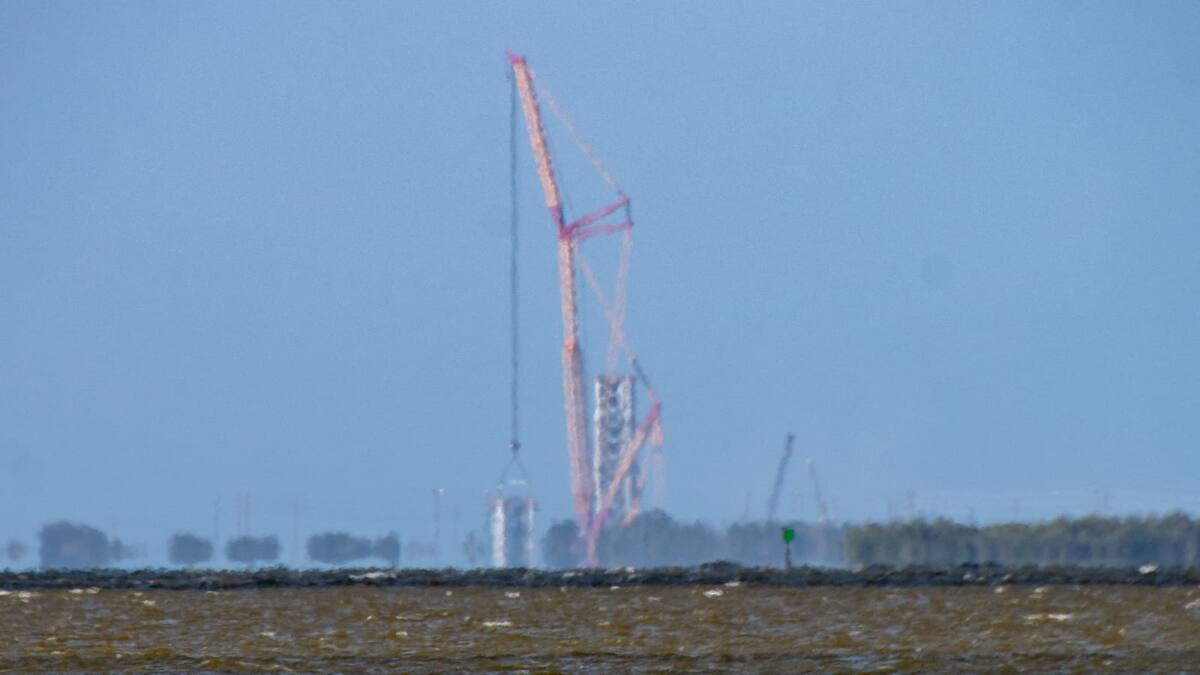
Two of the most important launch sites on Florida’s Space Coast are being rebuilt at the same time, and the contrast is hard to miss. At SpaceX’s Complex 37A, workers are preparing to lift the fourth section of Starship’s launch tower, while Blue Origin is tearing into LC-36 to rework the pad for New Glenn after the rocket’s troubles in May 2026.
The race is no longer just about rockets. It is also about ground infrastructure, where tower sections, cranes, and assembly buildings can decide how fast a vehicle gets back on the pad. SpaceX is leaning into its giant Mechazilla stack-up, while Blue Origin is taking the slower but more flexible route of reshaping its launch flow.
Mechazilla rises at Complex 37A
New photos show SpaceX preparing to install the next module of the Starship launch tower at Cape Canaveral. Earlier images also caught delivery of the ”chopsticks” that will be mounted on the tower to catch both the Super Heavy booster and the Starship upper stage. That is the whole point of Mechazilla: fewer fixed service structures, more theatrical hardware, and a launch system that looks like it was designed by someone who really likes giant cranes.
The tower work is being handled with the Liebherr LR 13000, the German crawler crane billed as the most powerful in the world, with a lifting capacity of up to 3,000 tons. For SpaceX, that kind of muscle is not a luxury; it is the only practical way to build a tower this size on a tight pad footprint.
Blue Origin clears LC-36 for New Glenn operations
Across the spaceport, Blue Origin has started preparing to remove the first section of its existing tower at LC-36. That is the opening move in a wider rebuild tied to a new servicing layout for New Glenn, alongside construction of a new Vertical Refurbishment Facility, or VRF, for vertical work on the rocket.
Blue Origin has also said it will use a temporary integration process: the first and second stages of New Glenn will be joined horizontally, lifted upright by crane on the pad, and then the payload will be integrated vertically. It is a more cumbersome setup than SpaceX’s all-in-one tower approach, but it should help the company get back to flight faster after the May 2026 fire during static-fire testing.
What the two rebuilds say about reuse
Both companies are chasing the same prize: faster reuse. SpaceX is building a tower that can catch and service its rockets with minimal handoffs, while Blue Origin is redesigning the pad so New Glenn can move through assembly and refurbishment with less friction. Different architecture, same obsession: turn launch infrastructure into part of the vehicle, not a fixed obstacle.
The next obvious question is which approach ages better. SpaceX is betting that a highly integrated launch tower can scale with Starship’s ambitions, while Blue Origin is choosing a more modular path that may be easier to operate, even if it looks less elegant on paper.