

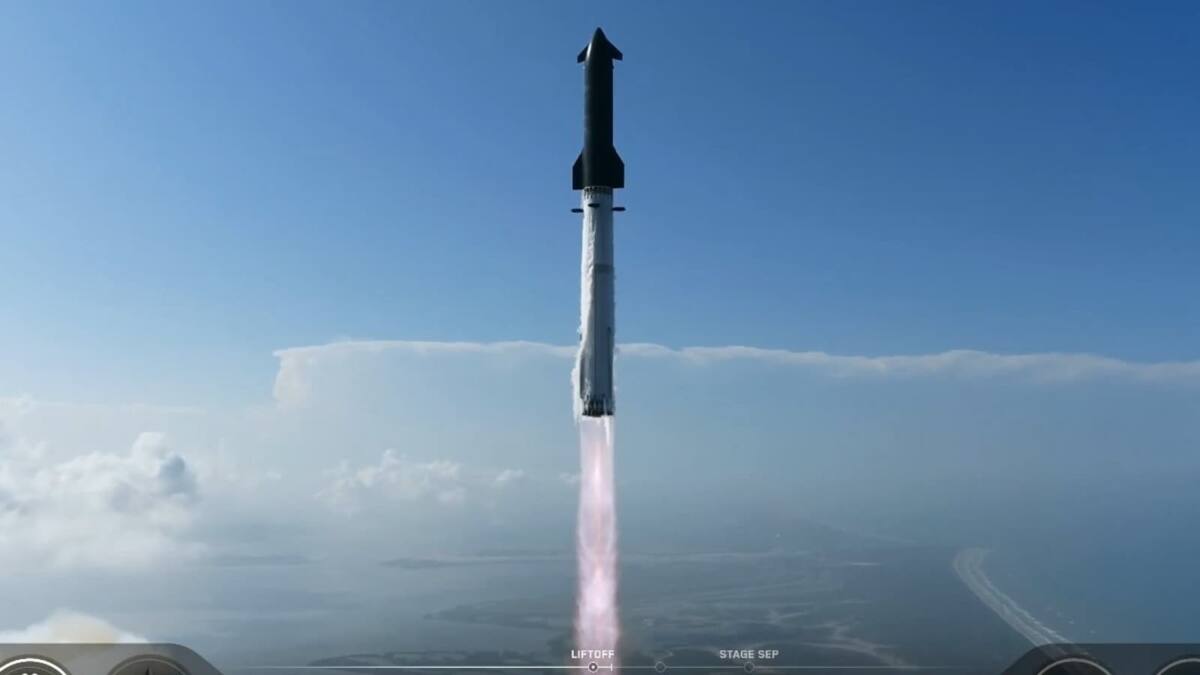
SpaceX’s Starship has just hauled about 45 tons of Starlink mass simulators into orbit, setting a new benchmark in the 12th test flight and posting the heaviest single-launch payload to space since 1973. The headline is not just the number. It is the direction of travel: Starship is turning from a spectacle into a system that can move serious mass, and that is the whole point of building a giant reusable rocket in the first place.
The record sits in an awkwardly specific place in space history. Saturn V still owns the bigger one-shot class with the Skylab mission at 77 tons, but SpaceX is chasing a different prize: a fully reusable stack that can make heavyweight launches cheaper, not merely larger. That is the part established rockets cannot easily copy without a painful redesign.
Starship’s 45-ton orbital haul
The payload on this flight was not a batch of live satellites. SpaceX used mass simulators for Starlink, which is a standard way to prove performance before sending up expensive hardware. Even so, 45 tons is a serious number, and it hints at how quickly the vehicle is moving toward operational usefulness rather than endless prototype theater.
According to information shared by the Truthful account and reposted by Elon Musk, the milestone marks an important step for reusable space transport. That claim is hard to argue with, even if SpaceX’s habit of celebrating tests before the system is fully mature can sometimes feel a bit like applauding a marathon runner at mile five.
How Starship compares with Falcon Heavy
SpaceX’s own workhorse, Falcon Heavy, is still a useful reference point. It can lift up to 63.8 tons to low Earth orbit if the boosters are not recovered, or up to 26.7 tons to geostationary transfer orbit. Starship’s edge is not just raw lift capacity; it is the promise that every part of the system can be reused, which is where the economics start to change.
- Starship: about 45 tons on this flight
- Falcon Heavy: up to 63.8 tons to low Earth orbit without recovery
- Falcon Heavy: up to 26.7 tons to geostationary transfer orbit
- Saturn V with Skylab: 77 tons
Starlink simulators point to real satellite launches
SpaceX has already used Starship to deploy all 20 Starlink mass simulators and two modified Starlink satellites designed for imaging. That progression matters more than the fanfare around a record because it suggests the next flights may carry actual payloads, not just placeholders. If that happens, SpaceX will be closer to the part everyone cares about: launching more satellites faster and making the network build-out less dependent on Falcon 9-era logistics.
The open question is whether Starship can keep this pace without trading away reliability. Heavy lift is impressive; repeatable heavy lift is the real business. SpaceX has already shown the first half.