

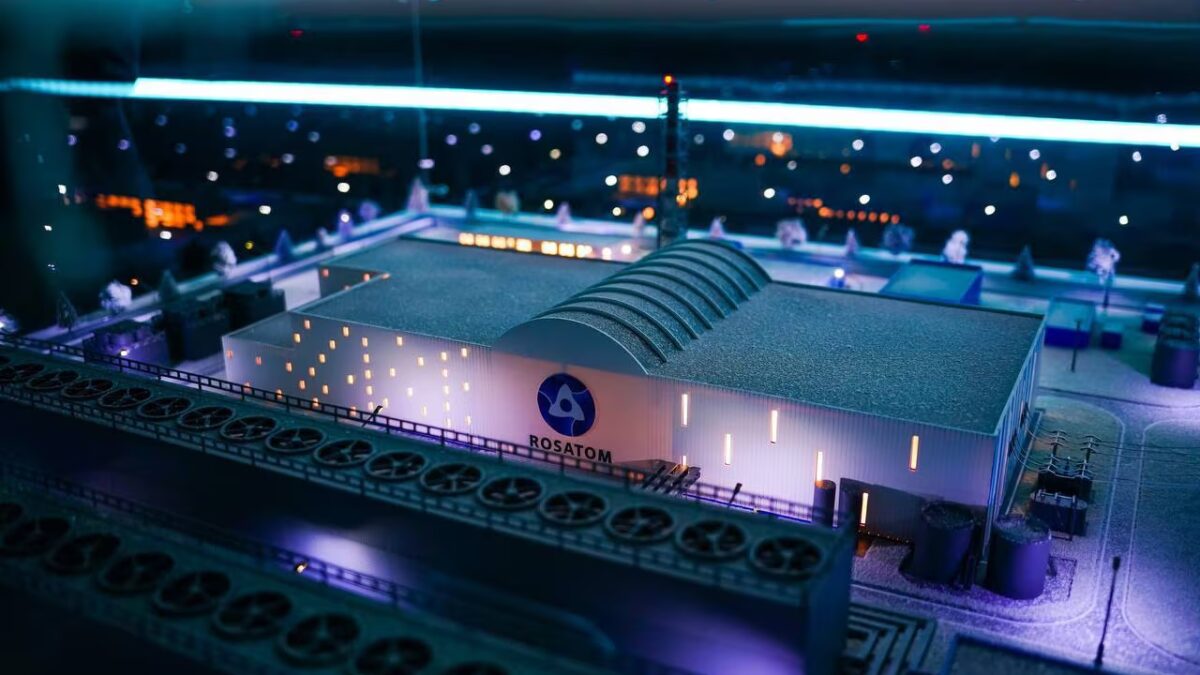
Russia’s state nuclear giant Rosatom is developing around 10 small-scale reactor projects while pushing ahead with its mini nuclear power plant plans, CEO Alexey Likhachev revealed. The company’s most mature design is the RITM family of reactors, which have been used in icebreakers, but it’s also developing even smaller units – including the ”Shelf-M,” aimed at supplying remote areas like Chukotka.
So far, Rosatom has built 13 RITM reactors for its icebreaker fleet. Another one has been assembled for the first floating power unit at the Baimsky mining site, with a second nearing completion. Since June, Rosatom has started constructing a small nuclear power plant in Uzbekistan, also using two reactors from the RITM lineup. Altogether, four small nuclear reactors are currently under production at Russian facilities.
On a separate track, Rosatom is advancing ultra-small reactors. The ”Shelf-M” is a flagship project designed to power the Elkon mining and metallurgical complex in Chukotka’s Arctic region. It promises a 60-year lifespan, with an electrical output of up to 10 MW and a thermal output of 35 MW. The project already has a construction schedule, site engineering surveys underway, fuel testing completed, and an investment case nearly finalized.
Rosatom’s RITM reactors and small modular reactor development
Small modular reactors (SMRs) are a growing trend beyond Russia. China is developing the ACP100 ”Linglong One,” while in the US, NuScale recently completed its first major project in Utah after a lengthy certification process, despite rising costs. Rosatom holds a notable advantage thanks to its proven technology: its floating nuclear plant, the Akademik Lomonosov, has been powering the port town of Pevek in the Russian Arctic since 2020. This operational experience boosts Rosatom’s credibility for exporting turnkey small reactors rather than just conceptual designs.
Global small reactor initiatives and Rosatom’s export potential
The International Atomic Energy Agency (IAEA) tracks dozens of small reactor initiatives worldwide, but few have transitioned to serial production. For Rosatom, the next two to three years are critical. Successful completion of the Uzbekistan plant and Baimsky mining power units would firmly place Russia among the limited number of countries capable of delivering small nuclear plants beyond the drawing board.