

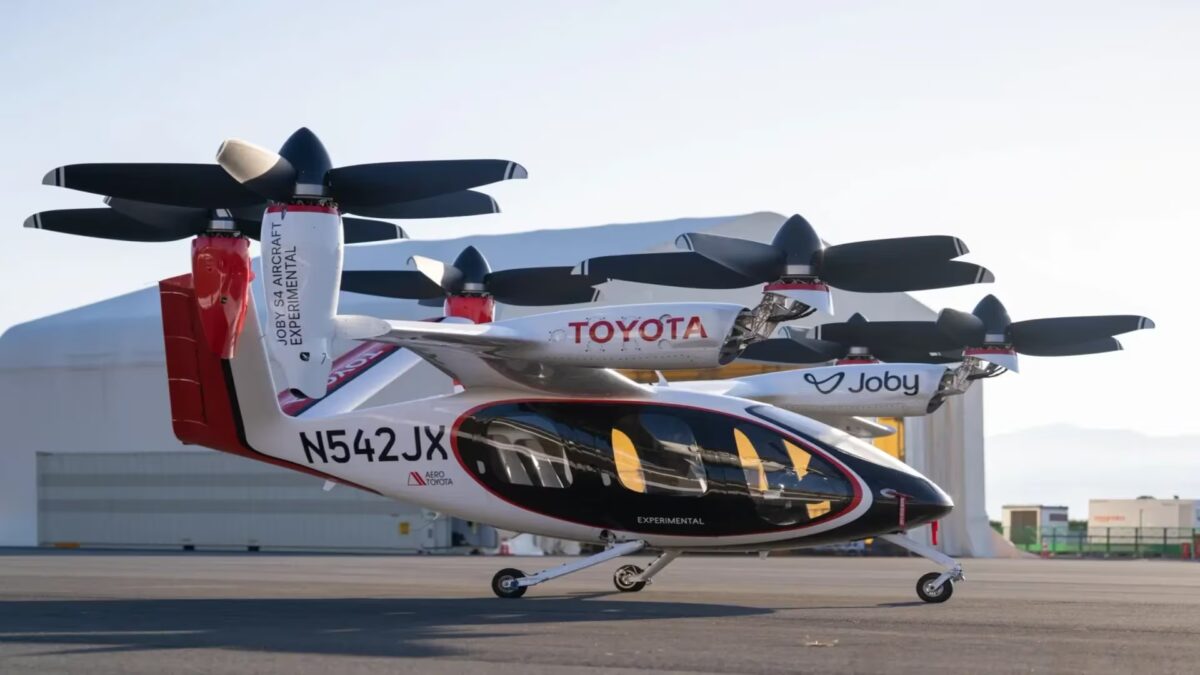
Toyota is teaming up with Joby Aviation to take electric air taxis from prototypes to production lines. This partnership isn’t just about flashy demos anymore – Toyota will help Joby build scalable manufacturing, tighten assembly processes, and cut costs to make eVTOL aircraft viable for urban transportation.
For Toyota, this marks an entry into a new mobility segment that’s still more hype than business. For Joby, it’s a chance to gain what most startups lack: disciplined factory know-how and mass production experience. In aviation, this expertise is just as critical as batteries and software.
Toyota’s role centers on applying its renowned production system-from process optimization to quality control-enabling Joby to switch from hand-built prototypes to serial manufacturing. Their internal jargon highlights automotive staples like standardization, cost reduction, consistent quality, and readying assembly lines for commercial scale.
Joby’s fully electric aircraft features vertical takeoff and landing (eVTOL) designed for short-distance urban and suburban routes. Beyond building aircraft, Joby aims to launch its own air taxi service and sell these vehicles to other operators. The logic is clear: if the eVTOL market takes off, money flows not only to service providers but also to the manufacturers supplying the flying taxis.
Toyota isn’t just dabbling. Chairman Akio Toyoda has repeatedly stated that mobility extends beyond roads. His company is exploring new transport forms where its automotive expertise might deliver an edge. Here, Toyota isn’t making an airplane from scratch – it’s transplanting its high-volume manufacturing culture into an industry still struggling to industrialize.
Toyota and Joby’s decade-long electric air taxi partnership
Toyota and Joby have collaborated for nearly ten years. Throughout this time, Toyota has helped refine Joby’s production system, introducing lean manufacturing principles, streamlining assembly, and boosting quality control. Now, they are entering the toughest phase: transforming a promising technology into a product that can be made regularly and in meaningful volume.
Toyota’s interest is both engineering and financial. By 2025, the automaker’s total investment in Joby is expected to approach $900 million, counting all funding rounds. This is one of the boldest bets by a traditional car manufacturer on the fledgling airborne mobility sector, where most players are still stuck in perpetual ”test flight” mode.
The eVTOL race has already expanded beyond startups. Archer Aviation is building a similar business backed by automaker Stellantis, while Hyundai is developing its Supernal air taxi project. But the industry has also faced harsh realities: certification hurdles, battery tech, infrastructure, and flight economics are proving far tougher than any pitch deck or demo.
This is why Toyota’s manufacturing muscle is so valuable. Launching a flying prototype is one thing; producing dozens or hundreds of reliable, safe, and maintainable aircraft on schedule and at scale is another. Automakers excel at this kind of operational discipline far more than most aviation startups – even if they can’t fast-track regulators overnight.
Neither partner has disclosed specific timelines. Yet Joby’s next milestones are clear: certification, commercial launch, and proving that eVTOL is practical urban transport, not just a showcase attraction. If Toyota succeeds in streamlining production, Joby will gain a serious edge over rivals still struggling to move beyond experimental assembly to true manufacturing lines.
This collaboration also serves as a test for the wider air taxi industry. Experts expect early commercial eVTOL services to start on limited routes like airport shuttles and central business districts. Beyond certification, the aircraft’s cost will be a major barrier. The Joby-Toyota partnership looks pragmatic: without driving down unit costs, air taxis risk remaining expensive tech demos instead of evolving into everyday urban transit options.