

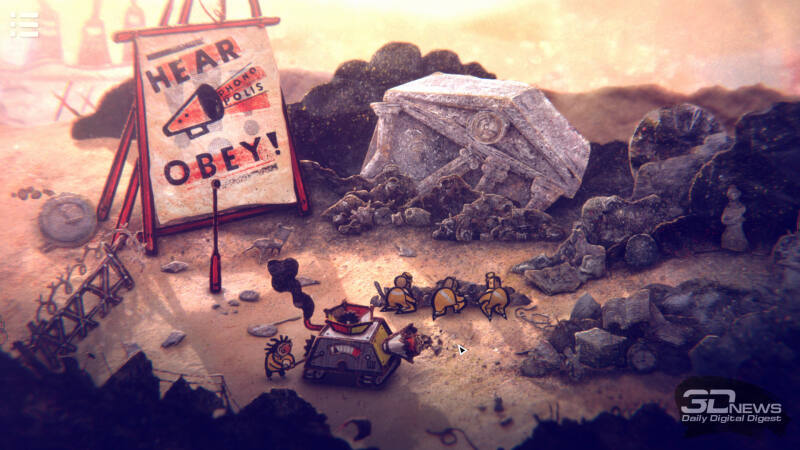
Phonopolis looks like a lost stop-motion treasure from Amanita Design, but the finished game is less enchanting than its art direction suggests. The cardboard city, the hand-built props, and the familiar musical touch are all here; the problem is that the story leans hard on obvious dystopian clichés, and the puzzles never quite rise to match the look of the thing.
That imbalance is the real story. For a studio with a reputation built on wordless charm and visual inventiveness, this is a rare case where the production values do most of the heavy lifting while the design underneath feels stretched thin.
A cardboard city with a very familiar tyrant
The setup is straightforward: a city ruled by a Leader who blares orders through loudspeakers, where ordinary workers are expected to obey, recycle, and keep their heads down. Felix, the protagonist, spends his days doing repetitive labour until a detour into an old opera house gives him a pair of headphones that effectively shut the regime out.
There is a perfectly workable anti-authoritarian idea buried in there, but Phonopolis mostly settles for the most recognizable signposts of the genre. Posters, police, slogans, dissidents, and crude satire all show up on cue, and the result feels less like an allegory than a checklist.
Amanita Design’s visuals still do the talking
Where the game earns its keep is in the craft. The team built locations out of cardboard, glue, and other physical materials, scanned them, and turned them into 3D spaces, which gives Phonopolis a handmade texture that few games can fake. That process also helps explain why development stretched for so long; this is the kind of labor-intensive production that has become rarer as even artful indie games chase speed over tactile charm.
The audio side is similarly dependable, with Tomáš Dvořák delivering a soundtrack that fits Amanita’s house style. The surprise is that this is also the studio’s first fully voiced game, and the extra dialogue rarely adds much beyond stating what the player can already see. Sometimes silence would have done the job better.
Phonopolis puzzles and playtime
Phonopolis is a short adventure, around 3 hours long, but it still finds room for repetition. A recurring mini-game appears more than once and wears out its welcome quickly, even though the game’s best moments come from poking at the cardboard environment itself and uncovering mechanisms hidden in plain sight.
- Genre: adventure
- Release date: 20 May 2026
- Platforms: PC
- Age rating: 10+
- Estimated playtime: 3 hours
When those puzzles work, they feel like opening a pop-up book and discovering a tiny machine inside. When they do not, the logic gets fuzzy and success can feel more like luck than insight, which is not the vibe you want from a game built around interaction and discovery.
Phonopolis has charm, but not much bite
The comparison with Machinarium and Samorost is unavoidable, and Phonopolis comes off second best. Those earlier Amanita games were playful, strange, and a little mysterious; this one is louder about its message and less sure about how to vary it. The upside is obvious: the world is beautiful enough that you keep looking. The downside is that beauty alone cannot carry a game forever, especially one so eager to tell you exactly what it thinks.
So the open question is not whether Amanita can still make striking games – it clearly can – but whether it can pair that visual artistry with sharper design next time. If it does, the studio may have something special again. If not, expect more lovely cardboard and more mixed results.