

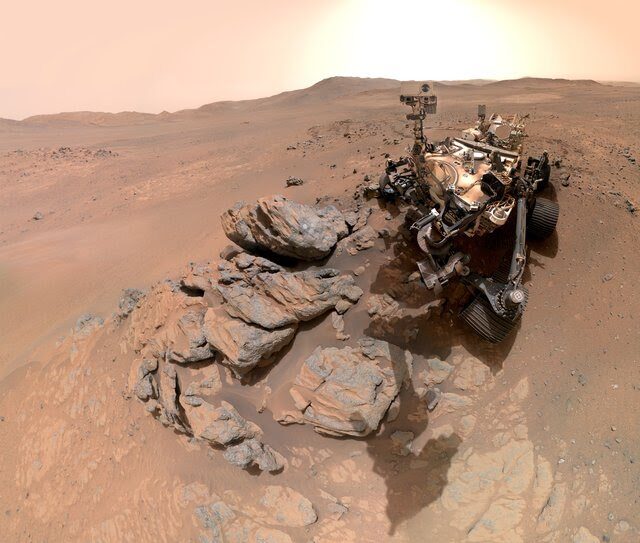
NASA’s Perseverance rover has snapped a new self-portrait from one of the most scientifically interesting corners of Jezero crater, and the timing is hard to miss: after more than five years on Mars, the robot is nearly at marathon distance and apparently still has enough energy for an ”ultramarathon.” The Perseverance Mars marathon milestone comes as the selfie, stitched from 61 frames, was taken on 11 March 2026 while the rover worked in the west of the crater, a stretch NASA says holds some of the oldest rocks the mission has found so far.
The rover is operating in a region the science team calls Lac de Charmes, where it has been studying volcanic outcrops that likely formed before Jezero itself. That matters because older rocks are the best shot at reconstructing Mars before the lake-filled crater era, and the mission has now moved beyond the easy headline phase of ”it found a rock” into the slower, nerdier business of sorting the planet’s deep history.
Lac de Charmes is becoming the main event
Perseverance took the selfie at its ”Wild West” location outside Jezero, the farthest west it has traveled since landing in the crater just over five years ago. NASA says the rover is on its fifth science campaign, and the current stop includes the Arethusa site, where researchers found magmatic minerals that may predate the impact that formed Jezero about 3.9 billion years ago.
That is the kind of geology planetary scientists love and everyone else politely pretends to understand. If the rocks really are that old, they offer a rare window into Mars before the crater was carved out, which is also why this part of the mission feels more like geological detective work than rover tourism.
What the latest Perseverance Mars marathon images show
Perseverance also used its Mastcam-Z camera to build a 46-frame panorama of the Arbot area in Lac de Charmes. NASA says the scene includes a mix of geological structures, possibly including megabreccias: large fragments blasted loose by a violent impact about 3.9 billion years ago.

Ken Farley, the mission’s deputy science lead at Caltech, said the pictures likely show the oldest rocks the team will examine during Perseverance’s mission. That is a tall claim, but Mars keeps making it easy to sound dramatic when every exposed layer is basically a page from a very old book.
A rover that has nearly run a marathon
In more human terms, Perseverance has now covered almost 26 miles, or 42 kilometers, on the Martian surface. That is basically marathon territory, and the mission team is leaning into the metaphor for good reason: slow, durable exploration is exactly how you get the best science out of a place as unforgiving as Mars.
Steve Lee, acting project manager for Perseverance, said the rover is a little dusty but in good shape and already looking ahead to an ”ultramarathon.” The next question is whether the mission can keep finding terrain this old and this revealing before the rover itself becomes the limiting factor.