

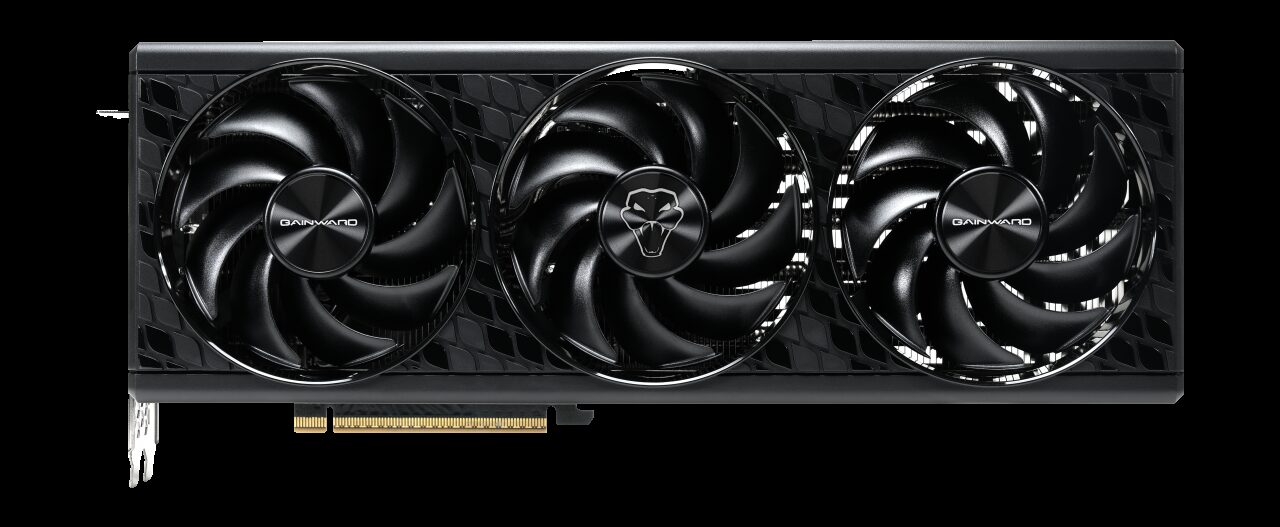
Gainward has joined Palit in giving the GeForce RTX 5080 a stealth makeover: the new Python III cards are fully black, come in both factory-overclocked and standard versions, and keep the same 332 mm footprint and roughly three-slot thickness as their sibling designs. The pitch is simple enough – same GPU, cleaner look, less visual chaos inside your case – which is exactly the kind of industrial-design flex graphics card makers lean on when the silicon itself is already spoken for.
Gainward says the finish is meant to look professional and not draw attention away from the rest of the build. The textured shroud is also described as resembling python scales, which explains the name without requiring a marketing translator. It is cosmetic branding, yes, but in a market where board partners are fighting for differentiation with cooler shells and paint jobs, cosmetics are often the only place left to be interesting.
GeForce RTX 5080 Python III specs and boost clocks
Both Python III variants are technically the same cards apart from clock speed. The factory-overclocked model boosts to 2,625 MHz, while the standard version runs at 2,617 MHz. That is a tiny gap, which means buyers are mainly choosing between a mild out-of-box overclock and the standard version.
- GPU: GeForce RTX 5080
- Series: Gainward Python III
- Length: 332 mm
- Thickness: about three expansion slots
- Boost clock: 2,625 MHz or 2,617 MHz
Why Gainward is selling a black RTX 5080
This is the familiar board-partner playbook: reuse the underlying card, change the styling, and hope black-on-black sells better than yet another silver-and-RGB slab. For builders who want a muted system rather than a glowing aquarium, Python III lands in the right place. For everyone else, the silicon story is unchanged – and that is probably the point.
The bigger question is whether more GPU vendors will keep leaning into restrained designs as premium cases and cleaner builds stay popular. If the rest of the industry follows the same script, the loudest thing about next-gen graphics cards may end up being how quiet they look.