

A new astronomy algorithm called YOSO is trying to do something observatories have struggled with for years: find tiny moving objects without grinding through mountains of image combinations. Built by an interdisciplinary team working at the intersection of astrophysics and machine learning, the method is designed to speed up the asteroid search for faint asteroids and distant trans-Neptunian objects while cutting the computing cost that slows older search pipelines.
Instead of stacking images by testing thousands of possible motion paths, YOSO tracks how brightness changes in each pixel over time and turns a series of exposures into a single processed frame in one pass. That makes it a cleaner fit for the data firehose coming from next-generation surveys, and it also fits a broader trend in astronomy: less brute force, more pattern recognition.
How YOSO turns motion into a visible track
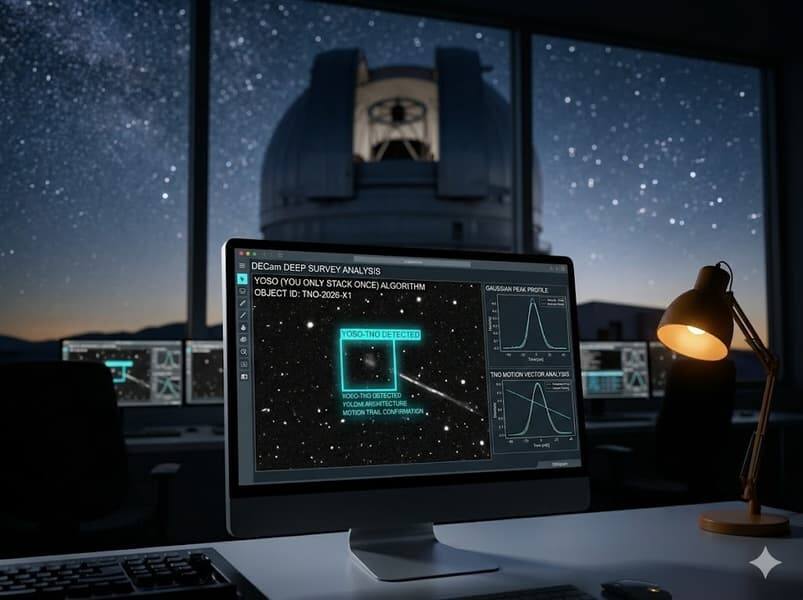
The method uses a Gaussian Motion Filter, or GMoF, to model the way a dim object brightens and fades as it crosses a telescope’s field of view. The resulting signal forms a bell-shaped curve, and the filter converts that motion into a sharp visual trail on the final image. In practice, that is the kind of trick that saves astronomers from staring at noise and cosmic-ray streaks until their eyes glaze over.
For detection, the team paired the filter with YOLOv8-L, a larger version of the well-known deep learning architecture. The model was trained on 16,000 images containing both artifacts such as cosmic rays, glints, and satellite trails, and synthetic objects with brightness from 19 to 27 magnitude.
Results from DEEP data and the false-alarm filter
The real test came on data from the DEEP project, which used the 4-meter Victor Blanco telescope in Chile. Even as a validation run, YOSO found 11 new trans-Neptunian objects and 216 other moving bodies inside the Solar System, including one fairly bright target at magnitude 21.49 that older algorithms had missed because of a difficult background.
After the software flags a candidate, it runs an automatic check to weed out random noise. The researchers set strict criteria, including nearly zero ellipticity for the source, and say the final catalog reaches 99% purity. That matters because false positives are the tax every survey pays; the smarter the filter, the less human time gets burned on junk.
Why Rubin and NEO Surveyor make this more than a lab demo
The timing is not accidental. The Vera Rubin Observatory is about to start generating data volumes that old-school search methods are unlikely to handle gracefully, and systems like YOSO are being pitched as real-time triage for that flood. The same logic extends to space missions such as NEO Surveyor, where sending one processed frame instead of hundreds of raw images would reduce bandwidth pressure and speed up alerts about potentially dangerous asteroids.
There is also a useful historical echo here. Astronomy has long depended on labor-intensive pipelines to tease out faint moving targets, but the balance is shifting toward automated recognition that can generalize across surveys, missions, and even other fields. The developers say the framework could also be adapted for exoplanet searches and plasma physics, which sounds ambitious, but so did machine vision in astronomy before it started finding real objects.
The open question now is how well YOSO performs as the data gets messier and the cadence gets faster. If it scales the way its early results suggest, the next wave of sky surveys may spend a lot less time asking computers to guess every possible motion path and a lot more time asking them to spot the faint line that actually matters.