

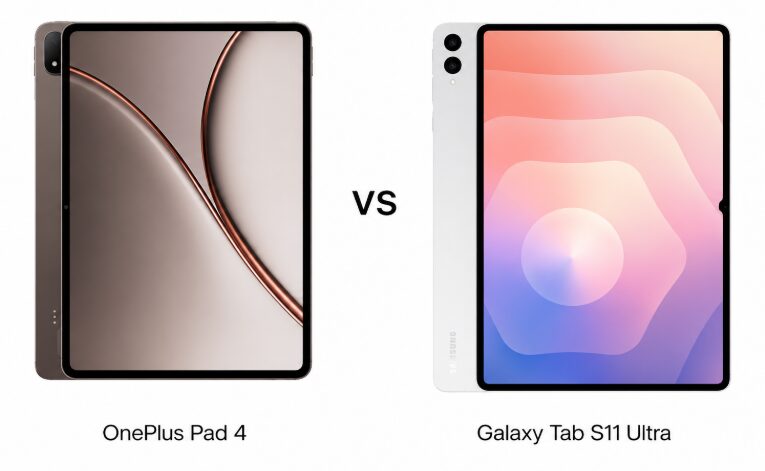
Samsung’s Galaxy Tab S11 Ultra is the shiny one in this OnePlus Pad 4 vs Galaxy Tab S11 Ultra matchup, but the OnePlus Pad 4 is the one doing the awkward math at the checkout counter. One tablet leans on a giant AMOLED screen, DeX, IP68 protection, and ecosystem polish; the other answers with a faster-sounding chipset, a bigger battery, quicker charging, and a price that undercuts Samsung by a lot.
That split is becoming familiar across premium Android tablets. The best hardware no longer automatically wins the argument, because buyers now have to decide whether display quality and desktop-style software are worth paying almost twice as much for a slate that sits between a laptop and a phone.
Display and build take different routes
The OnePlus Pad 4 is the sleeker bargain: a 5.9mm body, 672g weight, aluminum construction, a 13.2-inch LCD panel, 144Hz refresh rate, Dolby Vision support, and up to 1,000 nits brightness. Samsung answers with a larger 14.6-inch Dynamic AMOLED 2X display, HDR10+, 1,600 nits peak brightness, IP68 dust and water resistance, and optional Nano-SIM and eSIM support.
If your tablet lives on a desk and mostly serves movies, sketching, and split-screen apps, Samsung’s panel is the classier pick. If smooth scrolling and lighter weight matter more than perfect blacks, OnePlus keeps the argument annoyingly close.
Snapdragon speed versus Samsung’s desktop tricks
On paper, the OnePlus Pad 4 has the flashier chip: Snapdragon 8 Elite Gen 5, plus UFS 4.1 storage and a 144Hz display to make the whole interface feel fast. The Galaxy Tab S11 Ultra runs on Dimensity 9400+, which should still be excellent for gaming, editing, and multitasking, but raw speed is only half the story here.
Samsung’s real edge is software. One UI 8.5 brings Wireless DeX, a microSD card slot, and the kind of device-to-device integration that turns a tablet into a workspace instead of a big Android screen. OnePlus has a clean OxygenOS setup and solid multitasking, but it does not have a direct DeX rival, which is exactly the sort of omission that keeps Samsung’s premium pricing alive.
- OnePlus Pad 4: Snapdragon 8 Elite Gen 5, UFS 4.1 storage, 144Hz panel
- Galaxy Tab S11 Ultra: Dimensity 9400+, Wireless DeX, microSD expansion
Battery life and charging are OnePlus territory
Battery is where OnePlus starts looking a bit smug. The Pad 4 packs a 13,380mAh battery and 80W wired charging, while Samsung uses an 11,600mAh cell with 45W charging. That should translate into longer sessions away from the wall for OnePlus, plus much less waiting around when it does need juice.
Samsung still has the broader accessory and ecosystem story, and that matters for people who actually use a tablet for work rather than treat it like a giant media remote. But battery life is the more tangible win, and it is hard to ignore when one device promises more endurance and faster top-ups for a lot less money.
Cameras, speakers, and the price gap
Samsung also brings the more versatile camera setup: a 13MP main camera, 8MP ultrawide lens, and a 12MP ultrawide front camera for video calls. The OnePlus Pad 4 keeps it simpler with a single 13MP rear camera and an 8MP selfie camera, but it fights back with eight speakers instead of Samsung’s four. That is the sort of trade-off that makes sense for a tablet: more sound, less camera theater.
The real headline, though, is price. The OnePlus Pad 4 is listed at approximately $700 / ₹60,000, while the Galaxy Tab S11 Ultra lands at approximately $1,200 / ₹111,000. Samsung’s premium extras do explain part of the gap, but not all of it – and that leaves OnePlus with the cleaner value play for most buyers.
For professionals already deep in Samsung’s ecosystem, the Ultra still makes a persuasive case. For everyone else, the smarter bet may be the tablet that gives up a little polish and returns a lot more battery, speed, and cash. The next challenge for OnePlus is obvious: keep this formula compelling once Samsung inevitably responds with a discount, because that is usually where premium tablet bravado meets reality.