

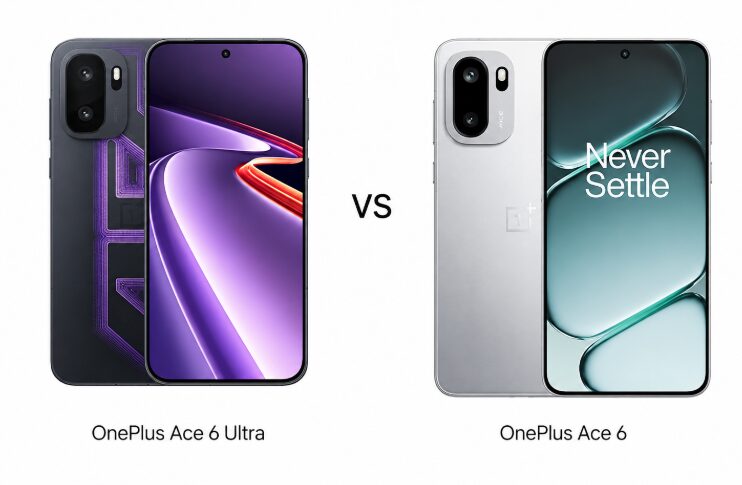
OnePlus has done the classic phone-maker trick here: sell two very similar devices, then make the pricier one look irresistible with a bigger battery, a newer chip, and a few shiny extras. The OnePlus Ace 6 Ultra vs Ace 6 comparison is close enough that most buyers will need to squint, but the Ultra does enough to justify itself for a narrow group of power users.
The catch is that the cheaper model is the one that feels like the better deal. It keeps the flagship-grade display, strong protection, and a Snapdragon platform that still carries a better gaming reputation. That makes this less of a generational leap and more of a carefully staged split between ”best value” and ”best of everything.”
Design and display are almost a tie
Both phones use an aluminum frame, Crystal Shield Glass, and IP68/IP69K resistance, so neither is pretending to be delicate. The Ace 6 Ultra adds an optional eco-leather finish, which is the sort of small luxury touch that sounds minor until you are the one holding the phone all day. The Ace 6 answers with a slightly larger 6.83-inch panel versus 6.78 inches on the Ultra.
Display specs are essentially identical: AMOLED, 1 billion colors, Dolby Vision, HDR10+, HDR Vivid, and a 165Hz refresh rate. In plain English, both should look fast, bright, and expensive. If you care more about screen size for gaming and media, the Ace 6 has the edge; if you care about materials and finishing, the Ultra looks a touch fancier.
Battery and chipset separate the two phones
This is where OnePlus stops being subtle. The Ace 6 Ultra runs on the MediaTek Dimensity 9500, while the Ace 6 uses Qualcomm’s Snapdragon 8 Elite, and both are built on 3nm processes. The Snapdragon chip still has the cleaner reputation for gaming optimization and GPU behavior, while the Dimensity part is positioned as the newer, more efficiency-minded option.
The battery gap is even harder to ignore. The Ultra packs 8600mAh, compared with 7800mAh in the Ace 6, and both support 120W charging plus bypass charging. That matters more than the spec sheet poetry: if you play games for long stretches or live on a charger, the Ultra’s extra capacity is the most obvious real-world upgrade in the entire comparison.
Feature-wise, the Ultra also brings enhanced cooling, better connectivity hardware, Bluetooth 6.0, a dedicated Wi-Fi chip, and faster touch response tech. That’s a lot of small wins bundled into one larger battery, which is exactly how premium phones are supposed to win arguments without sounding too loud about it.
- Ace 6 Ultra: Dimensity 9500, 8600mAh battery, 120W charging, Bluetooth 6.0
- Ace 6: Snapdragon 8 Elite, 7800mAh battery, 120W charging, 4K 120fps video
Camera trade-offs are sharper than the rest of the spec sheet
On paper, both phones share a 50MP main camera and an 8MP ultrawide, plus a 16MP selfie camera with 1080p video and gyro-EIS. The Ultra uses a larger 1/1.55-inch main sensor, which should help with low light and general light capture. The Ace 6, meanwhile, offers 4K 120fps recording, which is the kind of headline spec that content creators notice immediately and normal humans mostly ignore until they need it.
That split makes the camera decision easier than the rest of the comparison. The Ultra looks stronger for still photos, while the Ace 6 has the more interesting video feature set. For a category that often hides weak cameras behind huge battery claims, this is at least a real trade-off instead of marketing confetti.
OnePlus Ace 6 Ultra vs Ace 6 price comparison
The Ace 6 is priced around ₹32,000 ($400), while the Ace 6 Ultra comes in at around ₹48,500 ($485). That roughly ₹16,500 gap is big enough to make even a premium buyer pause. And since the Ace 6 already delivers a premium build, a 165Hz AMOLED display, IP68/IP69K protection, Snapdragon 8 Elite performance, and a 7800mAh battery, it does a very convincing job of looking like the sensible pick.
The Ultra is the more ambitious phone, but it is not a totally different species. It adds a bigger battery, newer silicon, better camera hardware, and some gaming-focused extras, yet the base experience stays remarkably close. That is the same trick plenty of rivals use to push buyers up the ladder: make the expensive model feel meaningfully better without making the cheaper one feel weak.
- OnePlus Ace 6: around ₹32,000 ($400)
- OnePlus Ace 6 Ultra: around ₹48,500 ($485)
So the real question is simple: do you want the smarter phone or the more complete one? If your answer includes battery life above all else, the Ace 6 Ultra has a case. If you want the stronger deal, the Ace 6 is the one that looks harder to argue with.