• 4 min read
China’s Kimi K3 jolts U.S. AI leaders
Moonshot’s Kimi K3 topped Arena’s coding ranking, intensifying pressure on Anthropic and OpenAI as Chinese open-source models gain ground.
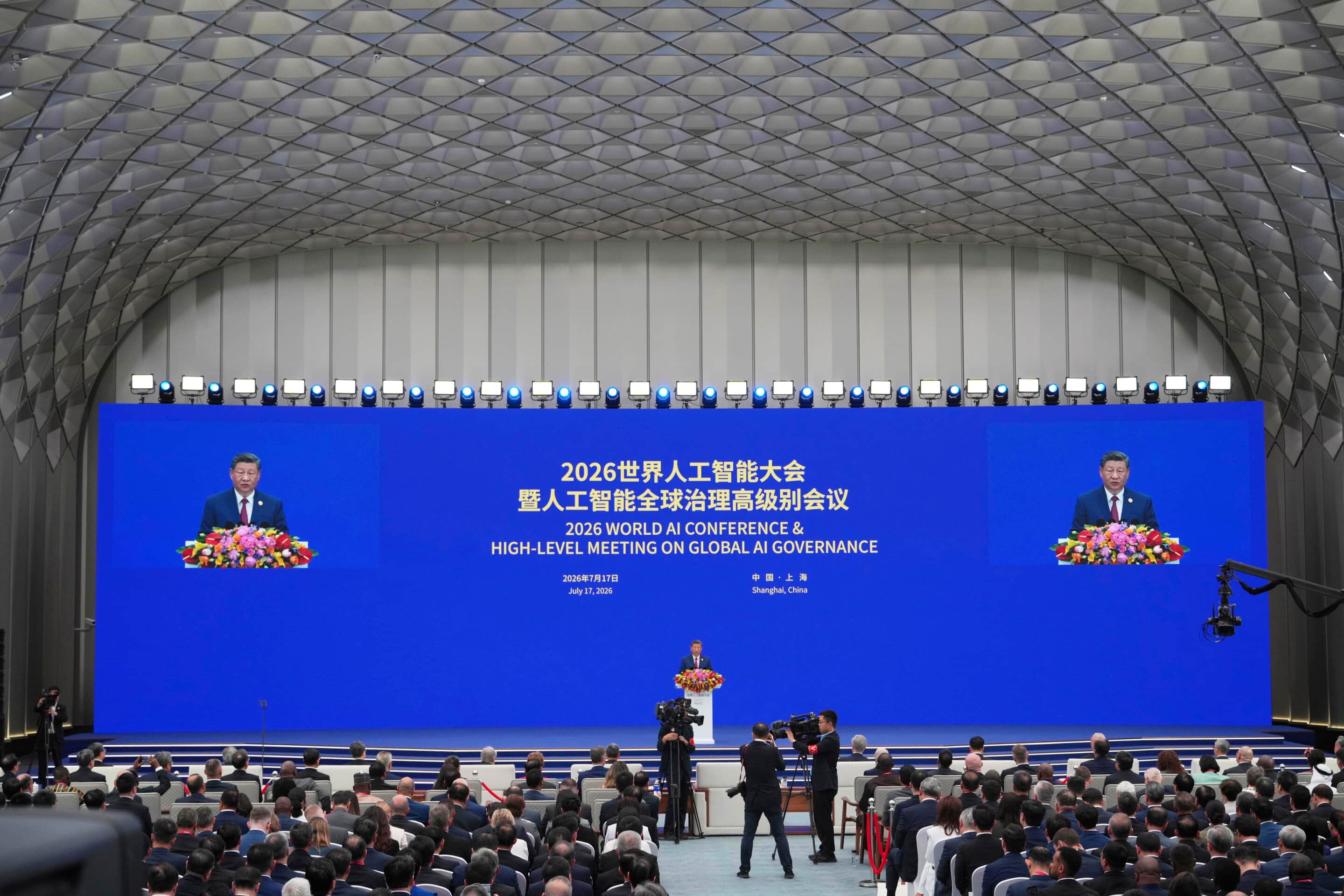
Image: TechXplore
Chinese President Xi Jinping speaks at the opening ceremony for the World AI Conference in Shanghai on Friday, July 17, 2026. Credit: AP Photo/Ng Han Guan, Pool
Moonshot’s Kimi K3 has taken the U.S. AI industry by surprise, with early evaluations suggesting it is approaching the capabilities of leading versions of Anthropic’s Claude and OpenAI’s ChatGPT. The Beijing-based startup’s release is the latest sign that Chinese companies publishing “open-source” models are putting pressure on U.S. AI leaders.
K3 topped Arena’s ranking for “front-end coding capability,” a measure of large language model performance. Anastasios Angelopoulos, Arena’s co-founder and CEO, called it a potentially defining release.

Recommended reading
Google Reconstructs Pelé’s Lost 1959 Goal
“This may be the single biggest release of the year,” and marks a moment when open-source Chinese models are surpassing closed U.S. models.
Angelopoulos said additional results were still arriving and were likely to keep K3 “at the top of the pack.” The model’s unveiling came shortly before Chinese President Xi Jinping opened the annual World Artificial Intelligence Conference in Shanghai, which runs until Monday.
Chinese AI models close the gap
K3 follows the release last month of GLM-5.2, the flagship model from Chinese startup Zhipu, also known as Z.ai. Software developers around the world have reportedly adopted GLM-5.2, saying it can perform nearly as well as top U.S. models at a lower price.
The reaction to K3 echoes the market turmoil following DeepSeek’s model release in early 2025. Tech analyst Patrick Moorhead called the response an “overreaction shockingly similar” to the reaction to DeepSeek, while warning that the broader market impact could challenge the revenues of Anthropic and OpenAI.
At the Shanghai conference, Huawei was showcasing the Atlas 950 SuperPoD, an AI computing system that highlights China’s efforts to build domestic hardware despite U.S. restrictions on imports from chipmakers such as Nvidia. Moonshot has not disclosed the hardware used to train K3, but it is a Huawei partner.
K3 is the most expensive Chinese AI model to use so far, according to a Friday report from Bank of America research analysts. Even so, its price is half that of OpenAI’s high-performing GPT-5.6 Sol model.
Distillation accusations follow the release
U.S. politicians and major AI companies, including Anthropic and OpenAI, have accused Chinese model developers of illicitly using distillation to extract capabilities from their systems. Beijing has called the accusation “groundless.”
Anthropic said in February that DeepSeek, Moonshot and China-based AI lab MiniMax were running campaigns to “illicitly extract Claude’s capabilities to improve their own models.” Distillation involves training a less capable model on the outputs of a stronger one. Anthropic acknowledged that the technique can be legitimate, but objected when competitors use it to obtain powerful capabilities faster and more cheaply than developing them independently.
The flow of model capabilities is not entirely one-way. San Francisco-based Anysphere, which makes the coding tool Cursor, has acknowledged that one of its leading products was based on Moonshot’s K2.5 model. Elon Musk’s SpaceX plans to close a deal to buy Cursor for $60 billion later this year.
Moonshot’s Carnegie Mellon connection
Moonshot co-founder and CEO Yang Zhilin earned his Ph.D. at Carnegie Mellon University in 2019. He is described as having made fundamental contributions to machine learning and as a fan of rock bands including Pink Floyd.
His former adviser, Russ Salakhutdinov, who was previously Apple’s director of AI research, celebrated the release on social media:
“What a huge win for the open-source community! It feels like just yesterday Zhilin was graduating from my lab at CMU.”
Open-source AI makes key components available for others to inspect, modify and build upon. Supporters say that approach accelerates innovation; critics warn that publicly accessible powerful models can create safety and security risks.
Andrew Zinin holds a master’s degree in physics and has research experience. He is a longtime science news enthusiast and contributes to Science X’s editorial work.

AI Editor
Ava covers the rapidly evolving world of artificial intelligence, from foundational models and research labs to the real-world economics of intelligence. With a background in computational linguistics, she cuts through the hype to find out what actually works. She firmly believes that benchmarks are just marketing until reproduced in the wild.
via TechXplore