• 3 min read
Startup targets Nvidia with 128TB AI server
Majestic Labs' Prometheus server replaces Nvidia GPUs and HBM with Arm AIUs and up to 128TB of shared LPDDR6 memory.
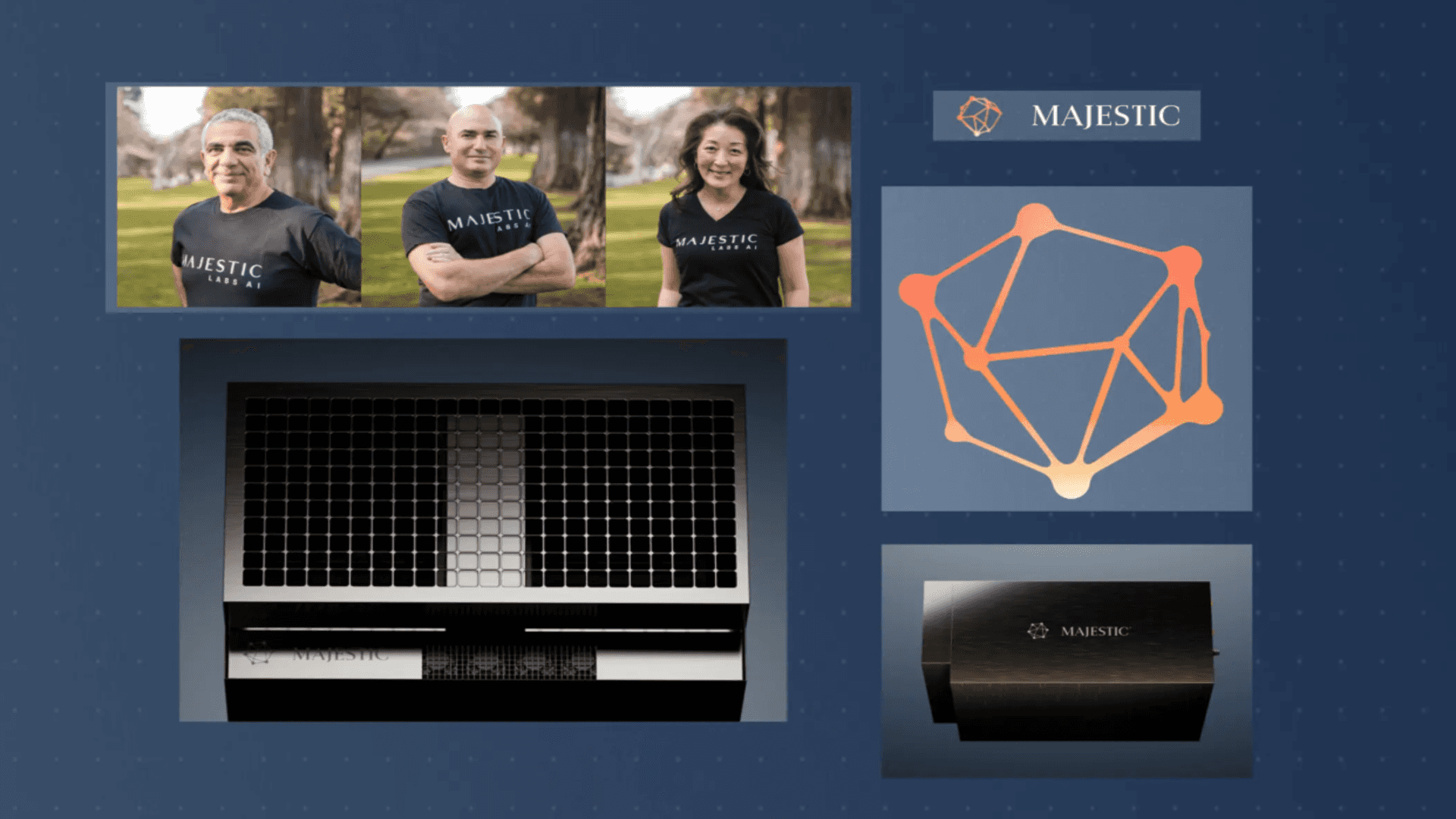
Image: TechRadar
Image credit: blocksandfiles
Majestic Labs, a startup founded in 2023 by former Google and Meta engineers, has unveiled a server designed to challenge Nvidia’s combination of GPUs and high-bandwidth memory (HBM). The Tel Aviv-based company says that pairing expensive graphics processors with HBM has created a memory-bound architecture for AI inference.
Its alternative is Prometheus, which replaces GPUs with Ignite AI Processing Units (AIUs). Each AIU combines Arm cores with RISC-V vector and tensor engines.
How Prometheus scales memory
A Prometheus server can house up to 12 AIUs and between 8TB and 128TB of LPDDR6 memory. The memory is shared across one contiguous, coherent pool rather than attached directly to GPU packages.
Recommended reading
Walsh puts a veto-capable risk manager over four trading agents
Majestic connects the pool through custom memory-aggregation chiplets and copper cables up to one metre long. Four Prometheus servers can fit in a standard 40U rack, drawing 120kW in total and using cold-plate liquid cooling instead of air cooling.
For comparison, Nvidia’s DGX B300 system combines eight Blackwell GPUs with 2.3TB of HBM3e and up to 4TB of DDR5 system memory. Majestic claims its design provides more than 50 times more fast memory than that configuration, along with 1.7 times its interconnect bandwidth.
“One Majestic rack holds the fast memory capacity of 25 Nvidia NVL72 Vera Rubin racks at a fraction of the power.”
The company also says Prometheus can provide up to 1,000 times more memory per processor. It did not explain in the announcement how that figure is calculated.
Cost, software and availability
Majestic Labs says Prometheus could cost 10 to 50 times less than a GPU system offering equivalent performance once it ships next year, while using less electricity per rack. The server is designed to be OCP-compliant and will support PyTorch, vLLM and OpenAI’s Triton, allowing existing AI models to run without modification.
The company was founded by CEO Ofer Shacham, President Sha Rabii and COO Masumi Reynders. It employs around 40 people across Tel Aviv and Los Angeles and raised $100 million in a Series A round late in 2025. Majestic says it has already received significant orders from large enterprises, neoclouds and hyperscalers.
Several hardware details remain unresolved. Majestic has not said how many memory-aggregation chiplets each server requires. If a 128TB configuration used widely available 2GB LPDDR6 dies, it would need roughly 64,000 dies, implying well over a hundred aggregation chiplets per server.
The performance, cost and power figures remain Majestic Labs' own projections. The company has not yet shipped the hardware or provided independent benchmark results, leaving enterprise buyers to wait for broader testing before its claims can be validated.
Via Blocks and Files
Follow TechRadar on Google News and add it as a preferred source for expert news, reviews and opinion.
AI Editor
Ava covers the rapidly evolving world of artificial intelligence, from foundational models and research labs to the real-world economics of intelligence. With a background in computational linguistics, she cuts through the hype to find out what actually works. She firmly believes that benchmarks are just marketing until reproduced in the wild.
via TechRadar