• 3 min read
Local ammonia plants can work—but only in the right places
A global study finds small electric ammonia plants can cut emissions and costs in some regions, but coal-heavy grids can make them worse than conventional production.
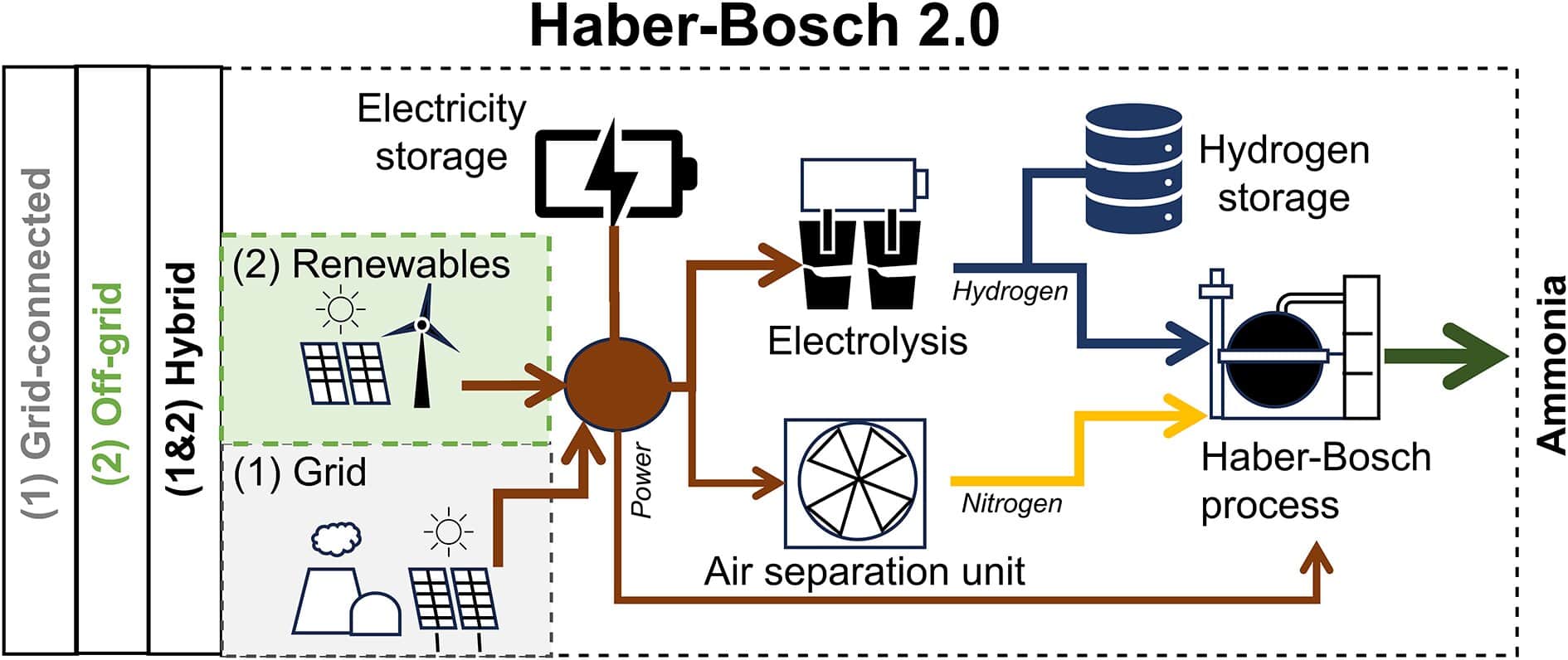
Image: TechXplore
Small-scale ammonia plants powered by electricity could make fertilizer supply chains shorter and more resilient, but a new global analysis shows they only make economic and climate sense in specific places.
The study, published in Energy & Environmental Science, examined roughly 13,000 scenarios worldwide with researchers from the Paul Scherrer Institute (PSI), ETH Zurich, and the Carnegie Institution for Science at Stanford University. The team looked at where decentralized plants using an electric version of the Haber–Bosch process could produce ammonia close to demand with lower emissions and acceptable costs.
Ammonia is essential for fertilizer production and is also being considered as a future shipping fuel. Today, it is mostly made in a small number of large chemical plants and then transported long distances. According to the researchers, localized production could reduce supply-chain risk and greenhouse gas emissions—but only if the electricity mix is clean enough.

Recommended reading
FCC clears startup to test orbital mirrors
“Decentralized plants could shorten supply chains, reduce greenhouse gas emissions and make the fertilizer supply more robust. But they would not automatically be low carbon or economical. The crucial factors are their location and the source of the electricity.”
Where electric ammonia makes sense
Current ammonia production is estimated to account for 1% to 2% of global greenhouse gas emissions. In the conventional process, hydrogen is typically made from natural gas, generating substantial carbon dioxide emissions. A lower-carbon route uses electrolysis to split water into hydrogen and oxygen, ideally with power from wind, solar, or other renewable sources.
The study found that hybrid plants perform best in many cases. These combine local wind and solar generation with electricity from the public grid. Fully off-grid systems can deliver the lowest emissions, but they are usually more expensive today because they need larger renewable installations plus added storage.
Terlouw said electrically produced ammonia is still generally more expensive than conventional ammonia, though it can get closer to current market prices in places with:
- cheap electricity
- abundant renewable energy
- low financing costs
The researchers point to China and the Netherlands as examples where those conditions can already line up.
Coal-heavy grids can erase the climate benefit
The paper also warns against treating all electric ammonia as inherently low carbon. In countries where grid power still relies heavily on coal, such as Poland or South Africa, the climate impact can be worse than with conventional ammonia production.
The assessment covered the full life cycle, not just plant operations. That includes the impacts of making electrolyzers, solar and wind installations, batteries, and storage systems.
For Switzerland, which has no industrial ammonia production and imports both mineral fertilizers and ammonia feedstock from neighboring countries, local production could be attractive. One reason is its relatively low-carbon electricity mix, with hydropower and nuclear power dominating and fossil fuels accounting for less than 2%.
The researchers say economics could improve significantly by 2050 as the costs of electrolyzers, storage, and renewable energy continue to fall. But Terlouw said deployment will still depend on investment, standards for low-carbon ammonia, and stable industrial decarbonization policy.

Frontier Editor
Dan is our resident futurist, covering electric mobility, space exploration, and the smart home. He's interested in atoms just as much as bits. Whether it's a new battery chemistry, a reusable rocket, or a protocol that finally makes IoT devices talk to each other, Dan breaks down the engineering that pushes humanity forward.
via TechXplore