

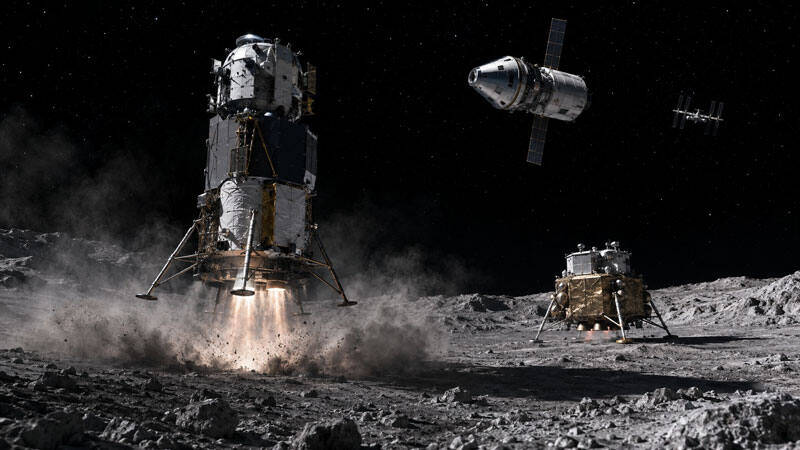
China’s planned Lanyue lunar lander is being pitched as tougher than the Apollo hardware that took humans to the Moon half a century ago, and the reason is brutally simple: more engines, more ways to keep flying. A new article in the Chinese journal Chinese Space Science and Technology argues that Lanyue’s design gives it a far better chance of surviving engine trouble than the single-engine Apollo-era lander ever did.
The claim lands at an awkward moment for NASA’s own lunar ambitions. Artemis still does not have a final lander configuration on the table, but the spacecraft under consideration from SpaceX and Blue Origin are already built around multiple engines, because the Moon is not a place where ”one and done” engineering inspires confidence.
How Lanyue builds in backup
According to the Chinese developers, Lanyue uses a shared fuel-and-oxidizer tank divided by a partition, and part of the structure belongs to the descent stage itself. That arrangement frees up enough mass to fit four main variable-thrust engines, which is the kind of trade-off lunar engineers like: less dead weight, more margin, fewer dramatic headlines later.
The redundancy does not stop there. Lanyue also carries six engines for orbital maneuvering, and those can help the lander lift off even if one or two of the main engines fail. In other words, it is designed to absorb a setback that would have been fatal in the Apollo era and keep going anyway.
- 4 main variable-thrust engines on Lanyue
- 6 orbital maneuvering engines as backup support
- Shared tank design with a partition between fuel and oxidizer
Apollo’s single-engine risk is the comparison point
The Apollo comparison is doing a lot of work here, and fairly so. The lunar module used for that mission line had just one engine for launching from the Moon, which made the ascent phase a life-or-death event if it failed. That is not exactly the kind of architecture you would choose now if you had a chance to start over.
NASA’s modern lander candidates are clearly trying to avoid that trap. SpaceX’s Starship is expected to have at least six Raptor 3 engines, plus two or three braking engines mounted higher on the vehicle to avoid kicking up too much dust during landing, while Blue Origin’s Blue Moon Mark 2 is expected to carry at least three BE-7 engines. Multiple engines do not guarantee success, but they do make a failure less absolute, which is the whole point.
The harder question is whether the hardware flies at all
China can confidently sell Lanyue as a more robust design, but the real lunar race is still full of unfinished vehicles and unanswered questions. Starship, in particular, is a huge gamble: a 50-meter lander touching down on the Moon sounds ambitious on paper and nerve-racking in practice. Blue Origin’s lander looks less audacious, though the company’s own program problems suggest a different kind of uncertainty – the sort that can delay a mission before redundancy even gets tested.
So the likely contest is not a neat head-to-head between finished machines. It is a race between one lander that has been publicly framed as engineered for survival, and two American rivals whose final forms are still not fully settled. If Lanyue reaches the pad on schedule, China may get to claim something the others still cannot: not just a lunar lander, but a plausible one.