

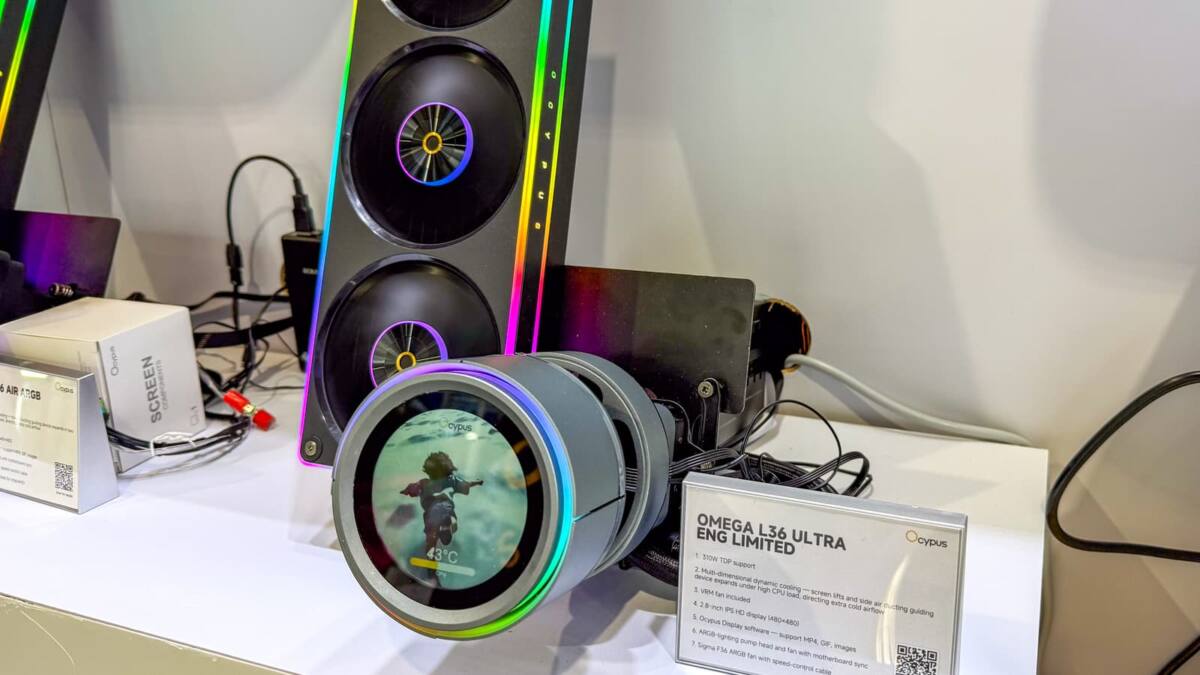
Ocypus used Computex 2026 to do two things at once: show off four new all-in-one liquid coolers and line up three cases that lean hard into screens, airflow, and desk-friendly layouts. The headline act is a limited-edition 360 mm cooler with a pump block that physically opens under load, but the rest of the range is just as eager to make a point: Ocypus wants its hardware to look busy and cool down a processor without pretending the display is the main event.
That approach lands in a crowded segment. Corsair, Lian Li, and DeepCool have spent the last few product cycles turning AIOs into tiny stages for OLEDs and animated status screens, so Ocypus is trying a more mechanical trick: move air where it is needed and make the cooling system part of the show. It is gimmicky, sure, but it is also one of the few ideas here that might justify the spectacle.
Omega L36 Ultra ENG Limited uses moving petals
The most eye-catching model is the Omega L36 Ultra ENG Limited, a 360 mm AIO capped at 200 units and priced at $300. Ocypus says it can handle roughly 300 to 310 W, which puts it in the same broad class as other premium 360 mm coolers, but the party trick is the pump block: when temperatures rise, a built-in fan starts spinning and the surrounding ”petals” open up to direct airflow around the socket area.
In practice, that means the cooler is aimed not just at the pump head itself but also at VRM heatsinks and nearby memory modules. The company first showed the concept in a much earlier prototype, and this time it has clearly been pushed into something closer to production.
Omega L36 Air ARGB keeps the moving frame, drops the drama
The Omega L36 Air ARGB is the more sensible sibling. It keeps the active airflow around the pump area and gets a 3.5-inch rectangular screen with a frame that expands as temperature rises, but it skips the limited-edition badge and the more elaborate mechanism. Ocypus puts the price at $160, exactly half of the Ultra ENG Limited, while still claiming roughly 300 W of heat dissipation.
- Omega L36 Ultra ENG Limited: 360 mm, 2.8-inch screen, $300, limited to 200 units
- Omega L36 Air ARGB: 360 mm, 3.5-inch screen, $160
- Delta L36 Elite ARGB Digital: 360 mm, mirror-like holographic surface instead of a full OLED
Sigma coolers lean on a 3.95-inch rotating display
The Sigma L36 EX ARGB and Sigma L42 EX ARGB are the more conventional pair, though ”conventional” is doing some heavy lifting here. The smaller model uses a 360 mm radiator, while the larger one goes to 420 mm and 140 mm fans. Both share a nearly square 3.95-inch pump display that can be rotated to the right orientation, with Ambient RGB lighting around the edge and support for system stats, images, animations, and video through Ocypus software.
That 420 mm version matters because it signals where the upper end of the AIO market is heading: bigger radiators, bigger fans, and bigger screens, all in one package. Not every case can swallow it, and not every buyer will care, but the thermal headroom is now part of the spec race.
Three cases push glass, mesh and front-mounted controls
Ocypus also used the show to unveil three cases, each with a different take on how much hardware should be hidden from view. The Delta C40 is the most restrained: tempered glass on the side, metal mesh up front, and a wood-style decorative strip, plus two front fans and one rear fan. Even the power supply sits at the front, with the cable routed through an internal extension to a rear connector.
The Sigma C50 Air ARGB goes vertical, with curved glass on the front and mesh on the sides. It supports graphics cards up to 350 mm, a 360 mm radiator on the side, and fans on top, while the buttons and ports are placed on the front for easier desk use. Ocypus will also sell an ES55 package with that case, and the 5.5-inch IPS screen can be bought separately as well.
The largest chassis, the Iota C74 Curve ARGB, is the one built for the glass-hungry crowd. Its front and side panels are made from a single piece of tempered glass with no visible seam, but the rest of the enclosure uses metal mesh so it does not turn into a sealed display box. Five RGB fans come in the bundle, and one cut corner helps direct airflow toward the center of the system.
Ocypus has clearly decided that coolers and cases should now do three jobs at once: move air, show data, and look unusual on a showroom floor. The real test is whether buyers want that much motion in their hardware, or whether a simple screen and a normal fan would have been enough all along.